 EN
Quick Links

Home > News > Company news
In medical imaging systems, cables are rarely the most visible components, yet they directly influence system stability, usability, and final image quality. For high-channel-count medical applications such as ultrasound and endoscopy, achieving a working prototype is only the starting point. The real engineering challenge typically arises when the design moves from prototype validation to stable mass production.
At this stage, parameters that appear well controlled in small-batch samples may gradually expose consistency issues during large-scale manufacturing, ultimately affecting delivery reliability and long-term performance.
| Parameter | Typical Risk | Why It Matters |
|---|---|---|
| Conductor Diameter | Dimensional variation | Affects electrical resistance and signal consistency |
| Insulation Thickness | Thickness variation | Influences dielectric performance and cable diameter |
| Impedance | Impedance deviation | Can cause signal reflection and transmission loss |
| Capacitance | Capacitance variation | May affect high-frequency signal performance |
| Shielding | Inconsistent coverage | Can reduce EMI protection |
| Core-to-Core Alignment | Position variation | May affect assembly accuracy and overall cable geometry |
| Outer Diameter | Dimensional variation | Important for connector compatibility and installation space |
| Bending Radius | Inconsistent flexibility | Can affect reliability in repeated-motion applications |
The parameters most likely to require tight control during mass production of ultra-fine multi-core medical cables are conductor dimensions, insulation dimensions, impedance, capacitance, shielding consistency, core alignment, overall cable diameter, and mechanical consistency. The risk increases when the cable combines very fine conductors, many signal channels, tight dimensional tolerances, and demanding medical-device routing conditions.
If the cable contains many ultra-fine signal channels → control dimensional and electrical variation across the complete cable structure → because small deviations can accumulate across multiple cores and affect the consistency of the finished assembly.
If the cable is used for high-frequency medical imaging → control impedance, capacitance, shielding, conductor geometry, and dielectric dimensions together → then validate the finished multi-core assembly rather than relying only on single-core measurements. For related electrical design considerations, see The Importance of Impedance Consistency in Ultra-Fine AWG Micro Coaxial Cables.
If the cable is used in ultrasound or endoscopic equipment → evaluate both electrical consistency and mechanical consistency → including capacitance, signal integrity, shielding, flexibility, cable OD, and termination repeatability. See How to Select Micro Coaxial Cable for Ultrasound Probe Applications and Technical Analysis of Reliable Signal Transmission Using Micro Coaxial Cable Assemblies in Miniature Endoscopic Imaging Systems.
The key manufacturing principle is therefore:
Prototype performance is not the same as production consistency.
A deliverable medical cable must maintain its critical electrical, mechanical, dimensional, and assembly characteristics across production runs and batches.
For customized products, see HOTTEN's Medical Cable Assembly and Ultra Fine Medical Cable solutions.
From Prototype Validation to Mass Production: Where the Risks Begin
During the prototype phase, production volumes are limited and manufacturing is often intermittent. Under these conditions, parameters can be closely monitored and adjusted with relatively high flexibility.
Once mass production starts, manufacturing shifts to long-duration continuous operation. Variations in operators, material states, and equipment stability begin to accumulate over time, systematically amplifying previously manageable parameter fluctuations.
For ultra-fine multi-core medical cables, the challenge is not whether a single parameter meets specification, but whether all critical parameters remain consistent across long production cycles and multiple batches. This is one of the fundamental differences between medical cables and general-purpose electronic wires.
Key Parameters Most Sensitive to Mass Production Variations
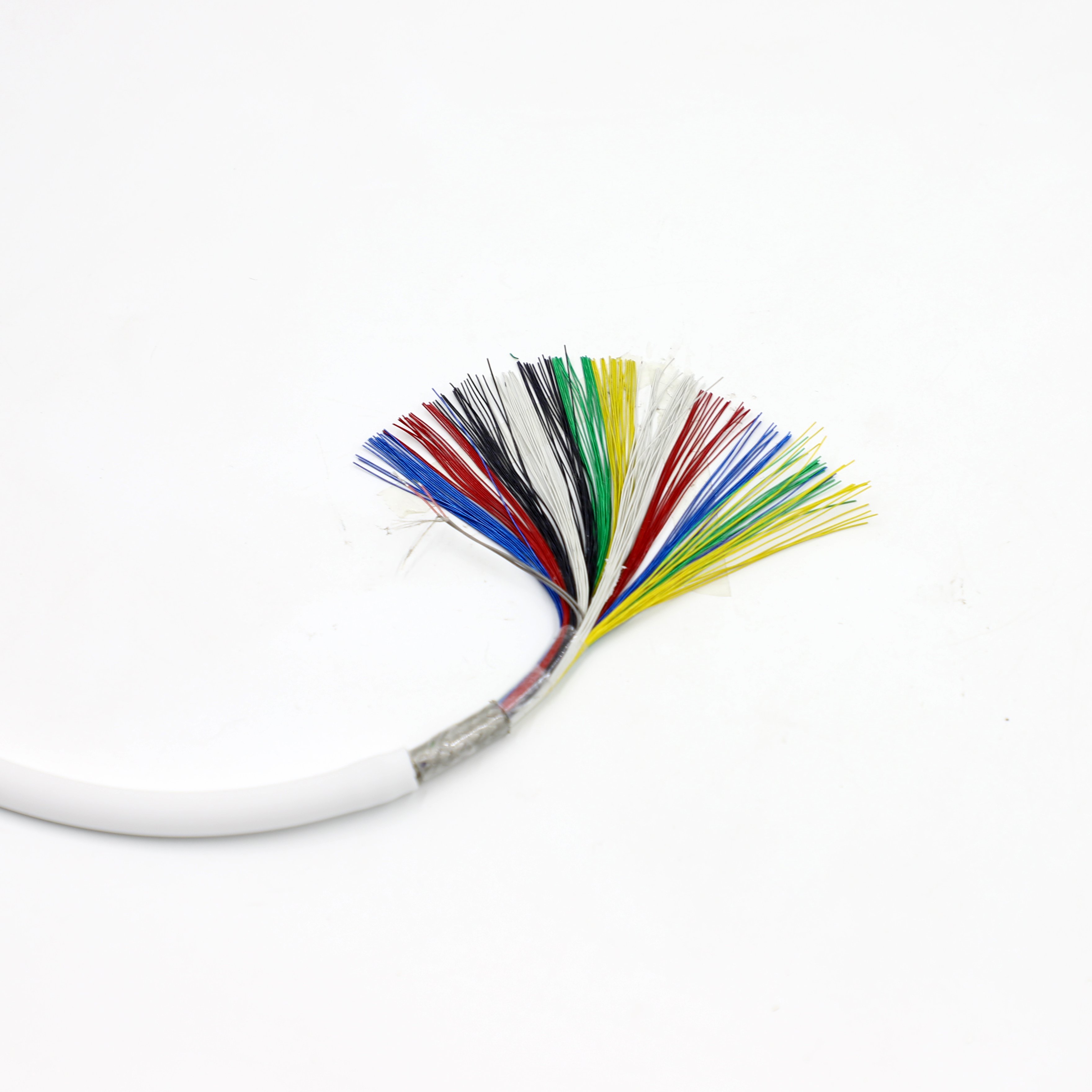
Single-Core Capacitance and Impedance Consistency. Medical ultrasound and endoscopic cables often consist of 64 cores, 128 cores, or even higher channel counts, with individual conductors typically in the 40–46 AWG range. Even when each single core meets its design target, excessive core-to-core variation can lead to system-level issues such as signal amplitude mismatch and uneven image brightness.
In practical engineering applications, core-to-core variation of critical electrical parameters usually needs to be controlled within ±10% or tighter to prevent performance degradation caused by multi-channel signal superposition.
Stability of Low-Capacitance Structures. To meet low-load and low-noise requirements, medical imaging cables frequently operate at unit-length capacitance levels of approximately 50–60 pF/m. Such low-capacitance designs place higher demands on material stability and process control. Any fluctuation during mass production can directly affect overall system performance.
Geometric Consistency in Multi-Core Structures. As wire gauges decrease and core counts increase, minor geometric deviations can accumulate across the cable structure. Variations in outer diameter, concentricity, and core alignment may indirectly influence impedance control, capacitance stability, and long-term mechanical reliability.
Consistency of Shielding Structures. In high-frequency medical signal transmission, shielding coverage and stability are critical. Variations in shielding structure during mass production can reduce EMI resistance and negatively impact imaging stability.
Why Single-Core Tests Are Not Enough. Passing single-core tests does not guarantee stable system performance in multi-core medical cables. When dozens or even hundreds of channels operate simultaneously, small parameter differences can be amplified through superposition effects.
In medical imaging systems, these inconsistencies often manifest as visible image artifacts rather than simple electrical deviations. As a result, the true engineering difficulty lies in maintaining bundle-level consistency under mass production conditions, not in optimizing a single conductor in isolation.
Issues That Typically Appear Only After Production Scales Up. Some risks rarely appear during early validation but gradually emerge during mass production. These include widened parameter distributions between batches (such as capacitance and characteristic impedance), slight performance drift after long continuous production runs, and low-probability defects becoming statistically significant at higher shipment volumes.
Without early consideration at the design and process-development stage, these issues can pose serious challenges to delivery schedules and long-term device reliability.
What Makes a Medical Cable Truly Deliverable. For medical applications, achieving extreme parameter values is not the ultimate goal. A deliverable medical cable solution must operate within reasonable design margins while offering long-term stability, batch-to-batch consistency, and repeatable manufacturability.
This is why mass-production feasibility must be incorporated into cable selection and design decisions from the earliest engineering stages.
Hotten’s Engineering Approach to Multi-Core Medical Cable Mass Production. Hotten has long specialized in the development and manufacturing of ultra-fine multi-core medical cables. In high-channel-count applications such as ultrasound and endoscopy, Hotten focuses on consistency and mass-production readiness from the outset.
Through systematic control of material selection, structural design, and manufacturing process stability, Hotten ensures reliable signal performance while maintaining long-term production consistency. By introducing mass-production thinking at the engineering-sample stage, Hotten helps medical devices transition smoothly from validation to stable delivery—forming a solid foundation for dependable medical cable solutions.
For an OEM medical-device project, mass-production readiness should be evaluated before the cable enters full-scale production. A prototype that meets the required electrical and dimensional targets demonstrates feasibility, but it does not by itself demonstrate long-term process stability or batch-to-batch consistency.
If the cable has ultra-fine conductors and multiple signal channels → evaluate conductor, insulation, geometry, shielding, and cable OD as one process chain → then identify which manufacturing steps can introduce variation.
For example, conductor drawing can influence conductor geometry, extrusion can influence insulation thickness, and shielding processes can influence coverage and cable diameter. These parameters are interconnected rather than independent.
For related ultra-fine design considerations, see Why Ultra-Fine High-Frequency Coaxial Cable Design Is So Difficult.
If the cable contains many high-frequency signal channels → evaluate impedance and capacitance both within individual cores and across the complete multi-core assembly → then verify channel-to-channel consistency.
Passing one representative core does not necessarily demonstrate that the complete cable bundle will remain consistent during production. Variations can occur between cores, along the cable length, or between production batches.
For related capacitance considerations in ultrasound cable design, see Why Low Capacitance Is Critical in Ultrasound Probe Cable Design.
For impedance-related dimensional control, see The Importance of Impedance Consistency in Ultra-Fine AWG Micro Coaxial Cables.
Not every characteristic needs the same level of monitoring.
If conductor diameter or insulation thickness directly determines downstream electrical performance → prioritize dimensional control during production → then verify the resulting electrical characteristics.
If shielding coverage affects EMI performance → monitor shielding structure and coverage → then validate the finished cable.
If cable OD and core alignment affect connector compatibility or routing → monitor geometry and dimensional consistency → then inspect the finished assembly against the interface requirements.
A practical process-control framework should therefore distinguish between:
Process input → Process parameter → Critical dimension → Electrical output → Final assembly performance
If the prototype meets the required specifications → do not immediately treat the design as production-ready → first confirm process repeatability, material stability, equipment stability, and batch consistency.
Prototype development typically allows more frequent adjustment and closer operator attention. Mass production introduces longer continuous runs, material-lot changes, equipment drift, operator variation, and statistical accumulation of low-frequency defects.
For a broader application-driven development approach, see Beyond Specifications: Why Application-Driven Design Is the Core of Precision Cable Assembly.
Different medical applications can create different manufacturing priorities.
If the cable is used for ultrasound → prioritize capacitance consistency, impedance, channel matching, shielding, cable dimensions, and flex performance → then validate the complete ultrasound cable assembly.
If the cable is used for endoscopy → prioritize ultra-fine dimensions, flexibility, shielding, termination consistency, and repeated-motion performance → then validate the finished endoscopic assembly.
See Endoscope Cable.
If the cable is used for ICE or another high-channel-count intracardiac imaging application → prioritize channel consistency, compact OD, electrical stability, shielding, flexibility, and termination reliability → then validate the complete multi-core structure.
See ICE Cable.
For broader medical-device applications, see HOTTEN's Medical Equipment solutions.
Before approving an ultra-fine multi-core medical cable for mass production, the OEM and supplier should confirm:
| Category | Parameters to Confirm |
|---|---|
| Conductor | Diameter, material, geometry, consistency |
| Insulation | Material, thickness, dimensional stability |
| Electrical | Impedance, capacitance, attenuation, channel consistency |
| Shielding | Structure, coverage, continuity |
| Geometry | OD, concentricity, core alignment |
| Mechanical | Bend radius, flex cycles, torsion |
| Interface | Connector compatibility, pitch, pinout, termination |
| Materials | Material grade, lot consistency, applicable requirements |
| Process | Extrusion, shielding, cabling, termination control |
| Testing | Inline / in-process / final electrical and dimensional tests |
| Batch Control | Lot traceability, sampling, batch-to-batch consistency |
| Production | Prototype-to-production transition criteria |
If a critical parameter shows increasing variation during a production run → identify the responsible process step → verify material and equipment conditions → then correct the process before accepting further production.
If multiple parameters drift together → investigate whether they share a common process input → rather than treating each deviation as an independent problem.
If electrical performance remains within limits but dimensional variation approaches the design tolerance → review process capability before shipment → because a cable can pass today's specification while leaving insufficient production margin.
If the cable passes prototype and pilot production but shows batch-to-batch variation → review material lots, equipment settings, process stability, and measurement repeatability → then repeat validation across representative production batches.
If the main risk is electrical inconsistency → prioritize impedance, capacitance, attenuation, continuity, and channel-to-channel validation.
If the main risk is mechanical failure → prioritize bending, flex-cycle, torsion, tensile, and strain-relief validation.
If the main risk is dimensional or interface failure → prioritize OD, alignment, pitch, termination geometry, and connector compatibility.
If the main risk is long-term production variation → prioritize batch-to-batch comparison, process monitoring, traceability, and repeatability studies.
The validation strategy should therefore be linked to the actual failure modes of the medical device rather than relying on a single final inspection.
A practical development process can be summarized as:
Application requirements → cable architecture → critical parameters → prototype validation → pilot production → process capability review → batch validation → mass production → ongoing process monitoring
The objective is not simply to produce one cable that meets specification. The objective is to establish a repeatable manufacturing process capable of maintaining the required electrical, mechanical, dimensional, and assembly characteristics across production runs and batches.
For customized high-density medical cable assemblies, see HOTTEN's Medical Cable Assembly.
For ultra-fine medical cable structures, see Ultra Fine Medical Cable.
For broader medical applications, see HOTTEN's Medical Equipment.
A: Conductor diameter, insulation thickness, impedance, capacitance, shielding consistency, core alignment and overall cable diameter are among the key parameters that require tight process control during mass production.
A: Conductor diameter directly affects electrical resistance, current-carrying capability and signal consistency. Small dimensional variations can become more significant as conductor sizes decrease.
A: Impedance variation can increase signal reflection and transmission loss, particularly in high-frequency or high-speed medical imaging applications.
A: Consistent shielding helps maintain electromagnetic interference (EMI) protection and reduces the risk of external interference affecting sensitive signals.
A: Common causes include conductor diameter variation, insulation extrusion fluctuations, material tolerances, process temperature changes and equipment alignment.
A: Manufacturers can use controlled materials, precision extrusion, inline dimensional monitoring, electrical testing and final inspection to maintain consistent cable performance across production batches.
 Hot News
2026-09-17
2026-09-04
2025-12-17
2025-12-11
2025-12-05