 EN
EN
Quick Links

Custom medical cable manufacturing is not simply a sequence of cutting, stripping and connecting wires.
For an OEM project, the complete process should connect:
Drawing Review → Material / Cable Preparation → Stripping → Conductor & Shield Preparation → Termination → Assembly → Electrical Testing → Dimensional / Visual Inspection → Final Release
The exact process depends on the cable construction and customer requirements.
If → the cable contains fine conductors or multiple high-density cores
Then → control stripping, conductor preparation and shielding handling more carefully
Why → small processing variations can damage fine conductors or affect the geometry of the finished assembly.
If → the cable includes connectors or PCB termination
Then → control pin sequence, termination position, connector orientation and dimensional tolerances
Why → the finished assembly has to match both the electrical interface and the mechanical installation requirements.
If → the cable is customized for a medical device
Then → define inspection and testing criteria from the customer's drawing, specification and application requirements
Why → there is no single inspection checklist that applies identically to every custom medical cable.
If → the project moves from prototype to volume production
Then → verify not only product quality but also process repeatability
Why → successful prototype assembly does not by itself demonstrate stable production capability.
The current HOTTEN manufacturing article already follows this basic path, beginning with drawing/specification review and continuing through cable processing, termination, electrical testing and final inspection.
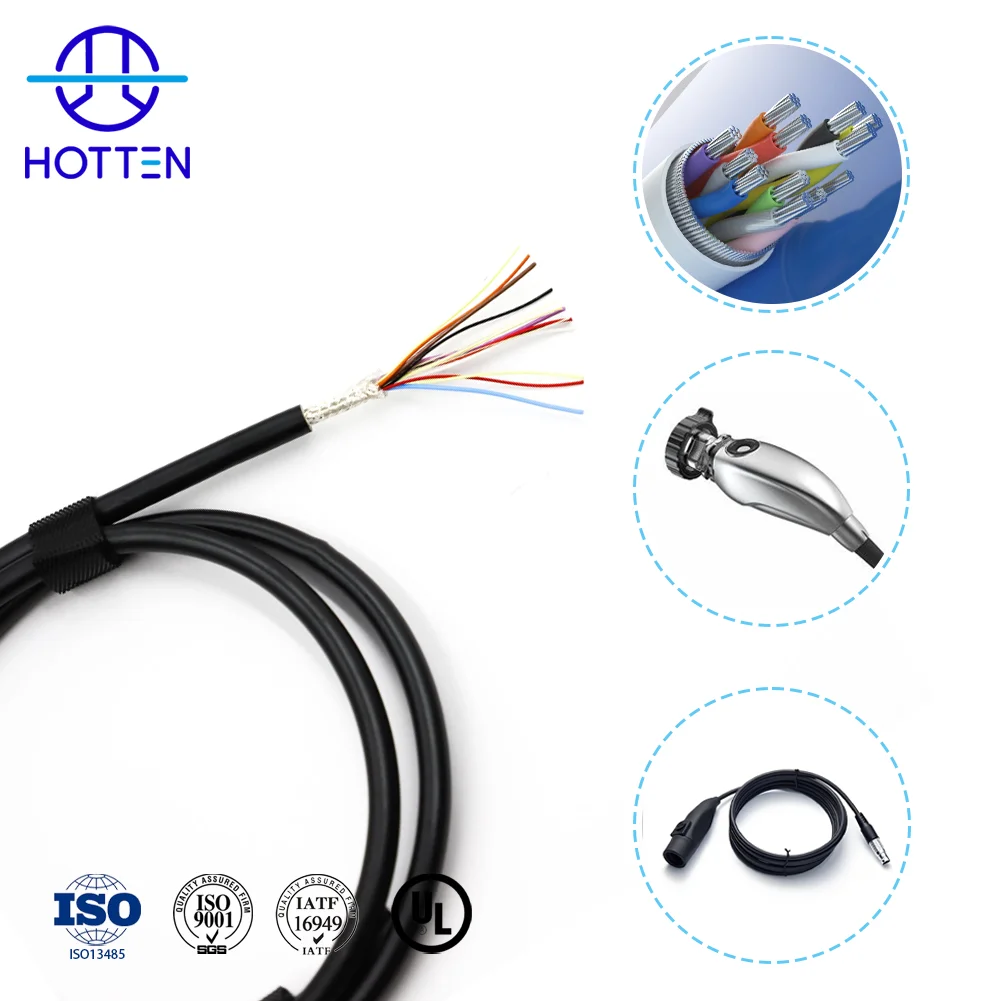
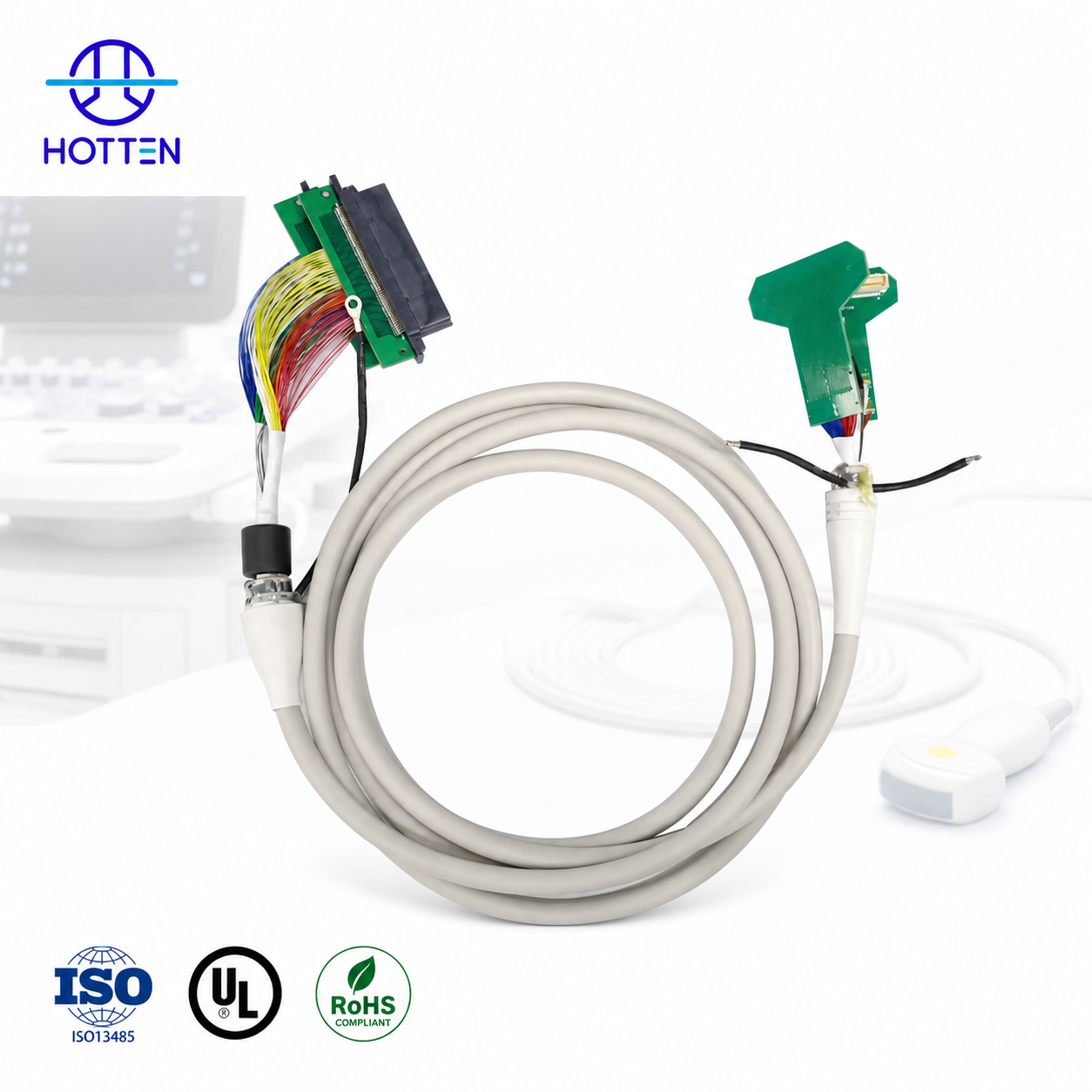
For customized Medical Cable Assembly, HOTTEN supports cable structures and assembly configurations based on project requirements.
Custom medical cables are rarely produced from one fixed recipe. Before processing begins, the engineering team should review the customer drawing, specification, or reference sample and confirm the key requirements. These may include core count, AWG or conductor size, cable OD, finished length, shielding structure, jacket material, connector or PCB termination, and applicable electrical requirements.
These inputs affect far more than the final dimensions. They determine stripping lengths, shielding treatment, conductor preparation, termination methods, fixture selection, and inspection criteria. In fine-wire or high-density projects, an early manufacturability review can reduce repeated changes during sampling and help identify difficult structures before production resources are committed.
Once the cable design is confirmed, processing normally begins with cutting to length and removing the outer jacket according to the required dimensions. Although stripping can look like a basic operation, it becomes much more sensitive when the cable contains fine conductors, multiple insulated cores, shielding, or other functional layers.
The process must remove the required material without nicking conductors, damaging insulation, or disturbing shielding that needs to remain in place. Different cable diameters and material combinations may require different equipment, tooling, and process parameters. A controlled stripping process helps keep the exposed length consistent and provides a stable starting point for the next operation.
After the outer jacket is removed, the shielding and internal conductors are prepared for further assembly. Depending on the design, this can involve separating conductors, trimming them to length, organizing wire positions, and retaining or reforming the shielding according to the drawing.
This stage becomes more demanding as conductor size decreases and core count increases. The working area is smaller, individual wires are easier to damage, and small inconsistencies can affect later assembly. For shielded medical cables, the shielding should also be handled according to the required termination method rather than simply being removed. Clean conductor organization and repeatable preparation are essential before any precision termination work begins.
There is no single termination method that applies to every medical cable. Some projects are delivered as processed cable, while others require connectors, PCB termination, soldering, crimping, or additional assembly steps. The correct method depends on the cable construction and the customer's interface design.
When conductors are very fine or the termination area is dense, magnification or microscope-assisted work may be used to improve positioning and process control. Specialized equipment may also be used for selected structures, but those processes should be chosen based on actual material and project requirements. In this sense, built-to-drawing manufacturing is not only about reproducing dimensions; the processing method must also be matched to the product structure.
When the project includes a connector, PCB, or other termination component, additional details must be controlled. Pin definition, wire sequence, termination position, dimensional tolerance, and assembly orientation all become part of the manufacturing requirement.
For high-core-count or space-constrained medical devices, the termination area may be compact and difficult to access. Conductor routing and connection quality therefore affect not only electrical performance but also whether the assembly fits the customer's housing or device. A sample build should verify more than appearance: it should confirm that the processing approach is practical, repeatable, and suitable for transition into production.
Processing is not complete when the last conductor is connected. Finished cables and cable assemblies should be checked according to the project specification before release. Depending on the design, this may include continuity checks, wire-sequence verification, relevant electrical tests, and visual inspection.
Inspection should also cover the areas created during processing: jacket condition, stripping dimensions, shielding treatment, conductor preparation, termination quality, and overall workmanship. The exact test plan should follow the drawing, specification, and application requirements rather than applying one identical test standard to every medical cable. The goal is to identify process-related issues before the product reaches the customer's assembly line.
For OEM buyers, the important question is not only:
“Can the supplier make this cable?”
It is also:
“Can the supplier process, inspect and reproduce this cable consistently according to the approved requirements?”
A practical evaluation framework is:
Engineering Review → Process Control → In-Process Inspection → Electrical Testing → Final Inspection → Traceability → Process Capability → Production Consistency
Before manufacturing begins, the supplier should understand which product characteristics are critical.
Typical inputs include:
| Input | Manufacturing Impact |
|---|---|
| Cable Drawing | Defines dimensions and tolerances |
| Core Count | Determines conductor organization |
| AWG / Conductor Size | Affects processing difficulty |
| Cable OD | Affects tooling and stripping |
| Shielding | Determines preparation / termination method |
| Jacket Material | Affects stripping process |
| Finished Length | Determines cutting control |
| Connector | Determines termination process |
| Pinout | Determines wire sequence |
| Electrical Requirements | Defines testing criteria |
| Reference Sample | Provides physical comparison |
The current HOTTEN article explicitly notes that customer drawings, specifications and reference samples determine stripping lengths, shielding treatment, conductor preparation, termination methods, fixtures and inspection criteria.
If → a drawing contains a critical dimensional or interface requirement
Then → identify it before production starts
Why → the requirement may affect both processing method and inspection method.
Not every cable should use the same manufacturing process.
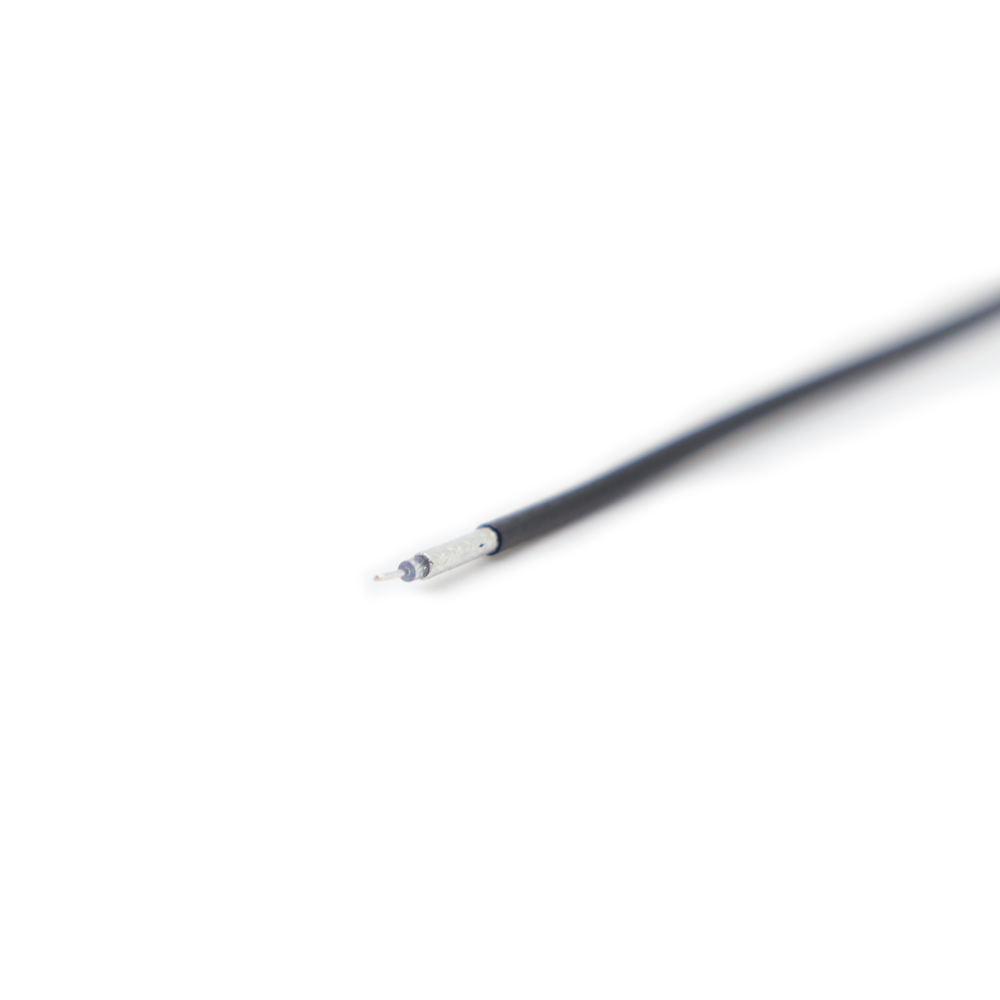
A fine-wire cable, a high-core-count cable and a shielded micro coaxial cable may require very different processing conditions.
If → conductor size becomes smaller
Then → review tooling, stripping method, conductor handling and inspection magnification
Why → finer conductors are more sensitive to mechanical damage.
If → core count increases
Then → standardize conductor organization and sequence control
Why → more conductors create more opportunities for routing and identification errors.
If → the cable contains multiple shielding layers
Then → define the shielding preparation and termination method before assembly
Why → removing or disturbing the wrong shielding layer can affect the finished cable.
Cable stripping should not be treated as a purely cosmetic operation.
The process has to control:
If → the strip length is too long
Then → evaluate whether the exposed conductor or shielding can create an assembly problem
Why → excessive exposure can affect termination geometry and mechanical protection.
If → the stripping process damages insulation
Then → investigate tooling, blade condition and process parameters
Why → insulation damage may not always be obvious in the final assembly.
If → strip lengths vary between units
Then → investigate process repeatability before continuing large-scale production
Why → inconsistent preparation can propagate variation into the termination step.
The current HOTTEN article specifically emphasizes preventing conductor nicks, insulation damage and unnecessary disturbance of shielding during stripping.
For medical high-density or fine-wire structures, conductor preparation can become a major manufacturing constraint.
Important controls may include:
| Process Area | Control Objective |
|---|---|
| Conductor Separation | Prevent damage and mixing |
| Wire Organization | Maintain correct sequence |
| Conductor Length | Maintain consistent termination |
| Shield Preparation | Preserve required shield structure |
| Shield Reforming | Maintain intended assembly geometry |
| Visual Inspection | Identify processing damage |
If → the conductor is very fine
Then → use appropriate magnification and controlled handling where required
Why → the working area is small and damage can be difficult to detect by unaided visual inspection.
If → the shield must remain partially intact for termination
Then → define exactly where and how it is prepared
Why → shielding treatment is part of the finished assembly design.
The current page already states that microscope-assisted work may be used for very fine conductors and dense termination areas.
A medical cable may use:
For each method, OEM engineers should define the critical characteristics.
| Termination Parameter | Engineering Concern |
|---|---|
| Conductor Position | Electrical connection |
| Strip Length | Geometry / mechanical support |
| Pin Assignment | Correct circuit mapping |
| Connector Orientation | Device integration |
| Solder / Crimp Quality | Connection reliability |
| Shield Termination | Shield continuity |
| Strain Relief | Mechanical stress |
| Finished Dimensions | Housing integration |
If → the connection is electrically continuous but the wire position is incorrect
Then → the assembly should still fail inspection
Why → continuity alone cannot verify correct pin assignment or assembly geometry.
If → the termination is electrically correct but the finished assembly does not fit the device
Then → review dimensional control and termination positioning
Why → OEM cable assemblies must satisfy both electrical and mechanical requirements.
The current page specifically identifies pin definition, wire sequence, termination position, dimensional tolerance and assembly orientation as manufacturing requirements.
A useful quality system does not wait until the final assembly to discover every problem.
A practical sequence can be:
Incoming / Project Review
→ Cutting Inspection
→ Stripping Inspection
→ Conductor / Shield Preparation
→ Termination Inspection
→ Assembly Inspection
→ Electrical Test
→ Final Inspection
If → a process creates a recurring dimensional error
Then → identify it at the process stage where it occurs
Why → early detection can prevent the error from propagating into subsequent operations.
If → every final unit is tested but one upstream process remains unstable
Then → continue to investigate the process rather than relying only on final inspection
Why → final inspection detects nonconformance but does not automatically eliminate its root cause.
This is one of the most important additions to the current article because it shifts the discussion from:
Inspection = checking the finished cable
to:
Quality = controlling the process throughout manufacturing.
The test plan should follow the approved specification.
Possible electrical tests include:
| Test | What It Verifies |
|---|---|
| Continuity | Electrical connection |
| Wire Sequence | Correct circuit mapping |
| Resistance | Conductor / connection condition |
| Insulation | Insulation performance where applicable |
| Capacitance | Electrical characteristic |
| Impedance | Transmission-line characteristic |
| Attenuation | Signal loss |
| Crosstalk | Channel interaction |
| High-Frequency Testing | RF / high-speed performance |
If → the cable is a basic multi-core medical wire
Then → continuity, wire sequence and applicable electrical checks may be central acceptance items
If → the assembly contains micro coaxial or high-frequency signal paths
Then → impedance, attenuation or other RF-related measurements may become relevant
Why → testing should correspond to the actual function of the cable.
The current HOTTEN article explicitly states that the test plan should follow the drawing, specification and application requirements rather than applying one identical test standard to every medical cable.
Electrical testing cannot verify every manufacturing characteristic.
For custom medical cable assemblies, final inspection may include:
If → the electrical test passes but the cable length is outside tolerance
Then → the product still requires disposition according to the specification
Why → mechanical integration is part of the OEM requirement.
If → the cable meets dimensions but shows termination damage
Then → inspect the termination process before release
Why → workmanship may affect both current assembly quality and long-term reliability.
The current page already lists jacket condition, stripping dimensions, shielding treatment, conductor preparation, termination quality and workmanship as final inspection areas.
For long-term OEM production, the supplier may need to distinguish:
Prototype Lot
→ Pilot Lot
→ Production Lot
Useful traceability information can include:
| Traceability Area | Example |
|---|---|
| Production Lot | Identifies manufacturing batch |
| Material Lot | Links material to production |
| Connector Lot | Tracks interface components |
| Production Date | Manufacturing reference |
| Inspection Record | Links product to acceptance |
| Test Record | Links electrical result to lot |
| Drawing Revision | Identifies approved design version |
| Change Record | Identifies approved changes |
If → the same cable is produced over an extended period
Then → control drawing revision and manufacturing records
Why → the OEM should be able to identify which approved configuration was produced.
A supplier may successfully produce a prototype without demonstrating stable mass-production capability.
For OEM evaluation, the development path should be:
Drawing Review
→ Prototype
→ Process Optimization
→ Pilot Production
→ Production Validation
→ Routine Inspection
If → the prototype meets the required specification
Then → evaluate whether the same process can be repeated at the intended production volume
Why → prototype success and production capability are different engineering questions.
The current HOTTEN article makes this same distinction by emphasizing the ability to move from engineering review and sampling toward repeatable production rather than judging capability only by whether the finished sample looks correct.
Rather than asking only:
“Do you inspect the cables?”
a more useful supplier review can ask:
| Question | What the OEM Is Actually Evaluating |
|---|---|
| What dimensions are inspected? | Dimensional control |
| How is strip length controlled? | Process repeatability |
| How are fine conductors inspected? | Damage detection |
| How is wire sequence verified? | Assembly accuracy |
| How is shielding checked? | Shielding-process control |
| What electrical tests are performed? | Functional verification |
| When are tests performed? | In-process vs final control |
| How are failures recorded? | Quality feedback |
| How are drawing revisions controlled? | Configuration control |
| How are production lots identified? | Traceability |
| How is prototype-to-production transfer managed? | Process capability |
| What inspection records are provided? | OEM documentation |
This gives an OEM much more useful information than simply asking whether the supplier has a “quality inspection department.”
A practical specification can be divided into four layers.
Cable Length
Cable OD
Strip Dimensions
Connector Position
Pinout
Shield Structure
Termination Structure
Continuity
Resistance
Capacitance
Impedance
Attenuation
Insulation
Crosstalk
Bend Radius
Flex Cycles
Temperature
Humidity
Cleaning / Sterilization
Vibration / Other Application Conditions
Inspection Frequency
Acceptance Criteria
Drawing Revision
Lot Identification
Test Records
Change Control
Prototype / Pilot / Mass Production
If → these requirements are defined before production
Then → the supplier can build its process and inspection plan around them
Why → quality control works better when acceptance criteria are defined before manufacturing rather than after the product is completed.
For an OEM buyer, finding a cable that looks identical to the required part is not always the best measure of supplier capability. Many medical device cables are project-specific. Even within the same application, core count, AWG, OD, shielding, jacket material, length, and termination can be completely different.
A more useful question is whether the supplier can support the full path from engineering review to cable preparation, shielding and conductor processing, precision termination when required, electrical testing, and final inspection. That process capability determines whether a supplier can evaluate a new drawing, produce a workable sample, and support a repeatable production solution.
As medical devices become more compact and integrated, internal cable requirements are increasingly difficult to meet with standard products alone. Medical imaging systems, endoscope handles, ultrasound equipment, and other custom devices often require cables to be processed around the actual mechanical and electrical design of the equipment.
HOTTEN supports custom medical cable projects based on customer drawings, specifications, or reference samples. Core count, conductor size, cable OD, shielding structure, jacket material, length, and termination requirements can be reviewed as part of the engineering process. The objective is not to force every project into one standard cable, but to establish a manufacturable solution that can move from evaluation and sampling toward stable production.
 Hot News
2026-09-17
2026-09-04
2025-12-17
2025-12-11
2025-12-05