 EN
EN
Quick Links

Home > News > Company news
Technical analysis for OEM engineers covering cable structure, shielding, impedance control, material selection, and reliability validation in high-performance cable assembly applications.
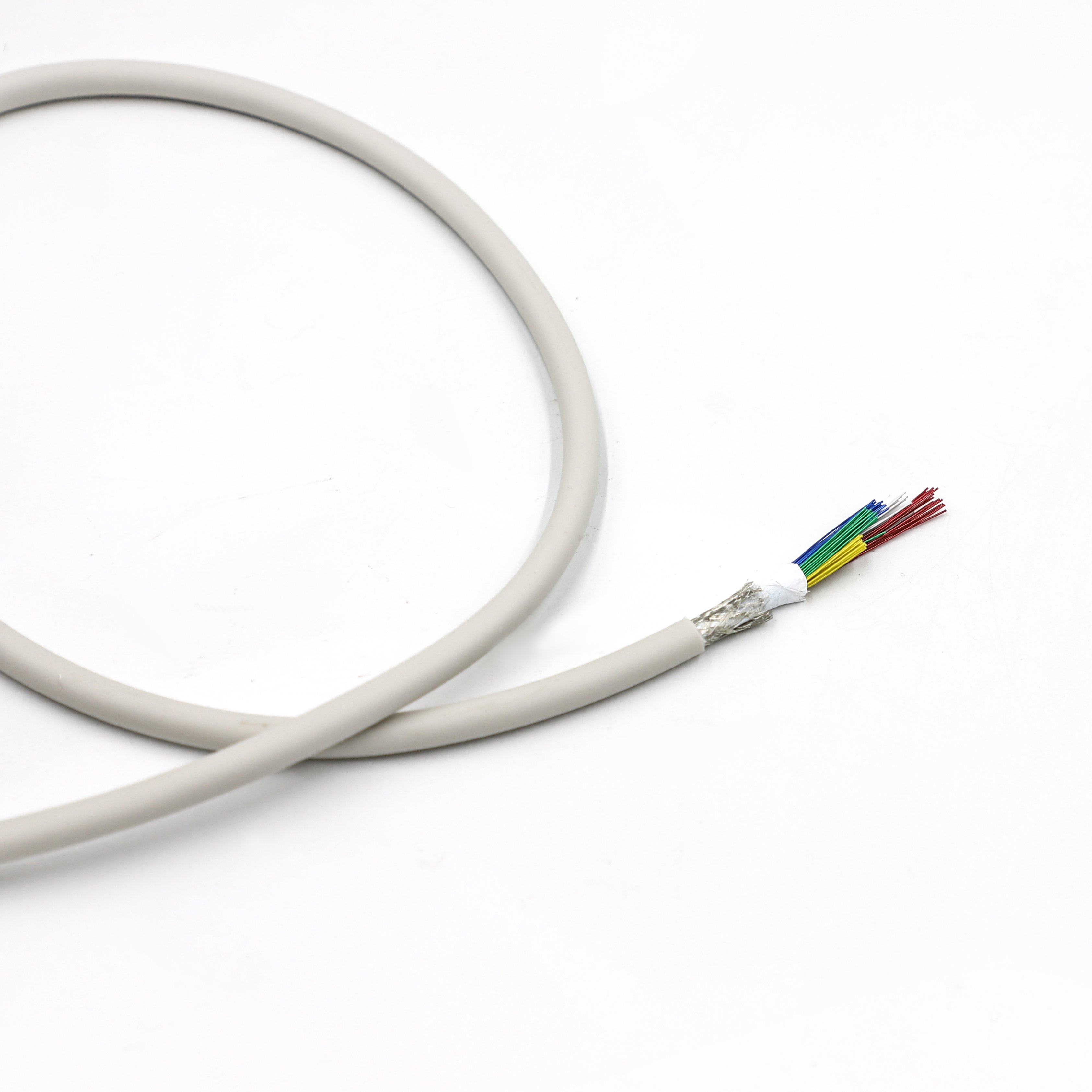
Low capacitance is important in ultrasound probe cable design because the cable becomes part of the electrical load seen by the probe's signal path. In high-channel-count systems, excessive distributed capacitance can increase capacitive loading and affect signal transmission, so cable capacitance should be considered together with impedance, attenuation, dielectric construction, channel count, and cable length.
If an ultrasound probe contains many signal channels and operates with high-frequency imaging signals → evaluate cable capacitance together with impedance, attenuation, cable length, and channel-to-channel consistency → then select the cable construction that meets the complete signal requirements.
If low capacitance is required within a very small probe structure → evaluate conductor size, dielectric material, insulation thickness, cable geometry, and cable OD together → because reducing capacitance cannot be separated from the physical construction of the cable.
The dielectric structure is especially important because capacitance is influenced by both the geometry of the coaxial structure and the electrical properties of the insulation. For related insulation considerations, see Comparison of Three High-Frequency Cable Foaming Technologies.
Conductor size is another part of the overall design. If a finer AWG is selected to reduce cable dimensions → the resulting electrical and mechanical characteristics should still be verified → because AWG alone does not determine capacitance, impedance, attenuation, or flexibility. See How Does AWG Affect Micro Coaxial Cable Performance?.
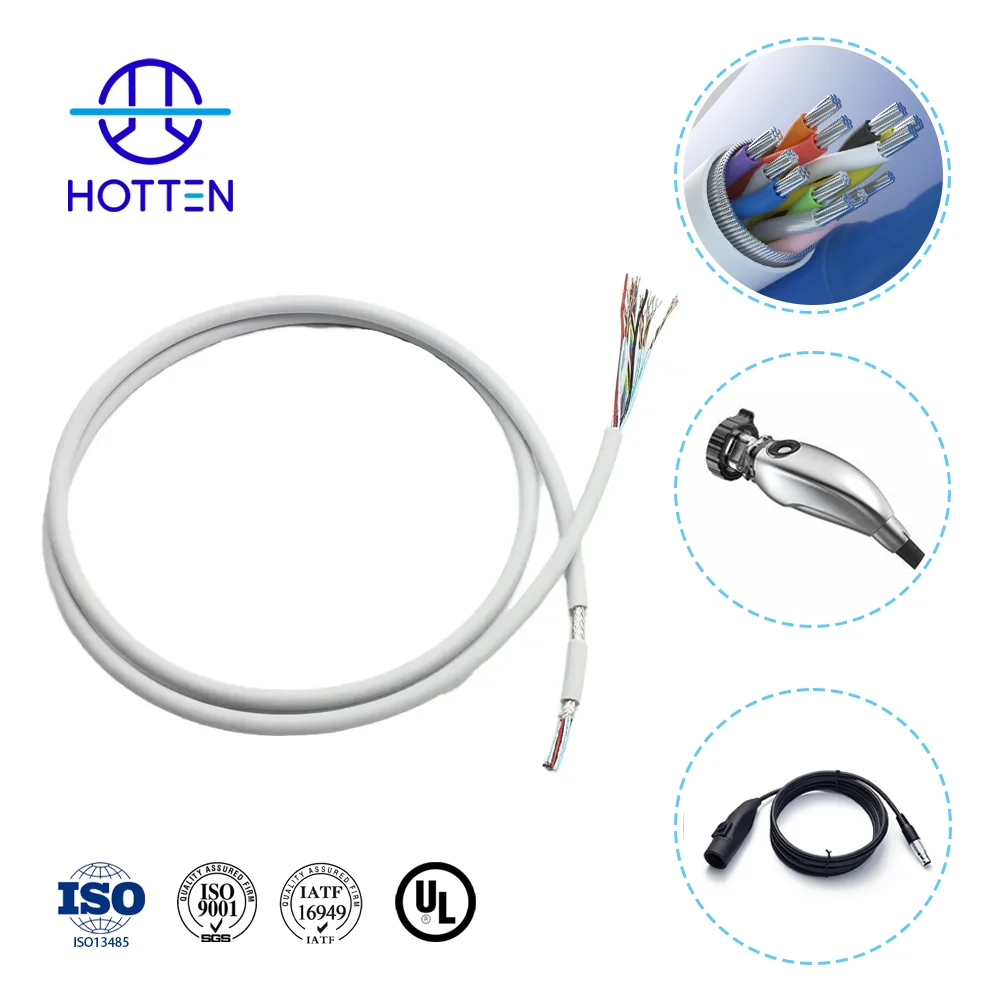
For customized high-density ultrasound interconnects, see HOTTEN's Ultrasound Probe Cable and Micro Coaxial Cable Assembly solutions.
In advanced ultrasound imaging systems, the interconnect network is directly connected to high-impedance, microvolt-level piezoelectric transducers. These front-end components are extremely sensitive to signal loss and electrical noise. When signals travel through dense 64-, 128-, 160-, 192-, and 256-channel array topologies, the distributed capacitance of the ultrasound probe cable acts as a parasitic low-pass filter shunt. Excessive cable capacitance directly degrades the signal before it reaches the beamforming system. Therefore, minimizing capacitance throughout the custom cable assembly is essential for maintaining signal-to-noise ratio (SNR) and achieving sub-millimeter axial and lateral spatial resolution.
Capacitance is directly determined by the physical geometry and dielectric properties of the insulation system. In coaxial cable structures, capacitance is proportional to the relative dielectric constant (εr) of the insulating material. Standard solid fluoropolymers such as FEP and PFA typically exhibit a dielectric constant of approximately 2.1. By utilizing microcellular gas-injection foaming technology to produce foamed PFA or FEP insulation, air voids (εr = 1.0) are introduced into the dielectric structure, reducing the overall dielectric constant to approximately 1.4–1.6. This approach enables ultra-fine micro coaxial cable constructions ranging from 40AWG to 48AWG to achieve target capacitance values as low as 50 pF/m.
Typical Distributed Capacitance Comparison:
Multi-channel probe systems require highly uniform impedance-controlled cable architectures to eliminate channel skew and phase mismatch. Even minor variations in concentricity or foam density can compromise electrical consistency and introduce destructive phase errors. At the same time, the dense arrangement of micro coaxial cables requires advanced EMI shielding strategies. Combining served-wire shielding with overall shield constructions provides the isolation necessary to reduce external electromagnetic interference and internal crosstalk, thereby preserving signal integrity.
Low capacitance is an important electrical target, but it should not be optimized independently. In an ultrasound probe, the cable must also satisfy requirements for signal integrity, channel density, flexibility, shielding, dimensional control, termination, and long-term mechanical reliability.
If the probe has very limited internal routing space → evaluate capacitance, cable OD, conductor size, insulation thickness, and cable geometry together → then verify whether the complete structure meets the required electrical and dimensional targets.
Reducing cable size can help increase routing density, but the final capacitance depends on the complete coaxial structure rather than conductor size alone.
For conductor-size considerations, see How Does AWG Affect Micro Coaxial Cable Performance?.
If low capacitance is a primary electrical requirement → evaluate dielectric constant, insulation thickness, conductor geometry, and manufacturing consistency together → then validate the finished cable.
The insulation system is therefore a key part of the capacitance design. Foamed dielectric structures can be considered when the application requires lower dielectric loading, but the selected structure must still satisfy mechanical, dimensional, and manufacturing requirements.
For related dielectric and foaming technology considerations, see Comparison of Three High-Frequency Cable Foaming Technologies.
If the ultrasound probe requires repeated bending, twisting, or operator movement → evaluate capacitance together with bend radius, flex cycles, shielding, strain relief, and cable stiffness → then validate electrical performance after mechanical testing.
A lower-capacitance structure is not automatically better if the resulting cable becomes too stiff for the intended probe configuration. The final design should therefore balance electrical targets with actual mechanical requirements.
For broader ultrasound cable selection criteria, see How to Select Micro Coaxial Cable for Ultrasound Probe Applications.
If the probe is sensitive to signal variation across many channels → evaluate capacitance uniformity together with impedance, attenuation, shielding, and cable length → then validate the complete multi-channel cable assembly.
A nominal capacitance value does not fully describe the performance of a high-channel-count probe. Consistency between channels and along the cable can also matter because differences in electrical characteristics may affect the overall signal path.
For related impedance-control considerations, see The Importance of Impedance Consistency (50Ω / 75Ω) in Ultra-Fine AWG Micro Coaxial Cables.
If a project specifies a very low capacitance target with tight dimensional tolerances → evaluate whether the supplier can reproduce the cable structure consistently in production → then verify prototype performance and production repeatability separately.
The engineering specification should therefore include both the target value and the validation method.
A practical OEM review should confirm:
| Requirement | Parameters to Confirm |
|---|---|
| Capacitance | Target pF/m, channel-to-channel consistency |
| Impedance | Nominal impedance and allowable tolerance |
| Signal | Frequency, attenuation, transmission length |
| Conductor | AWG, material, conductor geometry |
| Dielectric | Material, dielectric structure, insulation thickness |
| Dimensions | Cable OD, pitch, routing space |
| Shielding | Shield structure and coverage |
| Mechanical | Bend radius, flex cycles, torsion |
| Interface | Connector PN, pitch, pinout, termination |
| Validation | Capacitance, TDR, dielectric withstand, mechanical tests |
| Production | Prototype quantity, annual volume, process consistency |
Different probe designs may prioritize different combinations of electrical and mechanical characteristics.
If the probe prioritizes low capacitance and high-channel-count signal performance → prioritize dielectric structure, capacitance uniformity, impedance, attenuation, and cable geometry → then validate the complete cable assembly.
If the probe prioritizes compact dimensions → prioritize cable OD, conductor size, insulation structure, and channel arrangement → then verify capacitance and signal performance within the available space.
If the probe prioritizes repeated bending and operator handling → prioritize flexibility, bend life, shielding stability, and strain relief → then verify that the required capacitance and signal characteristics remain within specification.
For customized ultrasound cable solutions, see HOTTEN's Ultrasound Probe Cable.
For broader medical-device applications, see Medical Equipment.
A practical low-capacitance ultrasound cable development process can be summarized as:
Probe architecture → channel count → signal requirements → capacitance target → dielectric and conductor structure → shielding → mechanical requirements → connector → validation → production
The engineering objective is therefore not simply to achieve the lowest possible capacitance. It is to achieve the required capacitance and signal performance while maintaining the dimensional, mechanical, interface, and manufacturing requirements of the complete ultrasound probe cable assembly.
For related high-density ultrasound cable configurations, see Ultrasound Probe Cable and Micro Coaxial Cable Assembly.
Medical imaging applications require high-flex cables capable of withstanding tens of thousands of bending and torsion cycles encountered during clinical operation. However, reducing capacitance through thicker insulation layers or increasing shielding robustness inevitably increases cable stiffness and overall diameter. To balance this engineering trade-off, high-strength silver-plated copper alloy conductors and highly flexible jacket materials are commonly specified. Their performance must be validated through rigorous multi-axis flexing and bend-reliability testing.
The termination interface between the micro coaxial cable bundle and the system PCB is a common source of impedance discontinuity. Terminating ultra-fine conductors as small as 48AWG requires high-density direct soldering techniques or micro coaxial connectors with pitches as small as 0.3 mm. Abrupt geometric transitions at these interfaces can generate signal reflections that negatively affect imaging consistency across channels.
Producing high-yield medical cable assemblies requires strict control of wire drawing, fluoropolymer extrusion foaming, and multi-axis planetary cabling processes to ensure uniform tension distribution without introducing torsional stress. Manufacturing should be conducted in ISO 13485-certified facilities. Comprehensive quality assurance procedures include 100% capacitance testing to map the impedance profile along every channel and verify the absence of localized manufacturing deviations.
In a 128-channel high-frequency linear-array probe designed for superficial vascular imaging, replacing a standard solid-dielectric cable bundle with a custom 50 pF/m foamed-dielectric assembly can significantly reduce high-frequency insertion loss over a 2-meter cable length. The reduction in capacitive loading directly improves Doppler sensitivity and overall clinical image clarity.
Optimizing advanced ultrasound probes requires controlling distributed capacitance to a target threshold of approximately 50 pF/m through precision foaming technology and tightly controlled manufacturing tolerances. For OEM engineering teams, selecting an interconnect partner with specialized micro coaxial extrusion capabilities and ISO 13485 manufacturing infrastructure ensures that theoretical signal-integrity advantages translate into repeatable, real-world clinical performance.
 Hot News
2026-09-17
2026-09-04
2025-12-17
2025-12-11
2025-12-05