 EN
EN
Quick Links

Home > News > Company news
Technical analysis for OEM engineers covering cable structure, shielding, impedance control, material selection, and reliability validation in high-performance cable assembly applications.
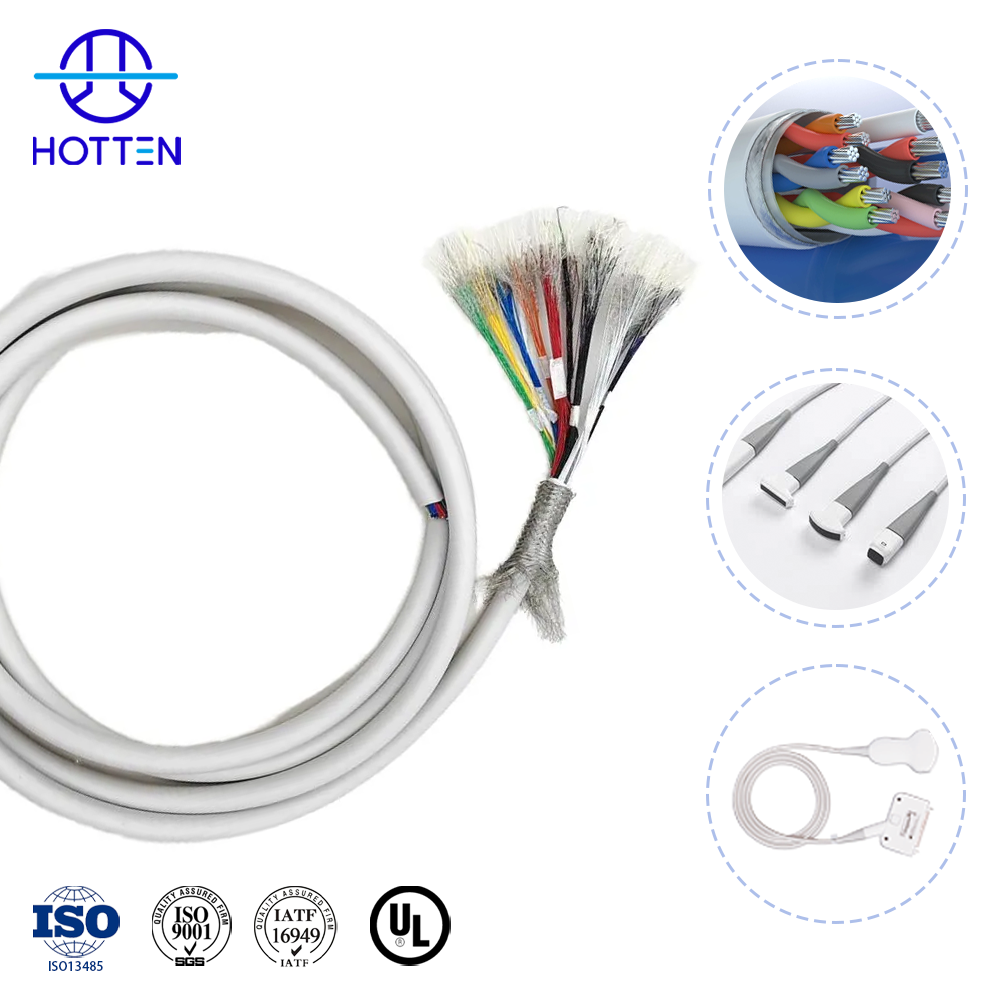
An ultrasound probe cable assembly must balance high channel density, signal integrity, low capacitance, compact dimensions, shielding, flexibility, mechanical durability, and high-density termination within a relatively small and frequently handled assembly. The appropriate cable structure depends on the probe architecture, channel count, available routing space, electrical requirements, mechanical movement, connector interface, and validation requirements.
If the probe requires 64–256 independent signal channels within limited space → evaluate core count, conductor size, cable OD, channel arrangement, and termination density together → then verify the complete assembly's electrical and mechanical performance.
If signal consistency is the primary requirement → evaluate capacitance, impedance, attenuation, dielectric construction, shielding, and dimensional tolerance together → because the cable assembly forms part of the complete ultrasound signal path. For related information, see How to Select Micro Coaxial Cable for Ultrasound Probe Applications and Why Low Capacitance Is Critical in Ultrasound Probe Cable Design.
If the probe is repeatedly bent, twisted, or handled during use → evaluate conductor fatigue, shielding stability, jacket construction, bend radius, flex life, and strain relief together with electrical requirements.
For the underlying impedance relationship between conductor geometry and dielectric structure, see The Importance of Impedance Consistency in Ultra-Fine AWG Micro Coaxial Cables.
For customized high-density interconnects, see HOTTEN's Ultrasound Probe Cable and Medical Cable Assembly solutions.
Modern diagnostic ultrasound imaging systems require high-density signal transmission within extremely limited space. A typical ultrasound probe cable assembly must accommodate 64 to 256 independent channels while maintaining an ergonomic outer diameter suitable for handheld operation.
To achieve this channel density, engineering teams commonly utilize ultra-fine micro coaxial cables ranging from 40 AWG to 48 AWG. The key engineering challenge is balancing mechanical flexibility with electrical performance. Reducing cable size improves handling and flexibility but increases the risk of crosstalk and conductor fatigue under continuous torsional stress.
In high-density medical ultrasound cables, capacitance directly affects signal attenuation, insertion loss, and imaging consistency. To optimize signal-to-noise ratio across a wide frequency range, cable structures are typically designed with a capacitance target of approximately 50 pF/m.
Reducing capacitance without increasing cable diameter depends on lowering the effective dielectric constant of the insulation material while maintaining stable impedance control.
When hundreds of micro coaxial elements are bundled into a single cable assembly, electromagnetic interference becomes a major engineering challenge. Effective shielding must suppress internal crosstalk while protecting weak analog echo signals from external noise.
Shield Type | Engineering Advantage | Mechanical Trade-Off
Spiral Shield | Excellent flexibility and low bending resistance | Lower shielding effectiveness at very high frequencies
Braided Shield | Superior EMI suppression and structural integrity | Increased stiffness and larger cable diameter
To achieve the optimal balance between electrical and mechanical performance, premium medical cables often utilize hybrid shielding structures. Individual micro coaxial elements are protected with spiral shielding, while the entire cable assembly is covered with a high-density overall braid, providing comprehensive EMI protection without compromising ergonomics.
As handheld medical devices, ultrasound probes are exposed to continuous bending, twisting, and physical impact during clinical use. Therefore, cable assemblies must provide exceptional fatigue resistance and withstand millions of flex cycles without conductor failure or shielding degradation.
For an OEM ultrasound project, the cable assembly specification should define the electrical, mechanical, dimensional, interface, material, and validation requirements together. A supplier should not be selected only on the basis of AWG, cable diameter, or nominal impedance.
If the ultrasound system has demanding signal-integrity requirements → define impedance, capacitance, attenuation, operating frequency, cable length, and channel-to-channel consistency first → then determine the appropriate conductor and dielectric structure.
Capacitance and impedance should be evaluated as part of the complete cable architecture. Changes in conductor geometry, dielectric dimensions, or shielding structure can affect the final electrical characteristics.
For a more detailed discussion of capacitance, see Why Low Capacitance Is Critical in Ultrasound Probe Cable Design.
For impedance-control considerations, see The Importance of Impedance Consistency in Ultra-Fine AWG Micro Coaxial Cables.
If the probe has a high channel count and limited internal routing space → define channel count, conductor size, cable arrangement, cable OD, and termination pitch → then evaluate whether the proposed structure can be manufactured consistently.
A smaller conductor is not automatically the correct solution. The complete structure also includes insulation, shielding, jacket, cabling arrangement, and termination.
For conductor-size trade-offs, see How Does AWG Affect Micro Coaxial Cable Performance?.
For customized Micro Coaxial Cable Assembly requirements, the cable structure and termination should be evaluated as one assembly.
If the probe cable is subject to repeated bending or twisting → define shielding structure, bend radius, flex cycles, torsion, jacket construction, and strain relief together → then verify electrical performance after mechanical testing.
Shielding can contribute to EMI control, but changes in shielding structure can also affect cable stiffness, OD, and flexibility. The selected structure therefore needs to match the actual movement profile of the probe.
For the broader ultrasound cable-selection process, see How to Select Micro Coaxial Cable for Ultrasound Probe Applications.
If the assembly contains hundreds of ultra-fine conductors → define connector type, pitch, pinout, termination method, and available assembly space before finalizing the cable construction → then optimize the cable around the interface.
For example, direct paddle-card soldering and miniature connector interfaces can impose different conductor spacing, stripping, thermal-management, and strain-relief requirements.
Termination should therefore be treated as part of the cable design rather than as a separate manufacturing step.
A practical RFQ or engineering specification should provide as much of the following information as available:
| Requirement | Parameters to Define |
|---|---|
| Application | Ultrasound probe type and intended use |
| Channel Configuration | Channel count, core count, arrangement |
| Conductor | AWG, material, conductor construction |
| Electrical | Impedance, capacitance, attenuation, frequency |
| Dimensions | Cable OD, pitch, routing space |
| Shielding | Individual shield, overall shield, grounding |
| Mechanical | Bend radius, flex cycles, torsion |
| Interface | Connector PN, pinout, pitch, termination |
| Cable Length | Finished length and routing path |
| Materials | Insulation, jacket, applicable medical requirements |
| Validation | Capacitance, impedance, TDR, dielectric, mechanical testing |
| Production | Prototype quantity, annual volume, quality-system requirements |
Where available, OEMs should also provide drawings, samples, connector part numbers, pinouts, existing cable specifications, or interface drawings. These details allow the supplier to evaluate the complete assembly rather than quoting a generic cable construction.
If electrical consistency is the main risk → prioritize impedance, capacitance, TDR, attenuation, and channel matching tests.
If repeated movement is the main risk → prioritize bend, flex-cycle, torsion, and strain-relief testing.
If miniature termination is the main risk → prioritize dimensional inspection, soldering quality, termination consistency, and interface validation.
If production consistency is the main risk → validate both prototype performance and production-batch repeatability.
The validation plan should therefore reflect the actual failure modes of the probe rather than relying on a single pass/fail test.
A practical OEM development sequence can be summarized as:
Probe architecture → channel count → signal requirements → cable dimensions → conductor / dielectric structure → shielding → mechanical requirements → connector / termination → prototype → validation → production
This sequence helps prevent a common development problem: selecting a cable first and discovering later that its capacitance, flexibility, termination, or routing characteristics do not fit the final probe.
For customized ultrasound cable development, see HOTTEN's Ultrasound Probe Cable solutions.
For broader medical-device applications, see Medical Equipment.
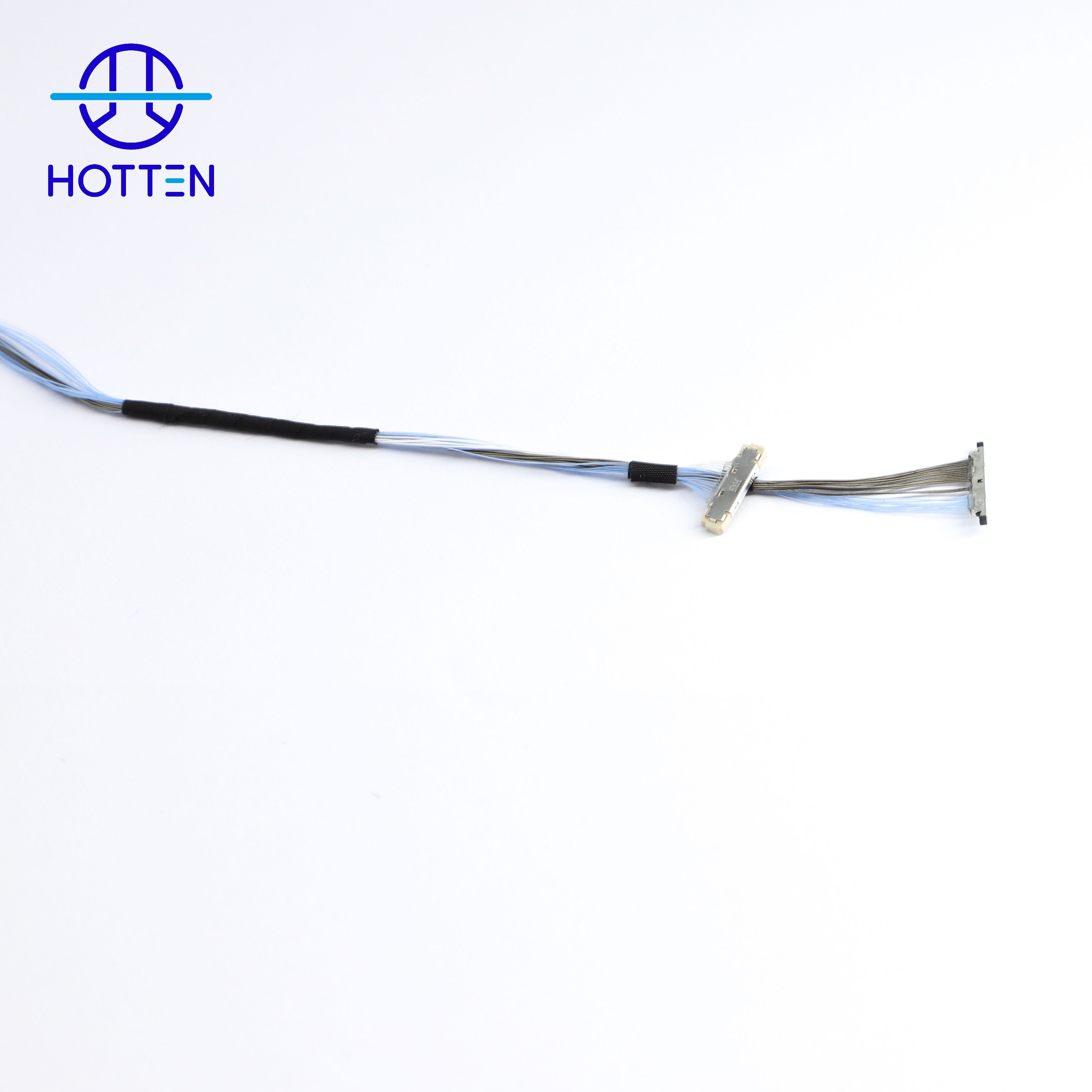
Terminating up to 256 micro coaxial elements requires ultra-fine interconnect solutions, typically involving direct soldering onto paddle cards or miniature PCBs with pitches of 0.3 mm or less. Precise thermal management during laser stripping and micro-soldering is critical to prevent foamed PFA insulation collapse, which could alter local impedance and degrade signal performance.
All manufacturing and assembly processes should comply with ISO 13485 medical device quality management requirements. Production should include 100% capacitance testing and high-frequency network analysis to verify impedance tolerance, capacitance limits, and propagation delay matching (skew) throughout the cable assembly.
For next-generation ultrasound imaging systems, involving cable design experts early in the development process helps ensure optimal conductor geometry, shielding configuration, and termination design. HOTTEN Cable provides comprehensive engineering support, from simulation and ISO 13485-compliant prototyping to high-volume production, helping OEM customers accelerate development while ensuring reliable performance.
 Hot News
2026-09-17
2026-09-04
2025-12-17
2025-12-11
2025-12-05