 EN
EN
Quick Links

Home > News > Company news
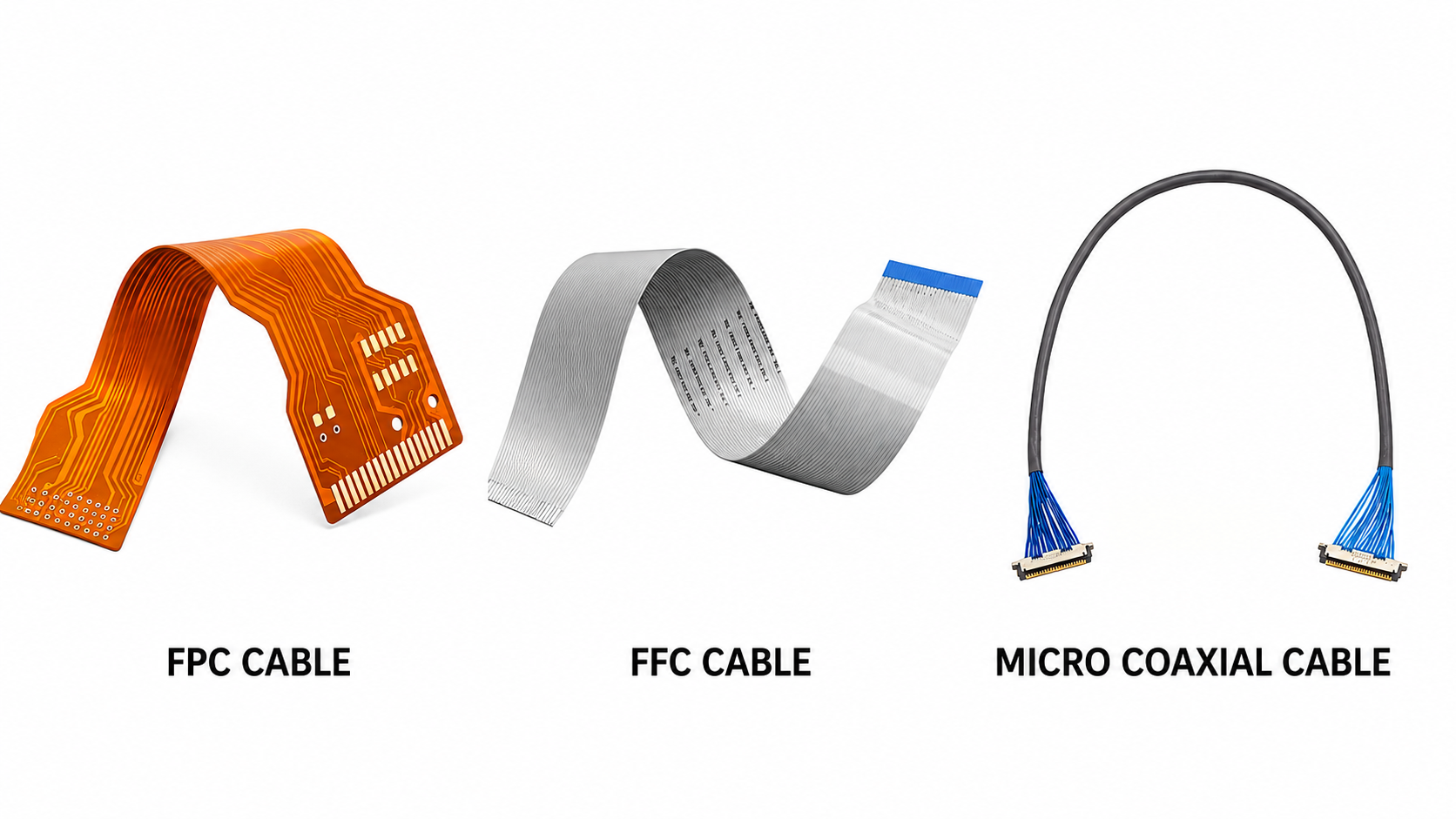
FPC, FFC, and micro-coaxial cable assemblies are suitable for different interconnect requirements. FPC is generally considered when circuit integration and complex planar routing are important; FFC is often used for simpler point-to-point connections where cost and production efficiency are priorities; and micro-coaxial cable assemblies are typically evaluated when high-speed signaling, individual shielding, compact routing, or dynamic movement are key requirements. The final choice should be based on the complete system requirements, including signal characteristics, routing space, bending conditions, connector configuration, cable length, and production requirements.
In highly integrated, miniaturized electronic devices such as AR/VR headsets, medical endoscopes, drones, and high-end displays, FPCs (Flexible Printed Circuits), FFCs (Flexible Flat Cables), and Micro-Coaxial Cable Assemblies are the three most critical interconnect solutions for high-speed/high-frequency signal transmission.
Although they are often broadly referred to as "flat cables" or "harnesses," their structural designs and application characteristics differ significantly. Below is a comprehensive comparison of their core advantages and disadvantages.
FPC, FFC, and micro-coaxial cable assemblies are designed for different interconnect requirements. FPC is generally considered when circuit integration, complex routing, and a highly customized flexible circuit structure are important. FFC is often suitable for simpler point-to-point connections where standardized construction, production efficiency, and cost are priorities. Micro-coaxial cable assemblies are typically evaluated when high-speed or high-frequency signaling, individual shielding, compact three-dimensional routing, or dynamic movement are important requirements.
The choice should therefore be based on the complete application rather than on flexibility or cable cost alone.
If the design requires components to be integrated directly into the flexible circuit → FPC may be considered.
If the design mainly requires a simple and standardized internal connection → FFC may be considered.
If the design requires compact routing together with high-speed signal transmission and shielding → micro-coaxial cable assembly should be evaluated.
The final selection should also consider connector configuration, signal characteristics, cable length, available routing space, bending conditions, EMC requirements, and production volume.
For micro-coaxial cable construction and conductor-size considerations, see How Does AWG Affect Micro Coaxial Cable Performance?.
For high-frequency insulation and dielectric considerations, see Comparison of Three High-Frequency Cable Foaming Technologies.
For customized high-density interconnects, see HOTTEN's Micro Coaxial Cable Assembly and Display & High-Speed Cable solutions.
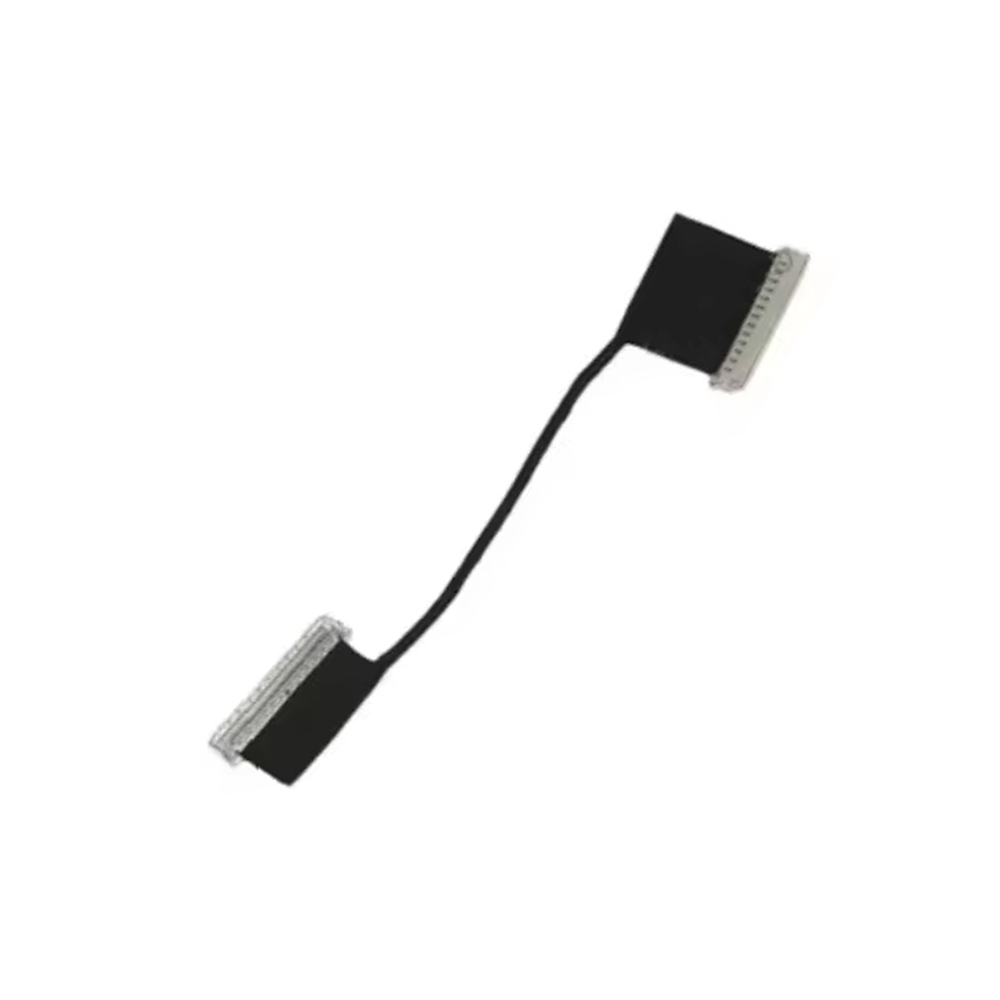
An FPC is a flexible printed circuit board formed by chemically etching copper foil onto a Polyimide (PI) base material.
An FFC is a ribbon cable made by sandwiching flat high-tech copper wires between two layers of insulating foil (typically PET) and compressing them using high-pressure automated equipment.
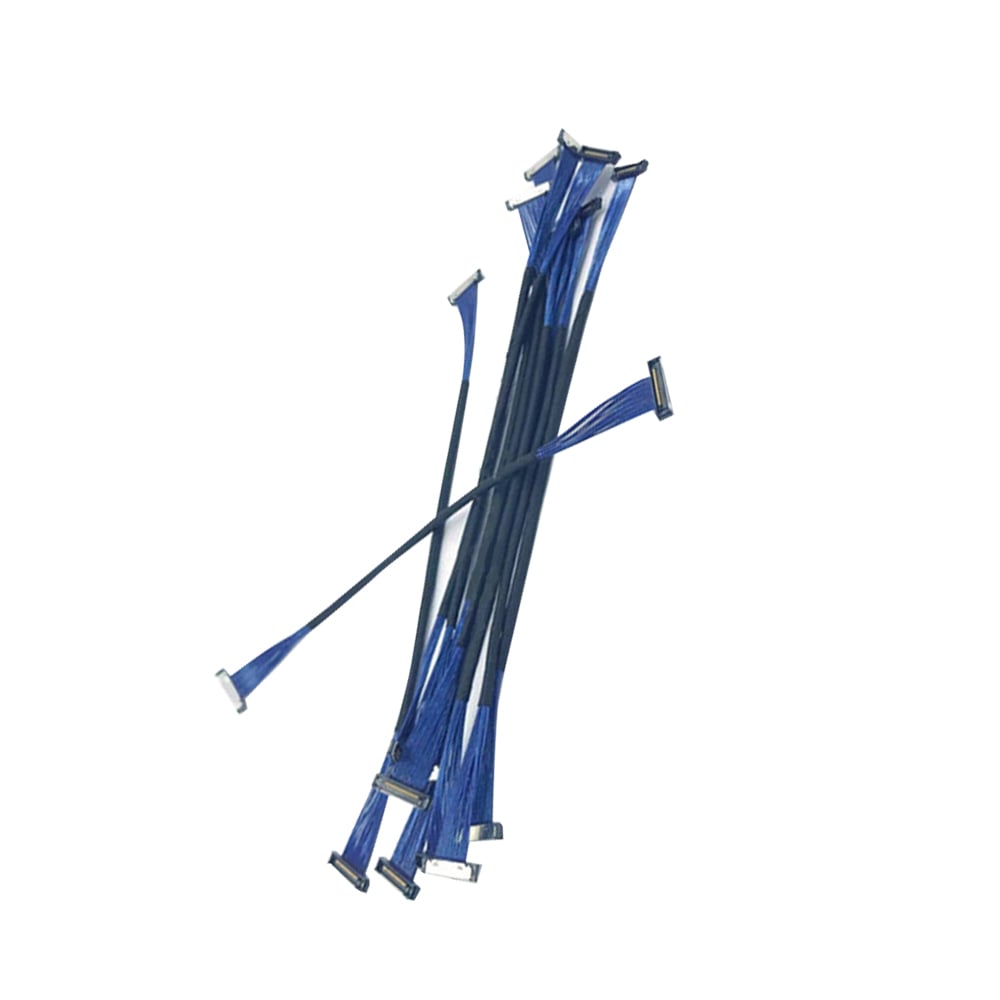
Micro-coaxial cable assemblies utilize an array of ultra-fine, individual coaxial lines with extremely slender center conductors (typically 40 AWG to 46 AWG, or even finer). Each individual line features its own center conductor, dielectric insulation, outer conductor shield, and outer jacket, which are ultimately bundled and terminated onto a connector.
Choosing between FPC, FFC, and micro-coaxial cable assembly should be based on the electrical, mechanical, spatial, and production requirements of the device rather than on cable type alone. The most suitable interconnect is the one that satisfies the required signal performance and mechanical constraints while remaining practical for the intended production volume and assembly process.
If the main requirement is highly integrated circuit routing, component mounting, or complex planar interconnect structures, FPC may be considered. FPC can combine conductive traces and circuit functions within a thin flexible structure, making it useful when the interconnect itself needs to perform part of the circuit function.
If the application mainly requires a simple, standardized point-to-point connection with cost and production efficiency as major considerations, FFC may be considered. It can be suitable for relatively simple internal connections where individual signal shielding and advanced high-frequency performance are not primary requirements.
If the application requires high-speed signal transmission, individual shielding, compact three-dimensional routing, or repeated multi-axis movement, micro-coaxial cable assembly should be evaluated. Its individual coaxial construction allows each signal path to have its own dielectric and shielding structure, which can help support controlled signal transmission in compact and electrically demanding assemblies.
The decision should also consider the relationship between cable size, signal performance, flexibility, and manufacturability.
| Engineering Requirement | FPC | FFC | Micro-Coaxial Cable Assembly |
|---|---|---|---|
| Circuit Integration | High | Low | Medium |
| Simple Point-to-Point Connection | Medium | High | Medium |
| High-Speed Signal Transmission | Application-dependent | Limited | High |
| Individual Signal Shielding | Application-dependent | Limited | Yes |
| 3D Routing Flexibility | High | Low | High |
| Multi-Axis Dynamic Movement | Application-dependent | Limited | Suitable for applicable designs |
| Small Routing Space | High | Medium | High |
| Custom Cable Assembly | High | Medium | High |
For micro-coaxial applications, conductor size is also part of the overall design decision. A smaller AWG number indicates a larger conductor, while a larger AWG number indicates a finer conductor. However, AWG alone does not determine the final cable performance or outer diameter. Engineers should evaluate conductor size together with insulation, shielding, cable OD, impedance, cable length, bending requirements, and connector design. For more detail, see How Does AWG Affect Micro Coaxial Cable Performance?.
The insulation structure can also influence the final electrical and mechanical characteristics of a micro-coaxial cable. Different insulation technologies may be considered depending on the required balance between dielectric performance, impedance control, flexibility, and environmental conditions. See How to Select the Right Foaming Technology for Micro Coaxial Cable Insulation?.
Before selecting the interconnect structure, an OEM engineering team should confirm:
Required signal type and operating frequency
Characteristic impedance, when applicable
Cable length and allowable signal loss
Required cable OD and available routing space
Bending, twisting, or flex-cycle requirements
Shielding and EMI requirements
Connector type, pitch, and termination method
Prototype and mass-production quantity
The final specification should therefore be based on the complete cable assembly rather than a single parameter such as flexibility, AWG, or cost.
For projects requiring customized high-density interconnects, see HOTTEN's Micro Coaxial Cable Assembly solutions. For compact moving applications such as drone and robotic systems, see UAV & Robotics Cable Solutions.
Characteristic |
FPC (Flexible Printed Circuit) |
FFC (Flexible Flat Cable) |
Micro-Coaxial Cable Assembly |
Primary Focus |
Highly integrated routing in extremely space-constrained areas. |
Budget-friendly, simple internal low-speed interconnections. |
Ultimate high-speed/high-frequency transmission, EMI shielding, and multi-axis dynamic twisting. |
Cost & Tooling |
Medium to High (requires tooling/molds). |
Extremely Low. |
Extremely High (requires specialized automation & processing precision). |
Signal Speed |
Medium to High. |
Low (does not support high-speed data). |
Ultra-High (Gbps-level and RF signals). |
Typical AR/VR Application |
Button boards, motherboard interconnections, micro-sensor mounting. |
Battery power lines, simple LED control lines. |
4K display signal lines, camera MIPI lines, RF antenna connectivity. |
At Hotten, we specialize in the engineering and high-precision manufacturing of custom Micro-Coaxial Cable Assemblies and advanced wire harnesses. Whether your project demands superior signal integrity for next-generation 4K display interfaces, tight EMI co-existence with RF modules, or millions of dynamic bending cycles for robotic or wearable applications, we deliver tailored interconnect solutions.
Contact our technical team today to request datasheets, engineering evaluations, or custom samples.
 Hot News
2026-09-17
2026-09-04
2025-12-17
2025-12-11
2025-12-05