 EN
EN
Quick Links

Home > News > Company news
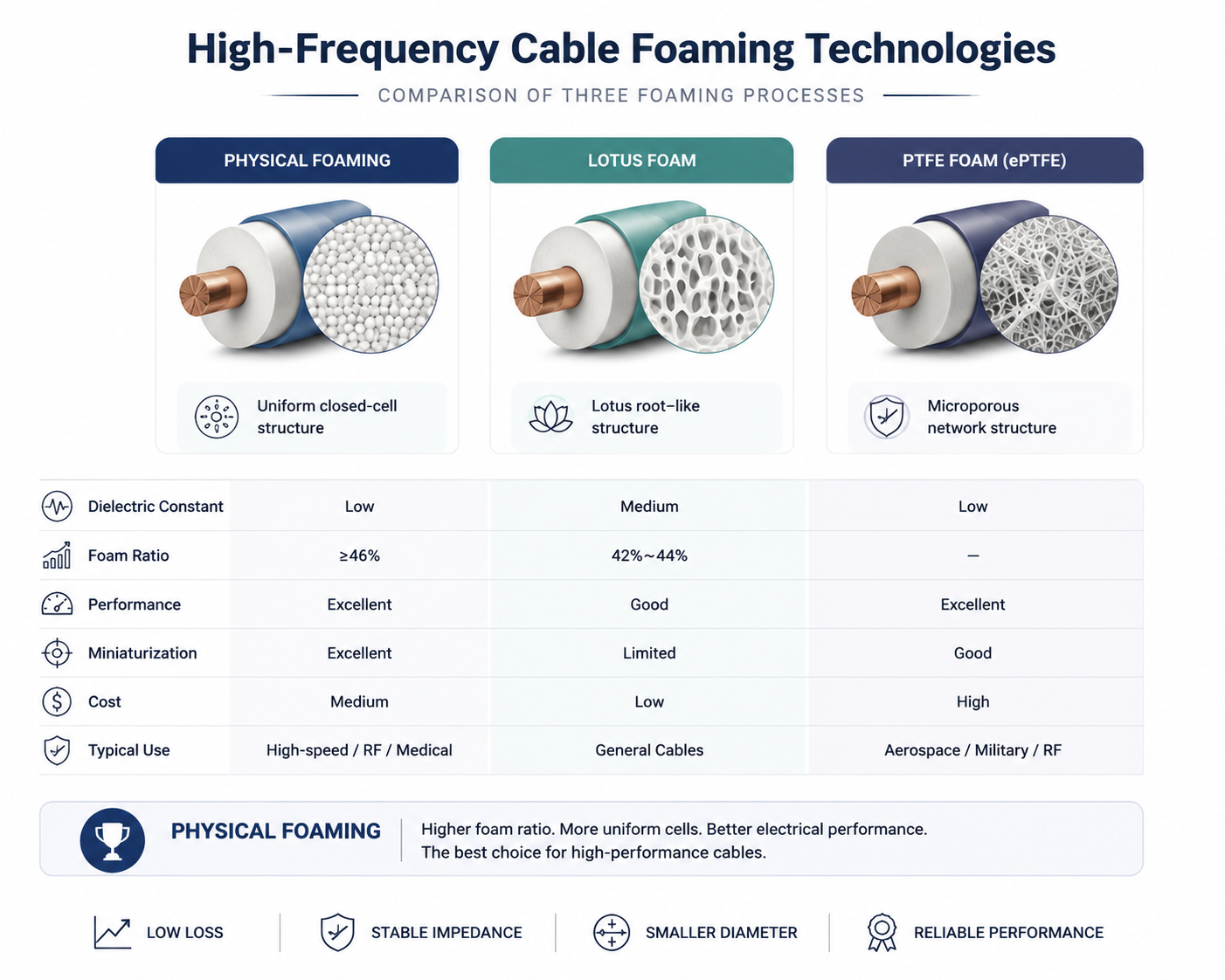
In cable insulation manufacturing, the foaming process plays a critical role in determining impedance stability, signal transmission performance, and cable miniaturization capability. The three primary foaming technologies currently used in the industry are Physical Foaming, Lotus Foam, and Expanded PTFE (ePTFE).
Physical Foaming, Lotus Foam, and Expanded PTFE (ePTFE) are three different approaches to creating low-dielectric insulation structures for high-frequency cable applications. The appropriate technology depends on the required balance of dielectric performance, impedance control, cable size, flexibility, environmental resistance, manufacturing complexity, and cost.
If the cable design prioritizes compact dimensions and controlled high-frequency electrical performance, Physical Foaming may be considered. Its microcellular insulation structure can help reduce dielectric constant while supporting fine-wire and compact cable constructions. This makes it relevant to applications such as Micro Coaxial Cable and Micro Coaxial Cable Assembly.
If the application requires high-frequency performance together with high temperature or chemical resistance, Expanded PTFE may be considered. The final choice should depend on the environmental and electrical requirements of the complete cable construction rather than insulation material alone.
If manufacturing maturity, processing requirements, and application cost are important considerations, Lotus Foam may be evaluated as another option. The appropriate choice depends on the dimensional tolerance, electrical targets, mechanical requirements, and production conditions of the cable.
For ultra-fine constructions, insulation technology should also be evaluated together with conductor size, shielding, cable OD, and impedance. See How Does AWG Affect Micro Coaxial Cable Performance? and Why Ultra-Fine High-Frequency Coaxial Cable Design Is So Difficult.
For application-specific high-frequency cable requirements, see HOTTEN's High Frequency & RF Systems solutions.
Physical foaming utilizes high-pressure nitrogen gas injection to create a uniform closed-cell microcellular structure within the insulation layer. Foam ratios can exceed 46%, resulting in a low dielectric constant, excellent impedance consistency, and minimal transmission loss.
This process enables ultra-fine cable constructions and is widely used in high-speed data cables, RF coaxial cables, and premium medical cable assemblies. It supports mass production for conductors ranging from 38 AWG to 46 AWG.
Lotus Foam technology forms lotus root-like cellular structures to reduce dielectric constant. Typical foam ratios range from 42% to 44%.
Although it offers lower manufacturing cost and mature processing, its bubble uniformity and dimensional control are inferior to Physical Foaming, limiting its use in ultra-fine cable applications.
Expanded PTFE is produced by stretching PTFE to form a porous microcellular network.
It provides excellent high-temperature resistance, chemical resistance, and high-frequency electrical performance, making it suitable for aerospace, defense, and RF communication applications. However, it has high cost and complex processing requirements, limiting it to specialized products.
The insulation process should be selected according to the requirements of the complete cable construction. Dielectric performance, impedance stability, cable diameter, flexibility, environmental resistance, manufacturing tolerance, and production requirements can all influence the final decision.
If minimum cable size and high-frequency electrical performance are major requirements → evaluate the dielectric constant, foam structure, insulation thickness, impedance stability, and final cable OD together → then select the foaming technology that can achieve the required cable construction consistently.
The insulation process should therefore be considered together with conductor size and shielding. A smaller conductor does not automatically produce a smaller finished cable if the insulation and shielding structure require additional space.
For related conductor-size considerations, see How Does AWG Affect Micro Coaxial Cable Performance?.
Different product categories may place different priorities on the insulation system.
If the target product is a micro coaxial cable or high-density cable assembly → prioritize dielectric performance, impedance control, cable OD, shielding integration, and manufacturing consistency. See HOTTEN's Micro Coaxial Cable and Micro Coaxial Cable Assembly categories.
If the target product is used in medical imaging → evaluate low capacitance, signal integrity, flexibility, dimensional consistency, and the applicable medical material and validation requirements. Related applications include HOTTEN's Medical Equipment solutions.
For more information about the relationship between dielectric structure and capacitance in ultrasound applications, see Why Low Capacitance Is Critical in Ultrasound Probe Cable Design.
If the target product is used in UAV, robotics, or other compact moving systems → evaluate cable OD, flexibility, shielding, environmental conditions, and dynamic routing requirements together. See HOTTEN's UAV & Robotics solutions.
The three technologies should not be compared using a single parameter.
| Engineering Requirement | Physical Foaming | Lotus Foam | Expanded PTFE (ePTFE) |
|---|---|---|---|
| Dielectric Performance | Important strength | Application-dependent | Strong |
| Fine Cable Construction | Well suited to applicable designs | More application-dependent | Possible for specialized designs |
| Impedance Control | Important | Important | Important |
| High-Temperature Resistance | Application-dependent | Application-dependent | Strong |
| Chemical Resistance | Application-dependent | Application-dependent | Strong |
| Manufacturing Complexity | High process control required | Mature processing | High |
| Cost Consideration | Application-dependent | Can be advantageous | Typically higher |
| Typical Use Direction | High-frequency and compact cable designs | Cost-sensitive / established designs | Specialized high-frequency and harsh-environment applications |
The table should be treated as an engineering comparison framework rather than a universal ranking. Final material selection depends on the required cable structure, operating environment, performance targets, and manufacturing capability.
If high-frequency performance and compact micro-coaxial construction are the main requirements → evaluate Physical Foaming first → then verify impedance, attenuation, dimensional consistency, and mechanical performance on the complete cable.
If high-temperature or chemical resistance is a dominant environmental requirement → evaluate Expanded PTFE → then confirm the resulting cable dimensions, flexibility, termination compatibility, and manufacturing feasibility.
If manufacturing maturity and production economics are important → evaluate Lotus Foam together with the required electrical and dimensional targets → then validate whether the resulting cable construction meets the application specification.
The final engineering question should therefore be:
Which insulation technology can consistently achieve the required electrical, mechanical, dimensional, environmental, and production requirements of the complete cable?
For additional background on ultra-fine high-frequency cable construction, see Why Ultra-Fine High-Frequency Coaxial Cable Design Is So Difficult.
For customized high-frequency and RF cable requirements, see HOTTEN's High Frequency & RF Systems solutions.
Physical Foaming provides the highest foam ratio, best uniformity, and superior electrical performance among the three technologies. It is the preferred solution for high-speed transmission and precision cable applications, representing the future direction of high-performance cable insulation manufacturing.
 Hot News
2026-09-17
2026-09-04
2025-12-17
2025-12-11
2025-12-05