 EN
EN
Quick Links

Home > News > Company news
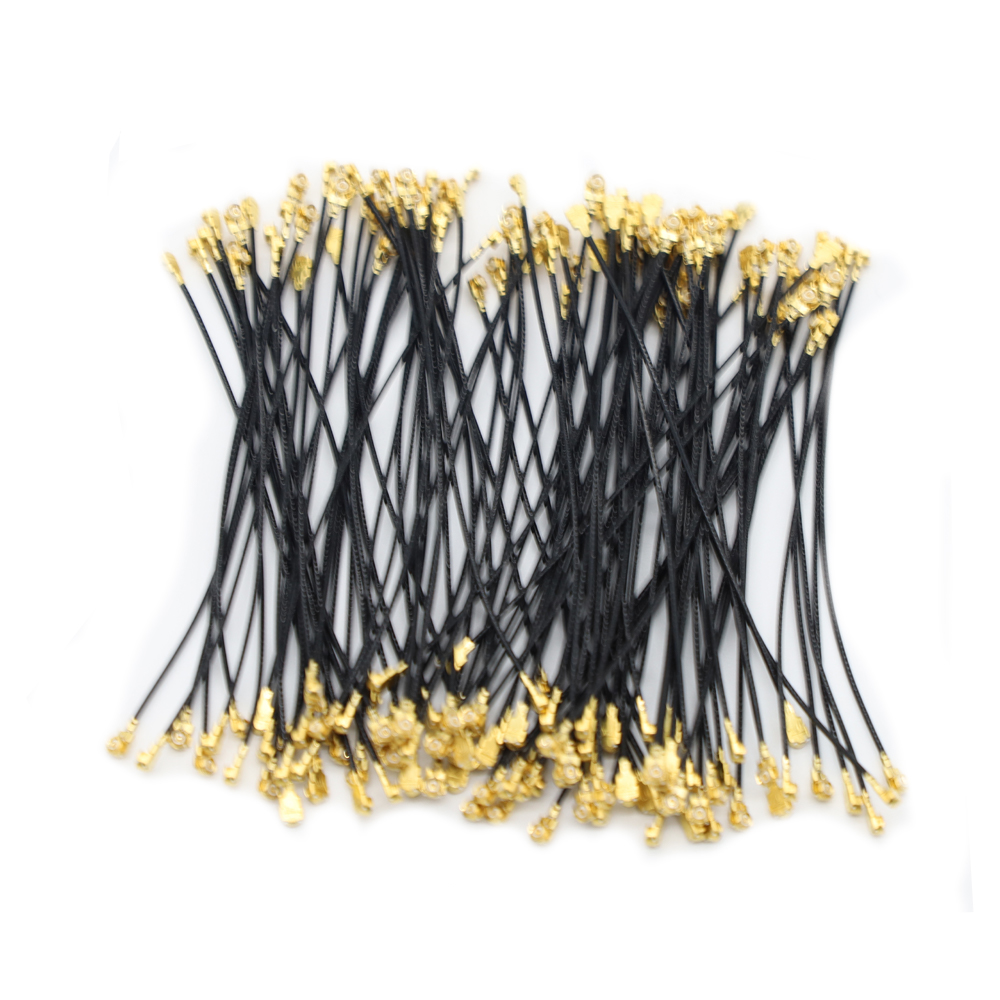
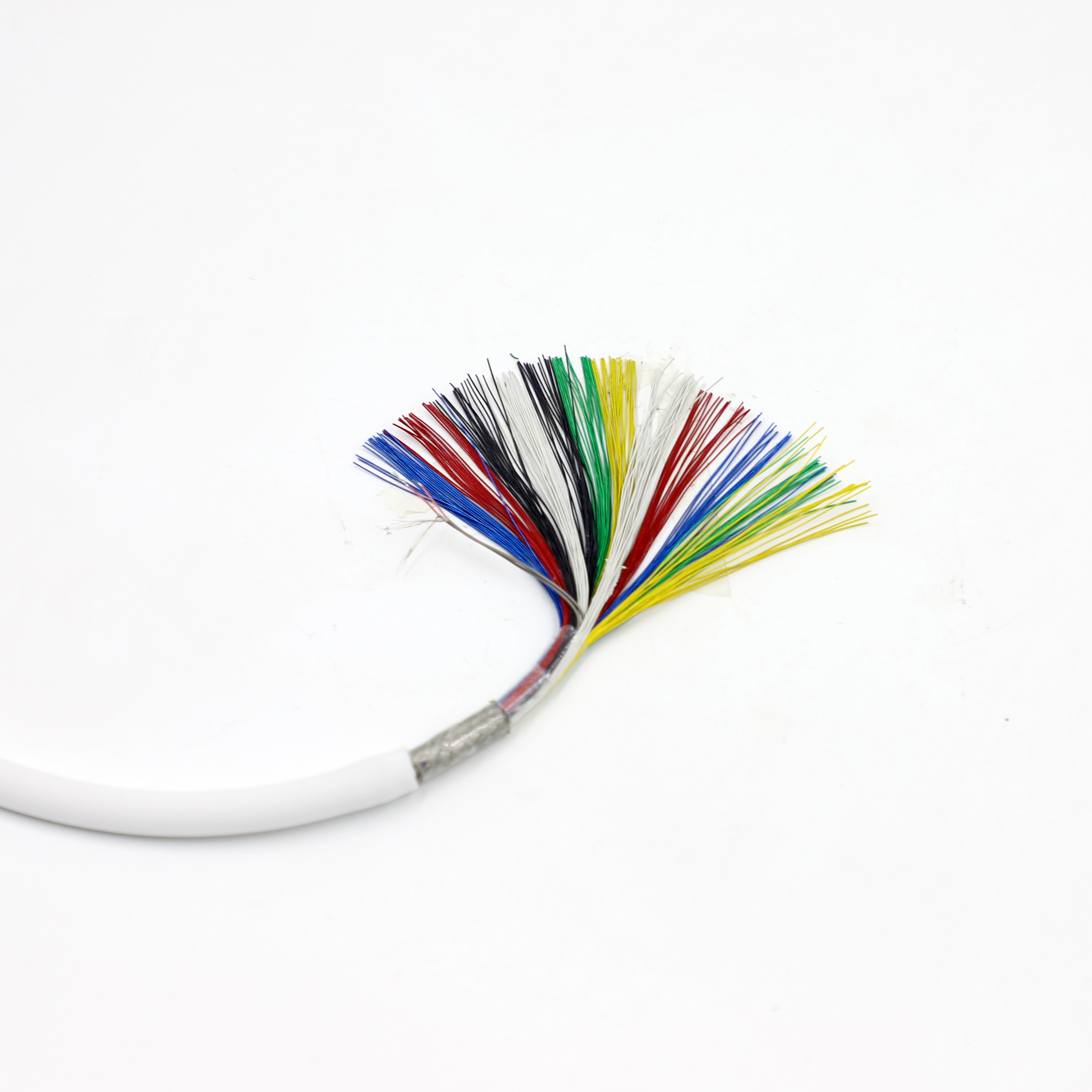
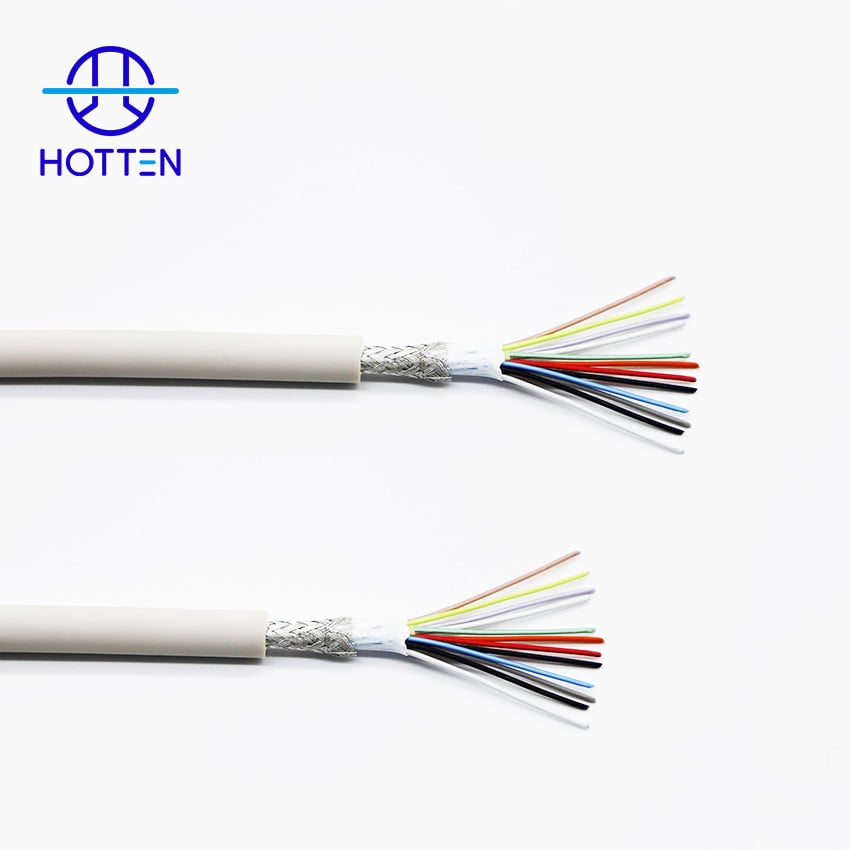
Micro-coaxial cable assemblies are commonly used in medical ultrasound probes because they can combine a high number of individual signal paths within a compact cable structure while supporting the electrical, mechanical, and routing requirements of high-channel-count imaging systems.
If an ultrasound probe requires many signal channels within a limited internal space, micro-coaxial construction can help achieve high routing density while maintaining individually controlled signal paths. The final cable design still needs to be evaluated according to channel count, conductor size, cable OD, impedance, capacitance, attenuation, shielding, flexibility, and connector requirements.
If signal integrity is a primary concern, engineers should evaluate impedance consistency, capacitance, attenuation, shielding, cable geometry, and connector transitions as part of the complete signal path. For related information, see The Importance of Impedance Consistency (50Ω / 75Ω) in Ultra-Fine AWG Micro Coaxial Cables.
If probe flexibility and repeated bending are important, the cable must also be evaluated for bend radius, flex cycles, torsion, shielding stability, and termination reliability. For conductor-size considerations, see How Does AWG Affect Micro Coaxial Cable Performance?.
The appropriate micro-coaxial cable is therefore selected by balancing channel density, signal performance, mechanical flexibility, cable dimensions, and interface requirements, rather than simply choosing the smallest available cable.
For related insulation and dielectric considerations, see How to Select the Right Foaming Technology for Micro Coaxial Cable Insulation?.
For customized ultrasound interconnects, see HOTTEN's Ultrasound Probe Cable solutions.
Covering cable construction, shielding, impedance control, material selection, and reliability validation for high-reliability cable assembly applications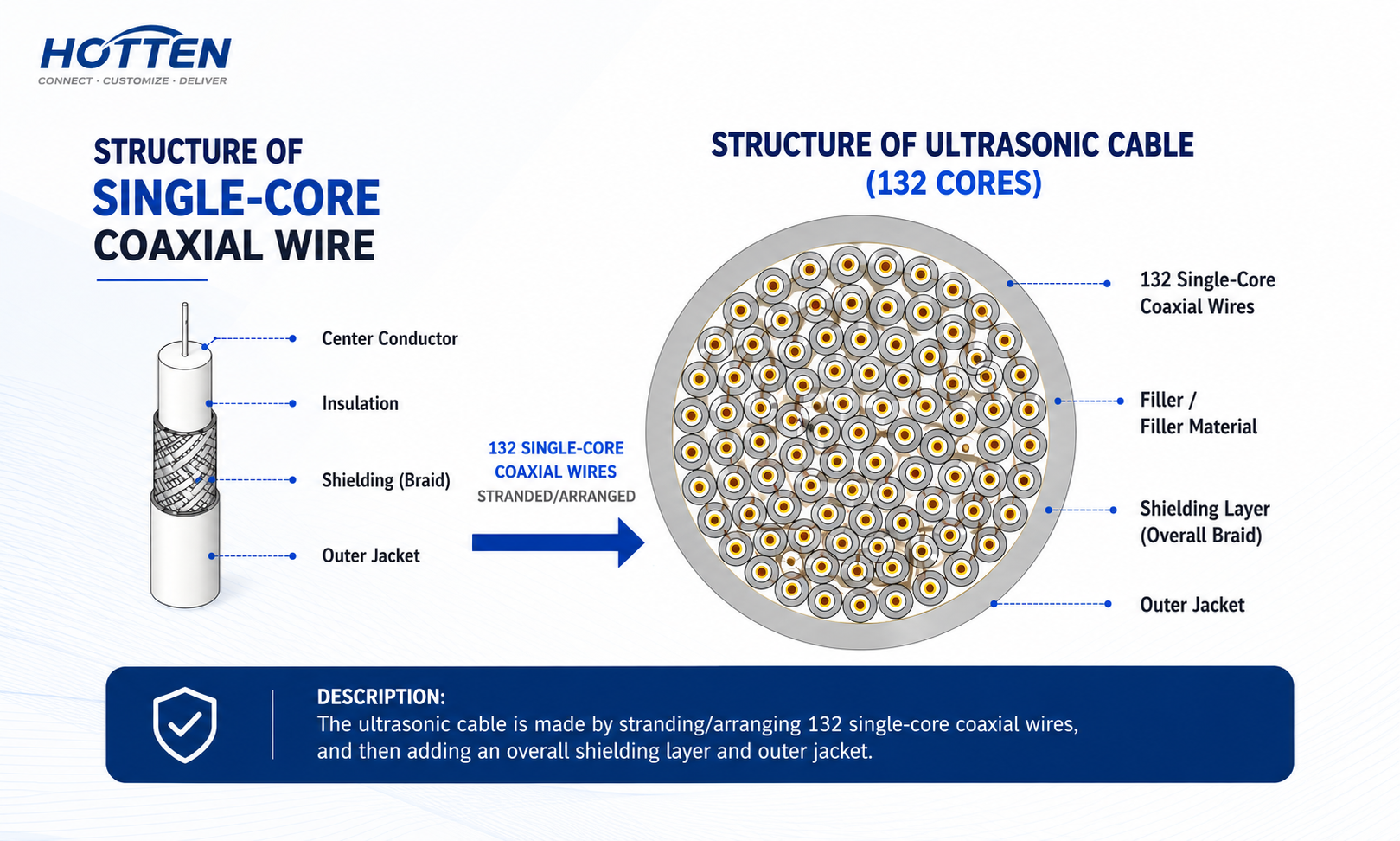
Modern medical ultrasound imaging systems rely heavily on the stable transmission of weak high-frequency acoustic echo signals from the transducer probe to the system's Analog Front End (AFE). To achieve high-resolution 2D and 3D imaging, a typical ultrasound probe cable must accommodate between 64 and 256 independent signal channels.
Micro-coaxial cable technology is the only practical solution capable of integrating these high-density parallel channels into a lightweight, highly flexible cable assembly while maintaining excellent handling characteristics.
The primary engineering challenge in medical ultrasound cable design is balancing electrical performance with mechanical flexibility.
Increasing conductor size reduces insertion loss but compromises ergonomics and flexibility. Conversely, reducing the cable outer diameter (OD) increases signal attenuation and crosstalk. Furthermore, cable assemblies must withstand hundreds of thousands of flex cycles while maintaining strict electrical symmetry across all channels to prevent image artifacts.
To minimize cable diameter, conductors are typically manufactured using 40 AWG to 48 AWG silver-plated or tin-plated high-strength copper alloy wire.
Dielectric material selection is critical because cable capacitance directly affects signal attenuation and imaging consistency. Therefore, low-capacitance cable constructions are essential. By utilizing foamed Perfluoroalkoxy (PFA) insulation, engineers can achieve a dielectric constant (εr) of approximately 1.4 to 1.5.
This enables a typical target capacitance of approximately 50 pF/m, minimizing signal attenuation throughout the medical micro-coaxial cable assembly.
Since the ultrasound Analog Front End (AFE) processes signals at the microvolt level, electromagnetic interference (EMI) shielding is a critical factor affecting imaging noise performance.
Each micro-coaxial cable incorporates a spiral or braided shield with over 90% coverage. The overall cable assembly employs a multilayer shielding structure combining conductive aluminum foil Mylar tape with a high-coverage copper braid.
This design enables impedance-controlled cable assemblies with nominal characteristic impedances of 50 Ω, 75 Ω, and 85 Ω, maintained within a tight tolerance of ±3 Ω. Precise dimensional control during the extrusion process minimizes impedance discontinuities and inter-channel phase mismatch.
Handheld ultrasound probes require highly flexible cable constructions to reduce operator fatigue while enduring continuous bending and twisting during clinical use.
To achieve this, the micro-coaxial elements are helically stranded around a central strength member such as Kevlar® fiber. The outer jacket is extruded from medical-grade PVC (65A) formulated for low friction and excellent biocompatibility.
Reliability is validated through mandatory rolling bend, 180° bend, and 360° torsion testing, ensuring no conductor breakage or shield degradation after more than 100,000 test cycles.
Terminating up to 256 micro-coaxial cables requires high-density miniature interconnect technology.
Micro-coaxial cables are typically processed using automated laser stripping and directly micro-soldered onto fine-pitch PCBs or interposer boards with 0.4 mm to 0.3 mm pitch.
The integrated miniature connector housing must incorporate carefully designed strain relief boots to provide a smooth stiffness transition between the rigid connector and the flexible cable bundle.
Each ultrasound platform features unique Analog Front End (AFE) architecture and transducer geometry, making customized cable assemblies essential.
OEM medical cable manufacturing requires precise tension control throughout the braiding and cabling processes to eliminate internal stress concentration. Dedicated termination fixtures and Automated Optical Inspection (AOI) ensure uniform coplanarity of 40–48 AWG conductors prior to soldering.
Engineering Selection Considerations for Medical Ultrasound Micro-Coaxial Cable Assemblies
Selecting a micro-coaxial cable for an ultrasound probe requires balancing channel density, electrical performance, flexibility, mechanical reliability, and connector integration. No single parameter determines whether a cable is suitable for a particular probe design.
1. Channel Count vs. Cable Size
**If the ultrasound probe requires a high number of independent signal channels within limited internal space,** engineers may evaluate finer conductors and higher-density micro-coaxial configurations.
However, reducing conductor size should not be treated as an isolated optimization. The selected wire size must be evaluated together with cable length, attenuation, resistance, capacitance, cable OD, flexibility, and the available termination process.
For this reason, [How Does AWG Affect Micro Coaxial Cable Performance?] can be used as a reference when evaluating conductor-size trade-offs.
2. Low Capacitance vs. Mechanical Flexibility
**If the probe design is sensitive to capacitance and signal consistency,** the dielectric structure and cable geometry should be evaluated together with the required electrical characteristics.
At the same time, handheld ultrasound probes are subject to repeated bending and twisting. A cable design therefore needs to balance low-capacitance construction with the required flexibility and mechanical life.
Different insulation technologies can provide different electrical and mechanical characteristics. See [Comparison of Three High-Frequency Cable Foaming Technologies] for related insulation considerations.
### 3. Signal Integrity vs. Shielding
**If the application has demanding signal-integrity or low-noise requirements,** engineers should evaluate impedance consistency, attenuation, capacitance uniformity, shielding structure, and termination quality as a complete system.
Shielding is not only a property of the individual micro-coaxial element. The overall cable assembly, connector transition, grounding method, and routing environment can also influence system-level EMI performance.
For additional information about impedance control in ultra-fine micro-coaxial cables, see [The Importance of Impedance Consistency (50Ω / 75Ω) in Ultra-Fine AWG Micro Coaxial Cables]
4. Cable Selection Checklist for OEM Ultrasound Projects
Before finalizing a custom ultrasound cable assembly, the engineering and procurement teams should confirm:
| Requirement | Parameters to Confirm |
|---|---|
| Channel Density | Core count, conductor size, cable arrangement |
| Electrical Performance | Impedance, attenuation, capacitance |
| Cable Dimensions | Cable OD, pitch, available routing space |
| EMI Control | Individual shielding, overall shielding, grounding |
| Mechanical Requirements | Bend radius, flex cycles, torsion, strain relief |
| Interface | Connector type, PCB pitch, pin assignment |
| Manufacturing | Termination method, dimensional tolerance, assembly process |
| Validation | TDR, capacitance uniformity, dielectric withstand, mechanical testing |
### 5. Selecting the Right Cable Architecture
The final cable architecture should be determined by the actual ultrasound probe design.
**If channel density is the main constraint → prioritize compact conductor and cable architecture → then verify signal and mechanical performance.**
**If signal integrity is the main constraint → prioritize impedance, capacitance, attenuation, shielding, and dimensional consistency → then validate the complete transmission path.**
**If operator handling and repeated movement are the main constraints → prioritize flexibility, bend life, torsion resistance, and strain relief → then verify electrical performance after mechanical testing.**
For broader medical applications, see HOTTEN's [Medical Equipment Solutions]
For customized high-density ultrasound cable assemblies, see [Ultrasound Probe Cable](https://www.hottencable.com/ultrasound-probe-cable) and [195 Core 44AWG/36AWG Medical Ultrasound Cable Assembly].
Medical imaging cable assemblies must comply with stringent regulatory requirements.
Manufacturing should operate under an ISO 13485-certified Quality Management System for medical devices.
According to ISO 10993, all patient-contact jacket materials must successfully pass mandatory biocompatibility testing, including:
Electrical verification requires 100% testing for:
High-Density Linear Array Probe
Endocavity Probe (Transvaginal / Transrectal)
Cardiac Phased Array Probe
When specifying micro-coaxial cable solutions, OEM manufacturers should prioritize suppliers capable of providing a fully integrated manufacturing workflow, from ultra-fine wire extrusion to precision micro-soldering.
Selecting a manufacturing partner with proven ISO 13485 certification and expertise in low-capacitance cable design helps ensure long-term signal integrity and reliable clinical performance.
For customized interconnect solutions, engaging suppliers early during the prototype development phase can significantly accelerate system-level validation and product development.
 Hot News
2026-09-17
2026-09-04
2025-12-17
2025-12-11
2025-12-05