 EN
EN
Quick Links

Quality and reliability of information transfer can make or break a production line in industrial automation. As factories grow smarter and more connected, the demand for robust, sophisticated sensor systems is skyrocketing. At the heart of these systems sit micro coaxial cables—often overlooked, frequently underestimated. Yet Hotten Electronic Wire’s development of ultra-fine coaxial solutions for the most demanding applications has quietly shown why this cable technology has become the undisputed standard for industrial sensors today.
| Cable Type | Advantages | Limitations | Typical Applications |
|---|---|---|---|
| Micro Coaxial Cable | Small diameter, excellent signal integrity, strong EMI protection, suitable for high-frequency transmission | Higher manufacturing complexity compared with standard cables | Machine vision systems, precision sensors, robotics |
| Twisted Pair Cable | Cost-effective and widely available | More sensitive to electromagnetic interference in high-noise environments | General industrial communication |
| Standard Coaxial Cable | Good shielding performance and stable transmission | Larger diameter and less suitable for compact devices | RF systems, industrial equipment |
| Shielded Multi-Core Cable | Supports multiple signals and power transmission | Larger size and reduced flexibility | Industrial control systems |
Fundamental Considerations: Signal Integrity in Unfriendly Situations
Industrial environments don’t play nice—physically or electrically. Machinery churns out heavy electromagnetic interference (EMI), temperatures swing unpredictably, and cables are constantly flexed, vibrated, and exposed to oils or chemicals. Conventional wiring often struggles here, leading to corrupted data, lost signals, and costly downtime. Pressure, position, temperature, or vision sensors must transmit their readings without compromise. That’s exactly where micro coaxial cables step in—and prove their worth.
Key advantages driving their adoption in automation:
Unshaken Signal Performance Under EMI Attack
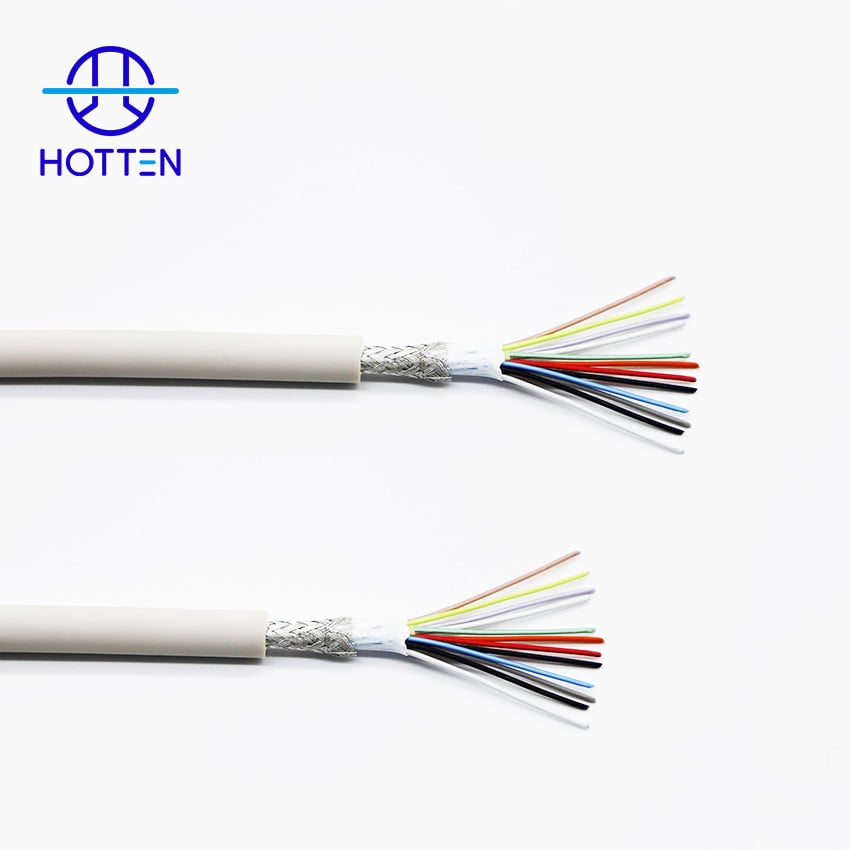
Electromagnetic compatibility isn’t just a feature—it’s the lifeline. A micro coaxial cable is built like a precision transmission line: a central conductor wrapped in dielectric insulation and shielded by multiple layers (typically foil plus braid). This structure acts as a Faraday cage, shielding sensitive sensor signals from external EMI generated by motors, drives, and wireless systems—while also preventing the signal itself from leaking out and interfering with other equipment. The result? A millivolt signal from a strain gauge or a high-frequency stream from a vision camera reaches the controller clean, intact, and uncorrupted.
High-Speed, Data-Intensive Sensing Needs High Bandwidth
Modern automation runs on high-resolution industrial cameras (often using LVDS or similar interfaces), LiDAR, and precision radar—all generating massive amounts of data that must move in real time. Micro coaxial cables excel at high frequencies with low attenuation (minimal signal loss), making them ideal for carrying both high-speed digital and analog signals across machines or cells without weakening. This capability is essential for real-time process control and instant quality verification.
Mechanical Toughness Built to Last
Industrial cables aren’t just installed and forgotten—they’re put through a lifetime of abuse. Hotten’s micro coaxial cables are engineered for high flex life, crush resistance, and vibration tolerance. They use fine-stranded conductors and special jacketing materials (oil- and chemical-resistant, as seen in our Robotics Wire Harnesses) to endure the constant motion of robotic arms, the repetitive thrust of linear actuators, and the general wear and tear of the factory floor. This durability keeps electrical performance stable over millions of cycles—eliminating those frustrating intermittent faults.
Miniaturization Meets Real-World Design Needs
As sensors and connectors shrink, designers must squeeze everything into tighter spaces inside smaller machines and robots. Cabling has to shrink too—without sacrificing performance. Micro coaxial technology delivers just that: an extremely small outer diameter paired with excellent signal integrity. In today’s crowded control panels packed with miniaturized sensors, this compact size isn’t optional—it’s essential to keeping signals strong and clear.
Hotten Electronic Wire: Reliability in the Automated World
Founded in 2018 on deep research into ultra-fine coaxial technology, Hotten Electronic Wire was built to meet the toughest challenges of industrial automation. Our annual production capacity exceeds 144 million meters of cable—a testament to our commitment. Our industrial solutions carry forward the same quality and precision standards that define our medical and consumer electronics lines.
Our product portfolio directly supports this industry:
Robotics Wire Harnesses: Designed for continuous, multi-axis flexing.
LVDS Wire Harnesses: Deliver transparent, noise-free signal paths for high-speed machine vision.
Gimbal Camera & Drone Wire Harnesses: Refined in mobile applications, now deployed in stability-critical robots like AGVs and inspection units.
RF Cables: Connect sensor systems to wireless networks or RFID setups reliably.
A: Micro coaxial cables are used in industrial automation sensors because they provide high-speed signal transmission, excellent EMI protection and compact dimensions required for precision equipment.
A: Micro coaxial cables support high-frequency data transmission with low signal loss, making them suitable for machine vision cameras, inspection systems and imaging devices.
A: The shielding structure of micro coaxial cables helps block external electromagnetic noise generated by motors, drives and industrial equipment, maintaining stable signal quality.
A: Yes. Their small diameter, flexibility and reliable signal performance make micro coaxial cables suitable for robotic joints, automated inspection equipment and moving cable assemblies.
A: Engineers should consider signal frequency, impedance requirements, shielding performance, bending cycles, operating environment and connector compatibility.
A: Yes. Micro coaxial cable assemblies can be customized with different cable structures, lengths, connectors, shielding designs and mechanical requirements to meet specific automation applications.
In conclusion, the rise of micro coaxial cables in industrial automation isn’t a passing trend—it’s a technical necessity. They offer a rare triple promise: immunity to electrical noise, high-speed data handling, and rugged physical endurance. By ensuring sensor data flows with flawless integrity, these cables form the reliable nervous system of smart factories. At Hotten Electronic Wire, we remain committed to delivering durable, high-performance cable assemblies that keep automation running—not just smoothly, but intelligently—as Industry 4.0 reshapes the future.
 Hot News
2026-09-17
2026-09-04
2025-12-17
2025-12-11
2025-12-05