 EN
EN
Quick Links

Growing adoption of minimally invasive medical procedures continues to drive demand for ever thinner, flexible and higher-performing cables. A key industry challenge is developing micro-sized cables that transmit HD video, control signals and therapeutic power—an issue perfectly resolved by micro-coaxial technology. Hotten provides solutions to this demand, designing over 300 new cable specifications per annum, and using a 10,000m facility with precision equipment, to produce the optimum micro-coaxial cables, for use in the next generation endoscope and its medical interconnect equivalent.
The core merit of micro-coaxial cables is their capacity to shrink the overall outer diameter of endoscope catheters. Conventional multi-wire signal bundles consume substantial internal space, especially when integrating multiple signal channels including video, illumination, motion control and sensor feedback. These bulky assemblies cannot fit within the ultra-narrow lumens required for modern minimally invasive diagnostic devices.
By minimizing the outside diameter to the range from 0.3mm to 0.6mm, micro-coaxial cable will allow more signal channels to be packed into the same space. Endoscope cable assemblies requiring multiple micro coaxial lines can accommodate well over a dozen channels within a bundle diameter of only 2-3mm, which allows the scopes to access harder to reach areas of the body more easily. This drastically reduces patient tissue trauma and shortens postoperative recovery time. At Hotten, we specialize in developing these compromises—maximizing channel density while minimizing outer diameter while maintaining excellent performance.
New endoscopes are being equipped with high definition cameras producing 1080p and even 4K video to be displayed on surgical monitors. High-definition video is easily susceptible to noise, attenuation and impedance mismatches. Any losses will affect image quality and obscure critical anatomical structures.
The coaxial construction also gives inbuilt protection to the video signal with central conductor carrying the video signal and surrounded by a shield encompassing a dielectric which acts as an electrical insulator against external electrical disturbances. Impedance matching (50Ω or 75Ω normally) between cables maintains a high signal transfer and every Hotten cable solution is designed so as to lose minimum signal through the length of cable. This is necessary for procedures like ICE and IVUS which are reliant upon good quality real-time video imagery in order to assist with life-saving procedures.
Miniaturized scopes need to be maneuverable through tortuous and curved pathways through the body—through the bronchial tubes, the gastrointestinal tract, through the vascular system, etc. Flexible cables minimize stress on the body cavity, minimize patient discomfort during endoscopic navigation, and provide less manipulation hassle for the physician.
The thin conductors and insulation within micro-coaxial cable contribute to superior flexibility. A cable harness made of numerous micro-coaxial cables can bend and twist to follow the articulation of the endoscope without resistance. This can include numerous cable arrangements—such as round or flat bundled cable configurations. ICE and endoscope cables, among others, exploit this characteristic to provide smooth maneuvering and improved control.
Modern endoscopes have become extremely complex instruments, requiring the capability for many additional features. This includes illuminated fiber optic channels (or illumination wire leads), irrigation/suction tubes, and steering wires, even potentially controlling RF electrodes, or tracking precise location of the scope tip. When assembling these necessary components, it is vital that the cables do not take up excessive space, allowing the medical device company to use its available space as effectively as possible.
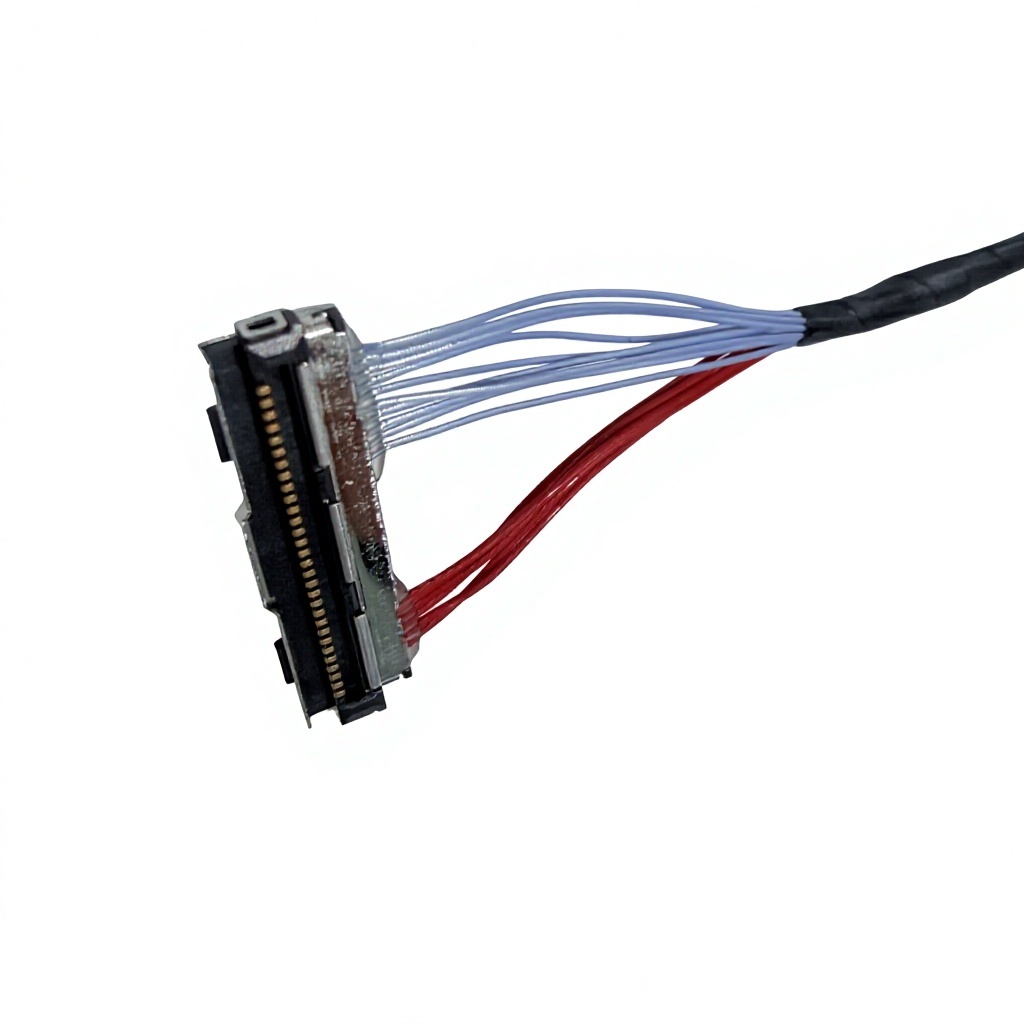
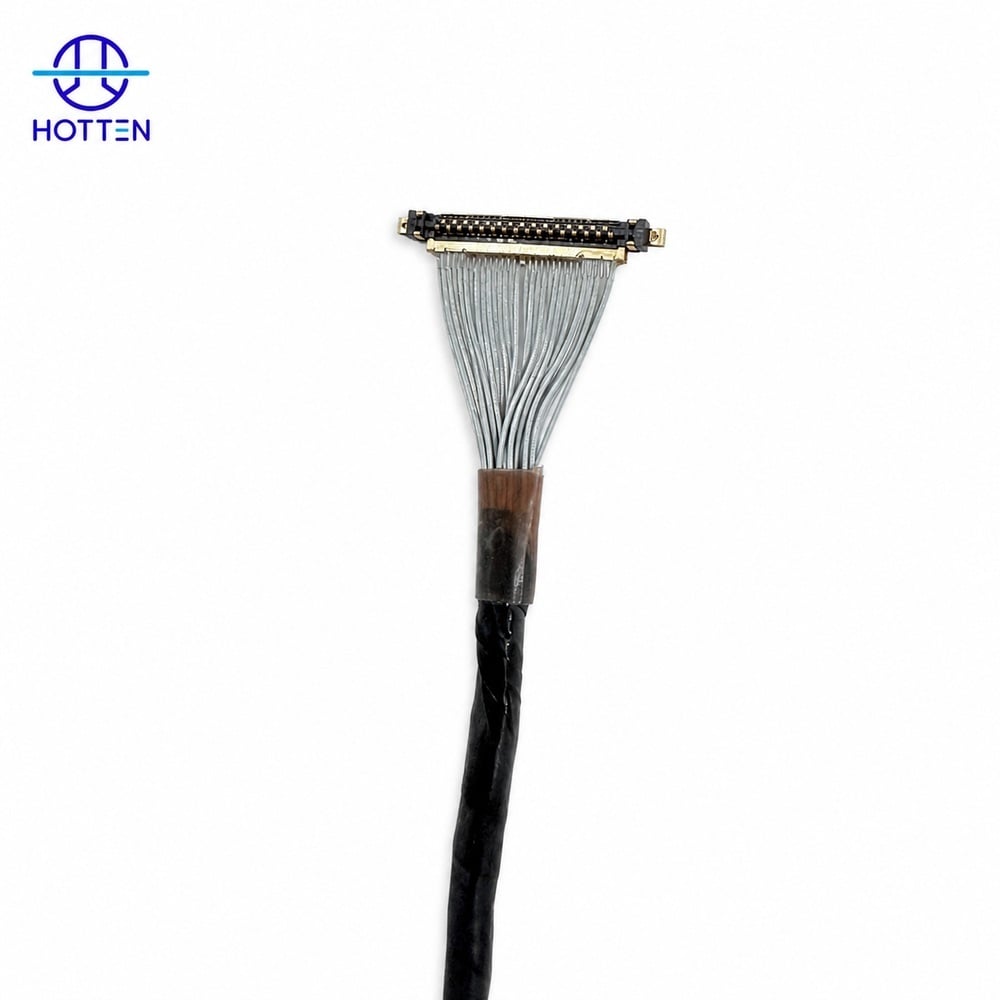
High-density micro-coaxial cables can be bundled with any necessary components to create a hybrid cable harnessing solution containing control wires, sensors, power lines, and other connections — all within the same bundle and with only a slight increase in diameter compared to a single micro-coaxial cable. Hotten's R&D department is capable of creating innovative solutions for complex endoscope cables that meet the many specifications needed for the next wave of diagnostic and therapeutic instruments. For example, a single cable may consist of ten or more individual micro-coaxial cables, along with control wires and power delivery wires, all tightly bundled.
Performing endoscope procedures typically requires physician manipulation and holding of the instrument for long periods. The heavier a cable is, the more fatigue it causes in the hand and arm. Micro-coaxial cables weigh substantially less than bundled shielded wires, thereby alleviating hand and arm fatigue for surgeons during prolonged procedures. Hotten’s design process prioritizes comfort while achieving high performance electrical connections.
Cable length, diameter, flexibility and the number of channels will be determined by the intended use for an endoscope. Examples include the bronchoscope, colonoscope, ureteroscope, arthroscope and many more. Using micro-coaxial cable provides you with almost any desired outcome, with a large number of channels and tailored to precise specifications, with defined length and diameters required, with high functionality.
Micro-coaxial cable is enabling the development of the new generation of micro endoscopes. This is leading to endoscopes that are smaller, easier to maneuver and more technically advanced than ever before. Maintain HD image signals, achieve fantastic anatomical flexibility, accommodate diverse functionality needed for endoscopes etc. The experienced Hotten engineers use their comprehensive knowledge of the medical industry and highly efficient, accurate manufacturing processes to develop leading micro-coaxial cable assemblies that are at the forefront of minimally invasive medicine.
What is a micro coaxial cable?
A micro coaxial cable is an ultra-miniature coaxial cable designed for high-frequency signal transmission in space-constrained medical and industrial applications.
Why are micro coaxial cables used in endoscopes?
Micro coaxial cables provide excellent signal integrity, flexibility and electromagnetic shielding while maintaining an extremely small diameter, making them ideal for modern medical endoscopes.
Can micro coaxial cables support 4K medical imaging?
Yes. Properly designed micro coaxial cables can support the high-bandwidth video signals required for HD and 4K medical imaging systems.
What is the smallest micro coaxial cable diameter?
Depending on the design and application requirements, micro coaxial cables can be manufactured with diameters as small as 0.3 mm.
 Hot News
2026-09-17
2026-09-04
2025-12-17
2025-12-11
2025-12-05