 EN
EN
Quick Links

Home > News > Company news
Within the precision structures of drones and handheld gimbals, engineers face a fundamental physical paradox: data bandwidth is growing exponentially—from 4K at 60fps to raw 8K video—while available routing space continues to shrink at the millimeter level.
When traditional FPC (Flexible Printed Circuits) approach their physical limits under high-frequency loss, and conventional multi-core cables introduce excessive torque that compromises gimbal responsiveness, micro coaxial cables are no longer an optional solution. They have become the critical backbone for maintaining stable, loss-free signal transmission in highly dynamic environments.
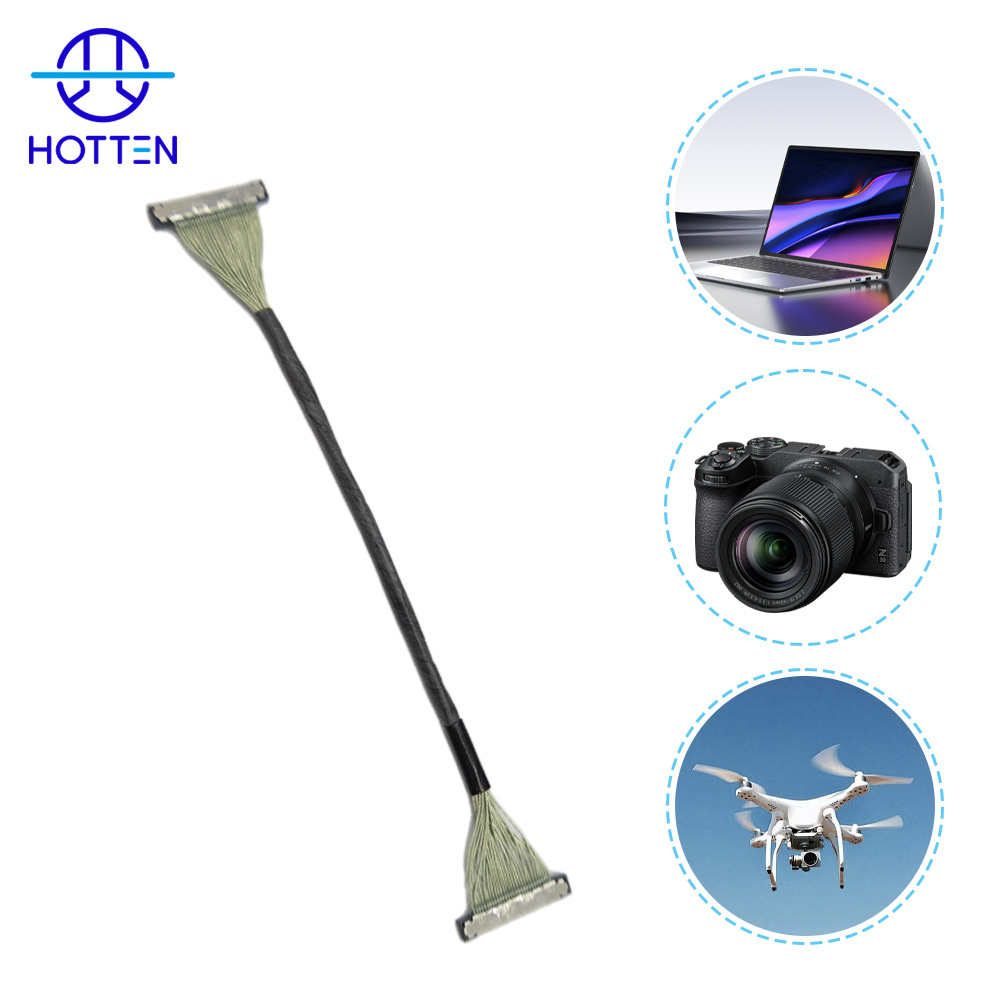
High-flex micro-coaxial cables are considered for dynamic drone gimbal systems because the cable must satisfy two demanding requirements at the same time: reliable high-speed signal transmission and repeated multi-axis mechanical movement within limited space.
If the cable moves continuously with a gimbal → evaluate flex life, bend radius, cable stiffness, shielding stability, and strain relief together with signal performance → then validate the complete assembly under the expected movement conditions.
If the cable carries high-speed camera or imaging signals → evaluate impedance, attenuation, shielding, cable geometry, cable length, and connector transitions together → then verify signal integrity across the complete transmission path. For related high-frequency design considerations, see Why Ultra-Fine High-Frequency Coaxial Cable Design Is So Difficult.
If the available routing space is extremely limited → evaluate conductor size, insulation, shielding, cable OD, and connector dimensions together → because reducing one dimension alone does not determine the size or flexibility of the finished assembly. See How Does AWG Affect Micro Coaxial Cable Performance?.
Individual shielding can be useful for compact high-speed signal routing, but shielding structure also influences cable diameter, stiffness, and mechanical behavior. For related impedance and dimensional considerations, see The Importance of Impedance Consistency in Ultra-Fine AWG Micro Coaxial Cables.
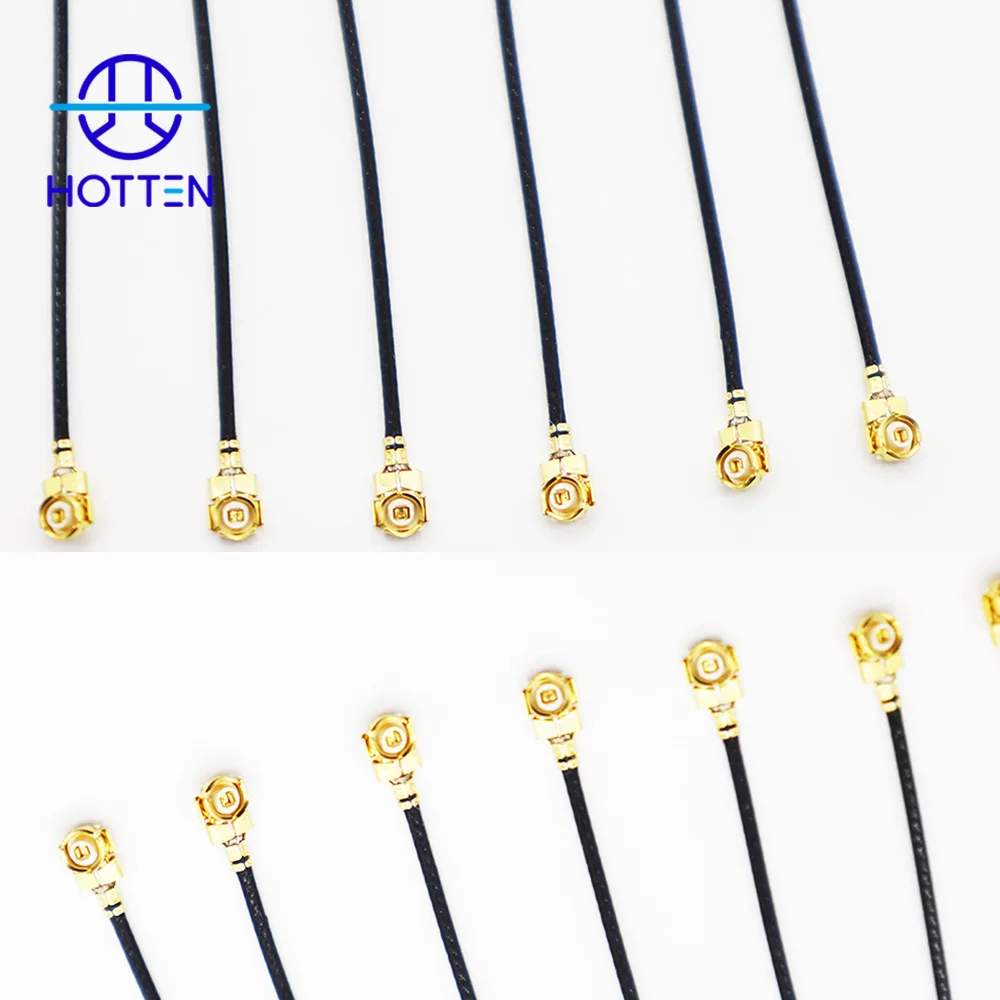
For customized camera interconnects, see HOTTEN's Gimbal Camera Wire Harness and Micro Coaxial Cable Assembly solutions.
For broader UAV applications, see HOTTEN's UAV & Robotics solutions.
Signal Integrity: A Structural Advantage in Shielding
The internal environment of a drone is electromagnetically complex. High-frequency noise from motors and RF emissions from transmission modules constantly threaten the integrity of differential signals from imaging sensors.
Physical Shielding Advantage
Unlike unshielded twisted pairs or flat cable structures, each channel in a micro coaxial cable is individually shielded. This provides ultra-fine conductors—typically ranging from 40AWG to 48AWG—with a nearly enclosed electromagnetic environment, significantly reducing interference. As a result, return loss can be tightly controlled at very low levels.
Impedance Consistency
At data rates exceeding 12Gbps, micro coaxial cables rely on precision dielectric extrusion processes (such as PFA insulation) to maintain highly stable characteristic impedance. This level of control is essential for preserving signal integrity and signal-to-noise ratio in high-resolution video transmission, including 8K imaging.
Dynamic Fatigue: The "Nervous System" Under Continuous Motion
Unlike static electronic systems, gimbal cameras operate under constant dynamic conditions, with cables subjected to repetitive small-radius bending across multiple axes.
Low Torque Requirement
Gimbal motors operate with limited output torque. Any increase in cable stiffness introduces mechanical resistance, which can directly result in control instability or visible jitter during operation.
Bending Life Optimization
Through process control and structural optimization, Hotten enables micro coaxial cables to withstand hundreds of thousands of bending cycles at radii as small as R = 2 mm, without significant signal degradation over time.
Key Drivers of Demand: From Single Cameras to Sensor Networks
The rapid increase in demand for micro coaxial cables is driven by fundamental changes in system architecture:
1. Multi-Sensor Integration
Modern drones integrate not only primary cameras but also obstacle avoidance systems, infrared sensors, and stereo vision modules. Each sensor node requires its own high-speed data link.
2. Bandwidth Evolution
The transition from HDMI 1.4 to MIPI D-PHY / C-PHY significantly increases frequency requirements—from the GHz range to beyond 10 GHz—placing greater demands on transmission media.
3. Real-Time Synchronization
Low-latency image transmission requires tight control over signal delay. Micro coaxial cables demonstrate superior group delay performance at high frequencies compared to conventional wiring solutions.
Manufacturing Challenges: Beyond Miniaturization
The engineering difficulty of ultra-fine coaxial cables lies not only in their size, but in maintaining tight manufacturing tolerances.
Outer Diameter Limits
Mass production of cables as fine as 46AWG demands extremely precise tension control during extrusion, as well as high-precision tooling.
Assembly Complexity
The reliability of soldering micro coaxial cables to PCB interfaces with ultra-fine pitch (0.3 mm / 0.25 mm) directly affects long-term product performance and yield stability.
A dynamic gimbal cable should be selected according to the actual movement profile, signal requirements, routing space, shielding needs, connector configuration, and production requirements. The objective is not simply to find the softest or smallest cable, but to balance mechanical movement with reliable signal transmission.
If the cable moves continuously across multiple axes → define the bend radius, movement range, flex frequency, torsion, and expected service cycles first → then select the cable structure and strain-relief design.
A cable that performs well in a fixed camera module may behave differently when routed through a continuously rotating gimbal. The cable should therefore be evaluated under the actual movement conditions of the final product.
For an example of ultra-fine cable flexibility optimization, see How We Optimized 46AWG Micro Coaxial Cable for Superior Flexibility.
If the cable carries 4K, 8K, MIPI, or other high-speed imaging signals → define the signal interface, operating frequency or data-rate requirements, impedance, attenuation, cable length, and shielding requirements → then determine the appropriate cable architecture.
The cable should not be selected only by AWG or nominal diameter. Connector transitions, cable geometry, dielectric structure, and shielding can all influence the complete signal path.
For related high-frequency cable design considerations, see The Importance of Impedance Consistency in Ultra-Fine AWG Micro Coaxial Cables.
For high-density camera applications, see HOTTEN's Micro Coaxial Cable Assembly for Camera Systems.
If EMI protection is important → evaluate shielding material, wire diameter, coverage, and structure together with cable stiffness and OD → then validate both shielding and flex performance.
A heavier or denser shielding structure may provide additional protection but can also increase stiffness and routing resistance. The shielding design should therefore match the actual electromagnetic environment and mechanical movement requirements.
For compact customized camera connections, see HOTTEN's Gimbal Camera Wire Harness.
If the gimbal contains very limited internal routing space → evaluate cable OD and connector dimensions together → then optimize conductor, dielectric, shielding, and termination around the available mechanical envelope.
Reducing the cable diameter alone may not solve an integration problem if the connector, termination, or strain-relief structure occupies more space than the cable itself.
For customized high-density connections, see Micro Coaxial Cable Assembly.
If a cable meets the required signal target but becomes too stiff during movement → review shielding, jacket, insulation, and structural parameters before changing the conductor → then revalidate signal performance after the mechanical optimization.
If a cable is sufficiently flexible but signal performance changes after repeated movement → review conductor geometry, dielectric structure, shielding stability, and termination → then perform combined electrical and mechanical validation.
This is why a dynamic gimbal cable should be validated as a complete assembly rather than by measuring electrical performance only before mechanical testing.
For broader ultra-fine cable design challenges, see Why Ultra-Fine High-Frequency Coaxial Cable Design Is So Difficult.
Different gimbal systems can create different cable priorities.
If the camera module has multiple high-speed signal channels → prioritize high-density routing, shielding, impedance, connector pitch, and compact cable OD → then validate the complete signal path.
If the gimbal performs continuous rotation or multi-axis movement → prioritize flex life, bend radius, low mechanical resistance, strain relief, and cable routing → then verify electrical performance after dynamic testing.
If the gimbal operates close to motors or RF modules → prioritize shielding, impedance consistency, grounding, and connector transitions → then validate the complete transmission path.
If the camera is part of an AI-enabled imaging system → prioritize high-speed data transmission, compact routing, connector integration, and overall assembly reliability → then select the appropriate cable architecture according to the device design.
For AI-related applications, see HOTTEN's AI & Smart Electronics solutions.
Before requesting a prototype or quotation, an OEM engineering or procurement team should define:
| Requirement | Parameters to Confirm |
|---|---|
| Application | Gimbal camera, UAV camera, robotic imaging |
| Signal | Video/data interface, frequency or data rate |
| Electrical | Impedance, attenuation, capacitance |
| Conductor | AWG, material, core count |
| Dimensions | Maximum OD, routing space, finished length |
| Mechanical | Bend radius, flex cycles, torsion, movement range |
| Shielding | Individual shielding, overall shielding, grounding |
| Connector | Manufacturer, part number, pitch, pinout |
| Termination | PCB, sensor, connector, soldering method |
| Environment | Temperature, vibration, moisture |
| Validation | Electrical, mechanical, dimensional testing |
| Production | Prototype quantity, annual volume |
Providing the gimbal drawings, cable routing path, connector part number, pinout, cable length, expected movement, and signal requirements can help the supplier evaluate the complete assembly before prototype production.
The development process can be summarized as:
Gimbal architecture → movement profile → signal requirements → routing space → cable OD → conductor / dielectric → shielding → connector → strain relief → prototype → mechanical validation → electrical validation → production
If dynamic movement is the main constraint → optimize flex life and mechanical resistance → then verify signal integrity after mechanical testing.
If high-speed signal integrity is the main constraint → optimize impedance, attenuation, shielding, cable geometry, and connector transitions → then validate the complete transmission path.
If space and weight are the main constraints → optimize the complete cable assembly rather than conductor size alone → then verify mechanical and electrical performance.
If several constraints are equally important → use the actual gimbal architecture to define the cable requirements → then develop the cable and termination as one integrated assembly.
For customized UAV and gimbal cable development, see Gimbal Camera Wire Harness and HOTTEN's UAV & Robotics solutions.
Conclusion: An Irreplaceable Foundation for High-Speed Imaging Systems
From consumer-grade drones to industrial inspection and mapping platforms, the performance ceiling of imaging systems is increasingly defined not only by sensors, but by the interconnects that link them.
Micro coaxial cables—thin as a strand of hair yet engineered for both flexibility and high-frequency performance—serve as the foundational layer enabling stable, high-bandwidth signal transmission in dynamic environments.
Hotten continues to advance this field by integrating material science with precision manufacturing, delivering optimized solutions that balance mechanical durability and signal integrity for next-generation imaging systems.
| OEM Requirement | Cable Assembly Consideration | Typical Engineering Focus |
|---|---|---|
| Miniaturization | Cable diameter and connector size | Space-constrained medical instruments |
| High-Frequency Signals | Impedance and shielding | Signal integrity and low interference |
| Repeated Flexing | Conductor and jacket construction | Flex life and bend radius |
| Sterilization | Material and jacket selection | Autoclave, EtO or other processes |
| Regulatory Requirements | Material documentation and traceability | Medical device qualification |
| Production Scaling | Assembly process and inspection | Prototype to volume production |
1. What is an OEM micro coax cable assembly?
An OEM micro coax cable assembly is a customized cable solution designed to meet the electrical, mechanical, dimensional and application-specific requirements of a medical device manufacturer.
2. Why do medical device manufacturers need custom micro coaxial cable assemblies?
Medical devices often require extremely small cable diameters, controlled impedance, high flexibility, reliable shielding and compatibility with specific sterilization processes. Standard cable assemblies may not meet all of these requirements simultaneously.
3. Can micro coax cable assemblies be customized for different medical devices?
Yes. Customization can include conductor size, dielectric material, impedance, shielding structure, cable diameter, jacket material, connector configuration, cable length and termination method.
4. Can medical micro coax cable assemblies withstand sterilization?
They can be engineered for specific sterilization requirements, including autoclave, EtO, gamma and other processes, depending on the selected materials and construction.
5. What information should an OEM provide when requesting a custom medical cable assembly?
Important information includes signal frequency and bandwidth, impedance, required cable diameter, bending requirements, flex life, sterilization method, connector requirements, operating environment and expected production volume.
6. Can HOTTEN support both prototypes and mass production?
Yes. HOTTEN supports the development process from engineering samples and pilot production through higher-volume manufacturing, allowing cable designs to transition from development to production.
 Hot News
2026-09-17
2026-09-04
2025-12-17
2025-12-11
2025-12-05