 EN
EN
Quick Links

Home > News > Company news
In the highly specialized field of Medical Microwave Ablation (MWA), ablation efficiency depends directly on the precision of energy delivery. As clinical systems continue moving toward higher operating frequencies — typically 2.45 GHz or 915 MHz — and increasingly compact transmission architectures, internal RF interconnect technologies face unprecedented engineering challenges.
For OEM engineers designing microwave generators and ablation catheter handle interfaces, transmission line selection is not merely a component choice; it is a core determinant of system performance.
The defining feature of a semi-rigid coaxial cable is its solid metal outer conductor, typically manufactured from seamless copper tubing. This structure provides 100% shielding effectiveness while maintaining permanent mechanical formability.
Within medical MWA systems, semi-rigid cables function as the critical RF bridge between the power generation module and the distal ablation antenna.
Inside surgical handles and multi-channel generator platforms where space is severely constrained, sub-miniature cable diameters enable high-density routing without compromising microwave performance.
In microwave ablation systems, the efficiency of power transmission from the RF generator to targeted tissue depends heavily on impedance continuity across the entire signal path. Any deviation from the standard 50-ohm impedance causes reflected power, quantified as Voltage Standing Wave Ratio (VSWR).
Traditional braided flexible coaxial cables inevitably experience mechanical deformation during internal routing bends or dynamic handle movement. These stresses disrupt the concentricity between the center conductor and outer shield, creating localized impedance discontinuities.
Under high-power microwave transmission conditions — typically 50W to 150W at 2.45 GHz — these discontinuities generate severe RF reflections, dramatically increasing VSWR. Reflected energy converts into heat and can easily damage expensive solid-state power amplifiers (SSPA) or magnetrons.
By contrast, semi-rigid coaxial cables utilize seamless copper tubing as the outer conductor, preserving constant concentricity. This mechanically unified structure provides exceptional permanent-set stability:
Even after precision forming into complex 3D geometries required for compact medical power platforms, the internal conductor geometry ratio (D/d) remains mechanically locked without displacement.
At 2.45 GHz, pre-formed semi-rigid cable assemblies can maintain overall system VSWR below 1.10:1 — and often below 1.05:1 — with return loss exceeding -26 dB.
Ultra-low reflection not only ensures accurate generator power delivery, but also fundamentally eliminates localized hot spots caused by impedance distortion at cable interfaces. This significantly improves both overall system reliability and surgical safety.
Microwave ablation is fundamentally a thermal process. Due to dielectric and conductor losses, high-power RF transmission inherently generates heat within the cable structure.
High-performance semi-rigid cables use PTFE (Polytetrafluoroethylene) as the dielectric material. PTFE is widely preferred in medical engineering because of its outstanding properties:
Minimizes RF energy conversion into unwanted internal heat.
Capable of withstanding temperatures of 200°C or higher, which is essential during extended ablation cycles where internal device temperatures rise significantly.
Critical for assemblies that may undergo sterilization or disinfection procedures.
Unlike low-cost PVC or PE insulated cables, PTFE does not soften or exhibit cold flow under thermal stress. If the dielectric softens, the center conductor may shift toward the shield, potentially causing catastrophic short circuits or severe phase instability.
At GHz-level frequencies, skin effect causes RF current to travel primarily along the conductor surface.
Semi-rigid coaxial cables typically use silver-plated copper-clad steel conductors. Since silver possesses the highest electrical conductivity of any metal, silver plating provides several key advantages:
Minimizes conductor surface losses during high-frequency transmission.
Prevents oxidation during medical device manufacturing and ensures long-term reliability at RF connector solder joints.
Modern medical environments are densely populated with highly sensitive electronic systems, including ECG monitors, anesthesia machines, and imaging equipment. Microwave leakage is therefore not only an efficiency concern, but also a patient safety issue.
Conventional flexible coaxial cables rely on braided shielding structures that inevitably contain microscopic openings through which microwave energy can escape.
Semi-rigid cables, however, feature a solid tubular outer conductor that delivers true 100% shielding effectiveness. This level of electromagnetic isolation ensures that high-power microwave energy remains fully contained within the assembly, preventing interference with nearby sensors and control electronics.
When integrating RF cable assemblies into next-generation microwave ablation platforms, engineers must address several important mechanical constraints.
Although semi-rigid cables are formable, excessive bending can fracture the outer conductor or compress the dielectric.
For example, SR-043 cable typically requires a minimum bend radius of approximately 3.2 mm. Precision forming tools are essential to prevent tubing cracks that would compromise shielding integrity.
In many systems, semi-rigid cables are used inside the generator enclosure for maximum stability, then transition into biocompatible flexible cables for external routing.
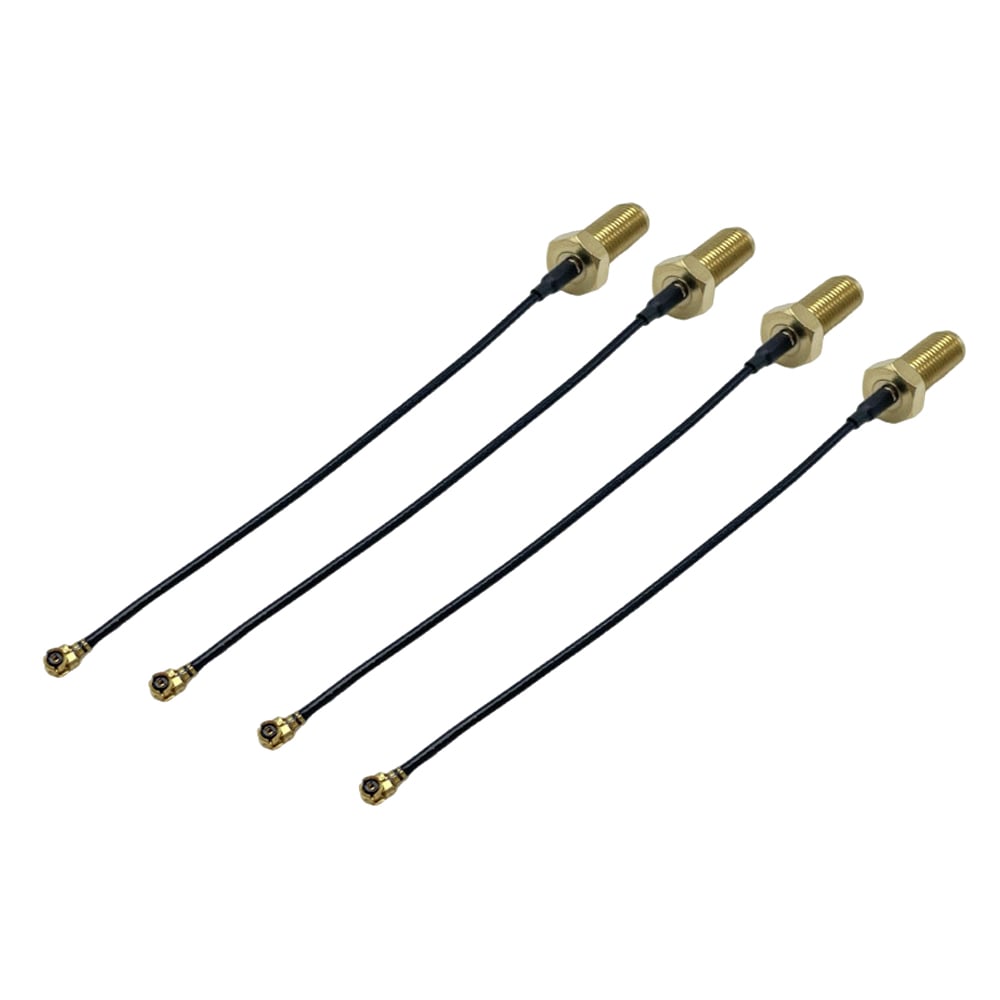
Ensuring proper impedance matching at transition points — typically through precision SMA or N-type connectors — is critical to preventing energy hot spots at the interface.
Microwave interconnect selection is not a secondary engineering consideration. It is foundational to both the safety and effectiveness of modern ablation systems.
Semi-rigid coaxial cables provide the mechanical rigidity, thermal resilience, impedance stability, and electromagnetic isolation required by advanced high-frequency medical applications.
For OEM medical device designers, adopting silver-plated, PTFE-insulated semi-rigid architectures can significantly reduce the risk of generator thermal damage while ensuring that the clinical energy delivered to patients precisely matches physician intent.
As the industry continues advancing toward robotic-assisted microwave delivery systems and increasingly compact SWaP-oriented designs, demand for precision-formed high-frequency transmission assemblies will only continue to grow.
As a specialized manufacturer of high-precision cable assemblies, Hotten provides OEM medical device companies with both customized manufacturing and engineering-level RF interconnect solutions.
If your engineering team is addressing SWaP (Size, Weight, and Power) challenges in microwave ablation platforms or robotic surgical systems, Hotten can provide tailored RF cable assembly solutions and prototype support designed specifically for demanding medical environments.
Semi-rigid coaxial cables are used in microwave ablation systems because they provide stable impedance control, excellent shielding performance and low transmission loss at high frequencies. Their rigid metal outer conductor helps maintain signal integrity during high-power RF energy transmission.
Semi-rigid coaxial cables use a solid metal outer conductor to provide better mechanical stability, shielding effectiveness and phase consistency. Flexible coaxial cables offer better bending capability but may experience more impedance variation under repeated mechanical stress.
Medical microwave ablation systems commonly operate at frequencies such as 915 MHz and 2.45 GHz. Cable assemblies must maintain low insertion loss and stable impedance characteristics within these high-frequency ranges.
PTFE is widely used because it provides excellent dielectric stability, low signal loss, high temperature resistance and chemical resistance, making it suitable for demanding medical RF applications.
Yes. OEM medical device manufacturers can customize cable diameter, cable length, connector type, bending shape, impedance requirements and assembly structures according to their system design requirements.
 Hot News
2026-09-17
2026-09-04
2025-12-17
2025-12-11
2025-12-05