 EN
EN
Quick Links

Wearable devices have evolved dramatically from the basic step counter to full health monitors, AR/VR headsets, and smart clothing. But all this new technology requires smaller, lighter, more capable internal cables in greater quantities than ever before. Traditional ribbon cables and discrete wiring may face challenges in meeting these evolving demands. They take up too much space, interfere with other signals, and the reliability of signals passing through numerous discrete wires quickly become a problem. Enter the miniaturized micro coaxial cable—a technology that is enabling next-generation wearable device development. At Hotten, with the ability to develop over 300 new cable specifications annually and a 10,000 sq. ft. facility dedicated to precision engineering, we are at the forefront of this revolution, producing high-performance micro coaxial cable assemblies for AR/VR cables, wearable devices, drone wire harnesses, and more.
Wearable devices combine limited internal space, high-speed data, multiple sensors, low weight and continuous user movement. A miniature micro coaxial cable assembly can address these requirements by combining a small physical structure with controlled signal transmission, shielding and flexible routing. HOTTEN's current article describes applications including AR/VR devices, smart wearables, medical wearables, cameras and sensor systems.
If → the device has very limited internal routing space
Then → evaluate miniature micro coaxial construction based on cable OD, channel density and connector size
Why → the complete interconnect has to fit within the device's mechanical envelope.
If → the wearable transmits high-speed display, camera or sensor data
Then → evaluate impedance, attenuation, shielding and connector transitions
Why → high-speed performance depends on the complete transmission path rather than cable diameter alone.
If → the cable moves with the user's body or an articulated device
Then → define bend radius, flex cycles, routing conditions and strain relief
Why → a wearable cable may experience repeated mechanical movement throughout normal use.
If → multiple cameras, sensors and high-speed interfaces share limited space
Then → evaluate high-density micro coaxial architectures and individually shielded signal paths
Why → dense routing and signal isolation may both be required in the same small enclosure.
If → device weight is a major mechanical constraint
Then → evaluate conductor size, shielding, jacket material and connector structure together
Why → reducing cable weight should not compromise signal integrity or mechanical reliability.
The primary advantage of a miniature micro coaxial cable is its size. Although traditional coaxial cables are excellent at signal transmission, their sheer size is a problem, especially when space is at a premium in wearable devices. Micro coaxial cable, on the other hand, can achieve an outer diameter (OD) as low as 0.1 mm to 0.3 mm, while still delivering extremely high quality signals.
With ultra-small cable sizes, industrial designers can produce leaner, lighter and more comfortable wearable devices. AR/VR head mounted displays can achieve better weight distribution. Smartwatches can fit more functionality into smaller casings, and medical wearables becomes much less obtrusive. Hotten's miniature micro coaxial cables—constructed with a very fine center conductor, an extremely thin fluoropolymer insulation layer, and a low profile braided shield—allow manufacturers to integrate higher functionality into increasingly smaller enclosures.
Wearables are basically an electrically noisy environment. Everything from processors and wireless radios (Bluetooth, Wi-Fi, 5G) to power management circuits, display drivers create significant electromagnetic interference that can affect extremely sensitive signals. High-resolution camera feeds and high-speed display interface are very sensitive, but so are medical devices that take precise readings of biometrics.
A micro coaxial cable inherently rejects much unwanted noise. The shielding around the center conductor isolates the signal from external interference and other wires, while also containing the magnetic field so it does not affect other signals. High bandwidth video signals, which are carried over AR/VR cables, or a gimbal camera wire harness that is transferring raw video feeds, need the superior shielding and accuracy of a micro coaxial cable. Hotten's micro coaxial cables provide an ample and tight fitting braided shield around the signal wires, allowing the signal to transmit without being disturbed.
A wearable must move with the body. A smart clothing fabric will stretch with every step the wearer takes, and an AR/VR cable harness will be constantly twisted and bent as the wearer looks left and right. Even the best round wires must be precisely positioned to avoid pulling in one direction, which hampers movement and prevents the cables from bending freely. The flat flexible cables have great maneuverability, but the strands cannot take the repeated mechanical stress required by a wearable.
A micro coaxial cable provides exceptional flexibility since its center conductor will be a very fine stranded wire and will be isolated by an ultra thin jacket. This allows them to be routed cleanly around corners and bent in unusual directions. Because multiple micro coaxial cables can be combined to form round or flat wire harnesses, this approach is highly efficient at delivering signals to their destinations without compromising device wearability. Robotics and drone wire harnesses both heavily rely on a high degree of flexibility in a small, protected harness.
It may not sound like it, but any ounce can and will significantly impact on a wearable. Heavier devices cause user fatigue. Medical wearables, in particular, must not be too heavy, or user compliance will suffer. Even on a consumer AR/VR headset, excessive weight on the back of the head can contribute to uncomfortable and painful sessions. With traditional shielded wires taking up a significant chunk of weight due to their physical size, reducing it can be one of the biggest benefits.
With a micro coaxial cable, manufacturers can achieve significant weight savings by implementing fine gage micro coaxial cable instead of multiple standard shielded cables or discrete wiring. For drone wire harnesses this can lead to increased flight time and payload capacity. Hotten's average daily production volume of 144 million meters includes over 14 million meters of micro coaxial cable, which contributes to these reductions in the wearable and consumer electronics market.
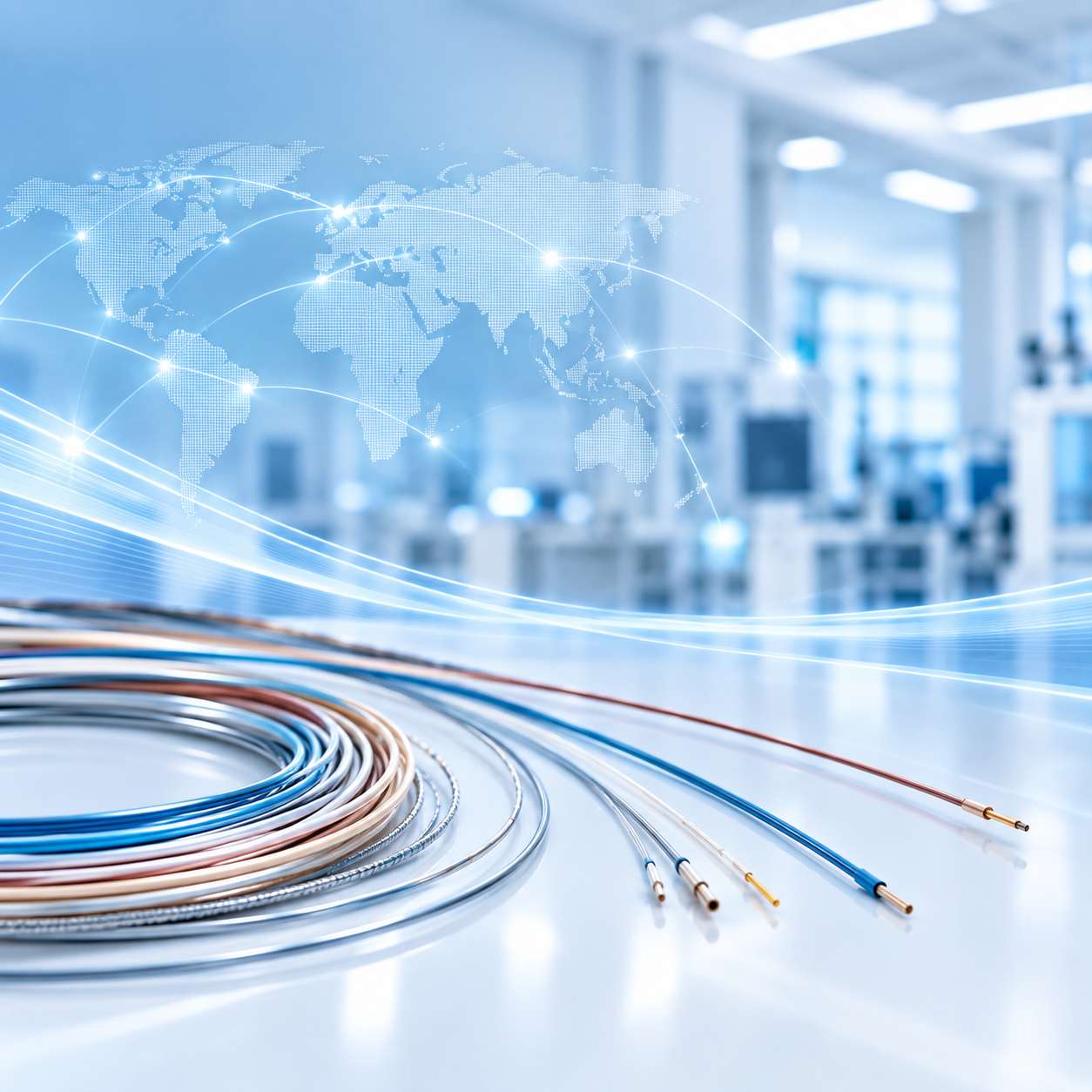 How Should OEM Engineers Select Micro Coaxial Cable for Wearable Devices?
For an OEM wearable project, the cable should be selected from the device architecture, signal requirements and mechanical movement profile, rather than simply choosing the smallest available cable.
A practical framework is:
Device Architecture → Signal Type → Data Rate → Channel Count → Cable OD → Impedance → Shielding → Flexibility → Connector → Termination → Environmental Conditions → Validation
Wearable products may contain several different modules within a very small enclosure.
| Module | Typical Interconnect Requirement |
|---|---|
| Display | High-speed signal transmission |
| Camera | High-speed image data |
| Eye Tracking | Dense sensor connections |
| Biometric Sensor | Low-level sensor signals |
| Haptic Module | Compact power / signal routing |
| Wireless Module | EMI-aware routing |
| Processor | High-speed internal interconnect |
If → several modules are distributed across the device
Then → map their positions and cable routes before selecting the cable
Why → cable length, branch points, connector orientation and bending conditions depend on the physical architecture.
Not every conductor inside a wearable needs to be coaxial.
A typical assembly may combine:
High-Speed Signal Lines
Power
Ground
Control Lines
If → the signal requires controlled impedance or strong EMI isolation
Then → evaluate micro coaxial construction for that signal path
Why → coaxial construction provides a defined conductor, dielectric and shield structure.
If → the conductor only supplies low-speed power
Then → evaluate conventional fine-wire construction separately
Why → using the same construction for every circuit can add unnecessary size or cost.
This distinction helps engineers design a mixed high-density harness rather than automatically converting every wire into micro coax.
The current HOTTEN page identifies miniature micro coaxial cable as a solution for very compact wearable structures and describes cable diameters as low as approximately 0.1–0.3 mm for its stated designs. Treat these as HOTTEN-specific design examples rather than universal industry limits.
If → the routing channel has a strict dimensional limit
Then → define maximum cable OD before selecting conductor, insulation and shielding
Why → the cable architecture must fit the actual mechanical envelope.
If → several cables must occupy the same channel
Then → evaluate bundle diameter rather than only single-cable OD
Why → total harness size is determined by the complete arrangement.
A finer conductor can help reduce cable dimensions, but conductor size also affects resistance, attenuation, flexibility and termination.
| Design Factor | Engineering Consideration |
|---|---|
| Smaller AWG Diameter | Smaller physical structure |
| Conductor Resistance | Electrical loss |
| Attenuation | High-speed transmission |
| Flexibility | Dynamic movement |
| Termination | Assembly feasibility |
| Mechanical Strength | Durability |
If → miniaturization is the dominant constraint
Then → evaluate finer conductor sizes
Why → smaller conductors can support tighter routing.
If → transmission distance or signal loss becomes critical
Then → evaluate AWG together with attenuation and cable length
Why → conductor miniaturization can create an electrical trade-off.
Wearable electronics can place high-speed signals close to:
If → sensitive signal paths run close to other electronic circuits
Then → evaluate individual shielding and overall shielding
Why → shielding can help control electromagnetic coupling between adjacent systems.
If → the cable must bend repeatedly
Then → evaluate shielding construction together with flex performance
Why → shielding contributes to both electrical and mechanical behavior.
A compact cable does not automatically provide high-speed signal integrity.
Potential electrical requirements include:
| Parameter | Engineering Question |
|---|---|
| Data Rate | What signaling speed is required? |
| Impedance | What nominal value is required? |
| Attenuation | What maximum loss is acceptable? |
| Skew | Are multiple paths time-matched? |
| Crosstalk | How much channel interaction is acceptable? |
| Cable Length | What is the complete transmission distance? |
| Connector | What interface is required? |
If → a wearable uses high-speed display or camera interfaces
Then → specify the interface requirements before selecting the cable
Why → the cable must support the actual signaling architecture.
If → several high-speed channels share one harness
Then → evaluate skew, crosstalk, shielding and electrical-length consistency
Why → the interconnect must preserve the relationship between multiple signal paths.
A very small cable does not guarantee a small finished assembly.
The complete interface includes:
Cable OD + Connector + Termination + Strain Relief + Routing Clearance
If → internal space is extremely limited
Then → evaluate cable and connector footprint together
Why → the connector or termination may consume more space than the cable itself.
If → the wearable uses a fine-pitch connector
Then → evaluate termination alignment, conductor preparation and inspection
Why → high connector density increases assembly precision requirements.
Wearables may experience:
If → the cable moves continuously with the user
Then → define bend radius, movement angle, flex cycles and fixation points
Why → “flexible cable” does not provide a measurable mechanical requirement.
If → the cable crosses a hinge or articulated joint
Then → define the exact routing and local strain-relief structure
Why → repeated movement may concentrate stress at a small region.
Wearable devices may be exposed to:
If → the cable is located close to the user's skin
Then → consider jacket material, surface properties and environmental exposure
Why → external wearable cables can experience a different environment from internal electronic connections.
If → the cable is inside a sealed headset or smart device
Then → focus more strongly on internal thermal conditions, routing and mechanical movement
Why → internal and external cable environments can be different.
A wearable assembly does not have to use one cable technology throughout the entire device.
Possible structures include:
Micro-Coax
LVDS / Differential Pairs
Fine Power Wires
FPC
Standard Connectors
If → the device requires very dense high-speed signal routing in three-dimensional space
Then → evaluate micro coaxial cable assembly
Why → individual coaxial signal paths can combine compact routing with shielding.
If → the route is primarily planar and fixed
Then → compare FPC or FFC with micro coax
Why → planar interconnect structures can be suitable for certain fixed layouts.
For broader selection:
A useful validation sequence is:
Prototype Cable
→ Initial Electrical Test
→ Device Installation
→ Mechanical Movement
→ Environmental Exposure
→ Post-Test Electrical Validation
→ Final Inspection
Potential tests include:
| Test | Purpose |
|---|---|
| Continuity | Verify electrical connection |
| Impedance | Verify controlled transmission path |
| Attenuation | Verify signal loss |
| Crosstalk | Evaluate channel isolation |
| Skew | Verify timing consistency |
| Shield Continuity | Verify shielding path |
| Flex-Life | Evaluate repeated movement |
| Tensile / Pull | Evaluate mechanical strength |
| Dimensional Inspection | Verify integration |
| Visual Inspection | Verify workmanship |
If → the cable passes standalone testing but the wearable shows intermittent signal problems
Then → investigate routing, connector transitions, EMI exposure and mechanical deformation
Why → system installation can introduce conditions not present during bench testing.
A practical OEM development flow is:
Concept
→ Cable Architecture
→ Prototype
→ Electrical Validation
→ Mechanical Validation
→ Design Optimization
→ Pilot Production
→ Process Validation
→ Mass Production
If → the prototype meets all requirements
Then → identify the critical dimensions and processes that must be controlled during production
Why → a successful prototype does not automatically demonstrate volume-production consistency.
If → the cable fails at a specific routing or connector location
Then → feed the result back into cable geometry, branch routing or strain relief
Why → wearable cable design should improve through test-driven engineering iteration.
| Category | Recommended Information |
|---|---|
| Device | AR glasses / VR headset / Wearable / Smart Clothing |
| Module | Display / Camera / Sensor / Processor |
| Interface | MIPI / LVDS / eDP / USB / Other |
| Data Rate | Required signaling speed |
| Channel Count | Number of signal paths |
| Impedance | Required value |
| Attenuation | Maximum acceptable loss |
| Skew | Required tolerance |
| Cable OD | Maximum allowable dimension |
| Cable Length | Nominal + tolerance |
| Conductor | AWG / material / construction |
| Dielectric | Material / structure |
| Shielding | Individual / overall |
| Connector | Manufacturer / part number |
| Connector Pitch | Required interface density |
| Pinout | Required mapping |
| Bend Radius | Minimum radius |
| Flex Cycles | Required endurance |
| Weight | Maximum assembly weight if applicable |
| Temperature | Operating range |
| Moisture | Relevant exposure |
| Testing | Electrical / mechanical / environmental |
| Production | Prototype / pilot / mass production |
If → the RFQ only specifies “miniature micro coaxial cable”
Then → provide the application, signal interface, cable OD, length, connector, shielding and mechanical requirements
Why → cable diameter alone does not define the required interconnect performance.
| Evaluation Area | What to Confirm |
|---|---|
| Fine Conductor Capability | Required AWG range |
| Micro-Coax Construction | Required OD and structure |
| Shielding | Individual / overall shielding |
| Connector Assembly | Fine-pitch termination |
| Flexibility | Dynamic cable capability |
| DFM | Routing and integration review |
| Electrical Testing | Impedance / attenuation / other relevant tests |
| Prototype | Development capability |
| Process Validation | Production repeatability |
| Quality | Inspection and traceability |
If → the supplier offers small-diameter cable but cannot support the required connector
Then → evaluate complete cable assembly capability
Why → connector termination may become the limiting part of the design.
If → the supplier has prototype capability but no documented production controls
Then → review the transition from prototype to pilot and mass production
Why → wearable products can require stable production of very small and highly integrated assemblies.
Wearable Device Architecture
→ Display / Camera / Sensor Modules
→ Signal Interface
→ Data Rate
→ Channel Count
→ Cable OD
→ AWG
→ Impedance / Attenuation
→ Shielding
→ Connector
→ Termination
→ Bend / Flex Requirements
→ Environmental Conditions
→ Prototype Testing
→ Mechanical / Electrical Validation
→ Pilot Production
→ Production Verification
Display + Cameras + Sensors
→ map module positions
→ define high-speed interfaces
→ determine channel count
→ establish maximum cable OD
→ select micro coaxial architecture for required signal paths
→ define shielding
→ select fine-pitch connectors
→ define flexible routing around the frame
→ validate electrical performance
→ perform repeated-movement testing
→ verify production consistency.
Display + Cameras + Tracking Sensors
→ define data interfaces
→ determine cable routing
→ establish impedance / attenuation requirements
→ select compact micro coaxial structures
→ define connector orientation
→ evaluate flexing around moving sections
→ validate signal integrity
→ perform mechanical testing
→ qualify production.
Sensor / Monitoring System
→ define signal sensitivity
→ identify noise sources
→ determine cable architecture
→ select low-noise / shielded structure where required
→ define flexibility and environmental exposure
→ validate electrical performance during movement
→ verify finished assembly.
The key engineering principle is:
For wearable devices, micro coaxial cable should be selected when compact 3D routing, high-density signal transmission, EMI control and mechanical flexibility need to be addressed together. HOTTEN's current wearable article identifies these same design pressures across AR/VR, medical wearables and other compact electronics.
50-Pin Micro-Coaxial Cable Assembly for Humanoid Robot Vision Systems
Why AR/VR Devices Require Micro Coax Cable Assemblies
Why OEMs Choose Custom LVDS Cable Assemblies
How Micro Coaxial Cable Design Ensures Signal Integrity in Medical Devices
How Low-Noise Medical Cable Assemblies Support More Accurate Diagnostic Signals
How Flex-Life Testing Helps Medical Cable Assemblies Maintain Performance After Repeated Bending
FPC vs. FFC vs. Micro-Coaxial Cable Assembly
The number of sensors and devices packed into even the simplest of wearable electronics today is increasingly complex. High resolution cameras, bio-metric sensors, eye-tracking, and haptic feedback systems, among others, all have a direct interface in the device and require interconnects. All these signals need to travel in and out of a very small enclosure without excessive size increase.
Micro coaxial cable makes high-density interconnects feasible by being able to fit many signals in an extremely small cross-section. A simple wire harness that includes dozens of high-speed, individually shielded signals along with power and control wires may still only take up a few cubic centimeters in space. Hotten's USB4 and LVDS cable harnesses often employ a micro coaxial construction in order to achieve necessary channel densities in the next generation wearable. We take great strides with our engineering department to develop custom configurations.
Wearable devices often face the toughest and least desirable of conditions. Sweating, liquids, changing temperatures, direct sun and repeated flexing will all degrade performance on even the best electronics. A wire harness must be durable enough to stand up to all these conditions while maintaining a constant connection and ensuring signal fidelity.
Jacketing on a micro coaxial cable will often be made from very durable TPU (thermoplastic polyurethane), silicone, or abrasion-resistant nylon, depending on what conditions the wearable may face. Shield terminations are engineered to prevent strain and to minimize damage. Hotten's attention to detail coupled with over 40 manufacturing units helps to ensure we make every micro coaxial wire harness ready to meet industry standards and stand up to real-world use.
Miniature micro coaxial cable is revolutionary for wearable device development, making smaller form-factors, improved signal integrity, increased flexibility, reduced weight, higher interconnect densities and enhanced durability possible. Hotten leverages this revolutionary technology by building a vast supply chain to accommodate a multitude of industry needs in various consumer electronics. From AR/VR cables and drone wire harnesses to medical wearable devices, Hotten continues to develop and produce custom solutions to take your next wearable product to the next level.
 Hot News
2026-09-17
2026-09-04
2025-12-17
2025-12-11
2025-12-05