 EN
EN
Quick Links

The medical device industry faces continuous pressure for faster imaging, smaller instruments, greater reliability, and stricter regulatory compliance. To the OEMs producing next-generation endoscopy systems, robotic surgical instruments or a new generation ultrasound platform, the cable assembly embedded in the device is no longer a passive component. It is a performance, patient safety and commercial success determinant.
Hotten Electronic Wire focuses on OEM micro coax cable assemblies to be used with manufacturers of medical devices. Our production facility covers 10,000 square meters and has 40 high-technology manufacturing units and a yearly production of more than 144 million meters, we are not just a supplier, but a strategic continuation of the engineering and supply chain sections of our customers.
An OEM medical micro coax cable assembly should be specified as a complete engineered interconnect, not simply as a length of miniature coaxial cable.
The final assembly may combine ultra-fine micro coaxial wires, customer-specified connectors, FPC or PCB interfaces, shielding, strain relief, housings, and other components according to the device design.
For medical device manufacturers, the most important requirements to define are:
signal requirements + cable dimensions + capacitance / impedance + flexibility + shielding + connector interface + environmental conditions + testing + production volume
| OEM requirement | What should be specified |
|---|---|
| Signal | Frequency, bandwidth, signal type and electrical requirements |
| Cable structure | Micro coaxial / fine-wire / hybrid construction |
| Conductor | AWG, material and channel count |
| Capacitance | Maximum or target value where applicable |
| Impedance | Required controlled impedance where applicable |
| Cable OD | Maximum allowable diameter |
| Flexibility | Bend radius, flex cycles and torsion |
| Shielding | Individual, grouped or overall shielding |
| Connector | Customer-specified manufacturer, series and part number |
| FPC / PCB | Interface drawing and electrical definition |
| Housing | Required dimensions and material |
| Environment | Cleaning, temperature, vibration and sterilization conditions where applicable |
| Testing | Electrical, dimensional and mechanical validation |
| Production | Prototype, pilot and annual volume |
If the medical device has strict space and signal-integrity requirements, then the cable, connector and termination should be engineered as one assembly, because the performance and packaging of the finished device depend on the complete interconnect rather than the raw cable alone.
For HOTTEN's related capabilities, see Micro Coaxial Cable Assembly, Medical Cable Assembly, and Medical Devices.
The OEM Challenge: Why Standard Cables Are Not Enough
There is a paradox facing medical device OEMs. The miniaturization requirement is driving the cable diameters to the lowest levels but clinical expectations of the resolution of an image and diagnostic accuracy are on the increase. Ready-made cable assemblies, particularly those designed for consumer electronics or a general-purpose industrial device, cannot meet these requirements.
The signal integrity of high frequencies, very high flexibility, sterilization, and biocompatibility have to coexist in a diameter that is usually within fractions of a millimeter. In addition, these requirements differ between applications. A disposable bronchoscope does not face the same lifecycle requirements as a reusable surgical arthroscope. Echocardiography probe used transesophageally needs dissimilar mechanical capacities as compared to a handheld ultrasound probe.
That is why OEMs are more willing to find custom-engineered solutions instead of catalog products. At Hotten, every OEM engagement begins not by a price quote, but by a technical discovery.
Our OEM Approach: Engineering as the Starting Point
When the manufacturer of a medical device wants to work with Hotten to assemble a micro coax cable, we do not ask for the part number. We ask:
What are the signal frequency and bandwidth requirements?
Mechanical constraints: bend radius, flex life, insertion force?
Which sterilization methods will the device undergo?
What production volume is expected, prototype, pilot, full-scale start-up?
What are the regulatory requirements- FDA 510(k), MDR or PMA?
These are the questions that lead to any subsequent decision made: stranding of conductors, dielectric material, shielding layout, the jacket polymer, connector choice, and the termination requirements.
Case Example: Miniaturizing a Surgical Camera Cable
One of the more recent partnerships that we have entered into with a major OEM of robotic-assisted surgery platforms exemplifies our OEM philosophy. The client needed a very thin coax assembly with the ability to transfer uncompressed 4K video over a 5mm instrument shaft- and still be autoclave compatible.
Coax assemblies of standard 50AWG were too thick. Available 52AWG products in the market did not have the mechanical stability of 1,000 or more sterilization cycles. Connectors off-the-shelf introduced impedance mismatches that reduced the image quality.
The design of a custom solution was by the R&D team of Hotten, which develops more than 300 new cable designs in a single year:
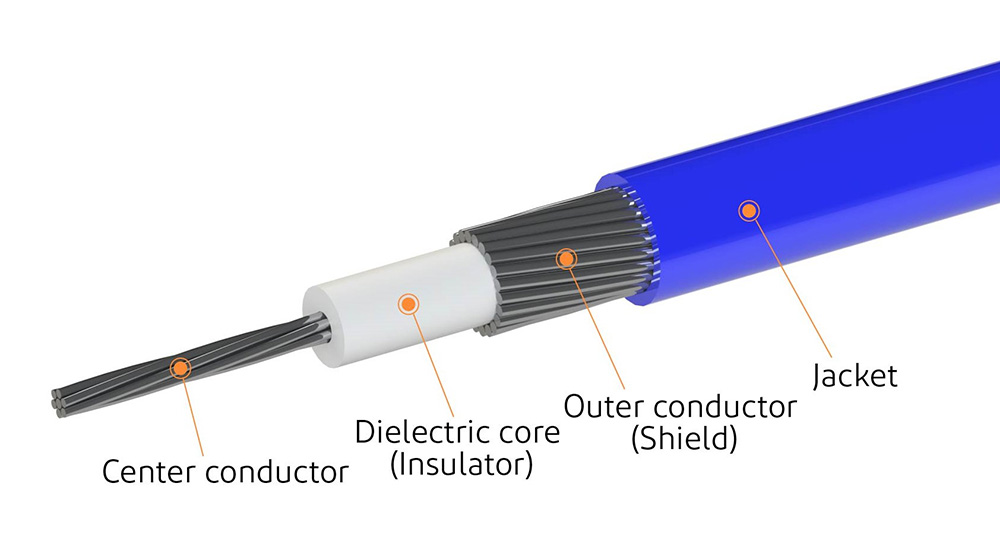
A conductor made of silver-plated copper, 54AWG and minimizing signal loss while reducing diameter.
Micro-porous PTFE dielectric with 50 Ω impedance in a 0.28mm profile.
100% spiral-wrapped foil with ultra-fine braid dual-layer shielding.
A proprietary polyether ether ketone (PEEK) jacket which has been tested at 1,200 cycles of the autoclave without cracking or discoloring.
Strain relief molded to fit perfectly round the sterile interface of the OEM.
The result? A cable assembly allowing the OEM to cut instrument shaft diameter by 18 percent and increase signal-to-noise ratio by 3.2dB, providing a measurable competitive advantage and delivered in 14 weeks after concept approval.
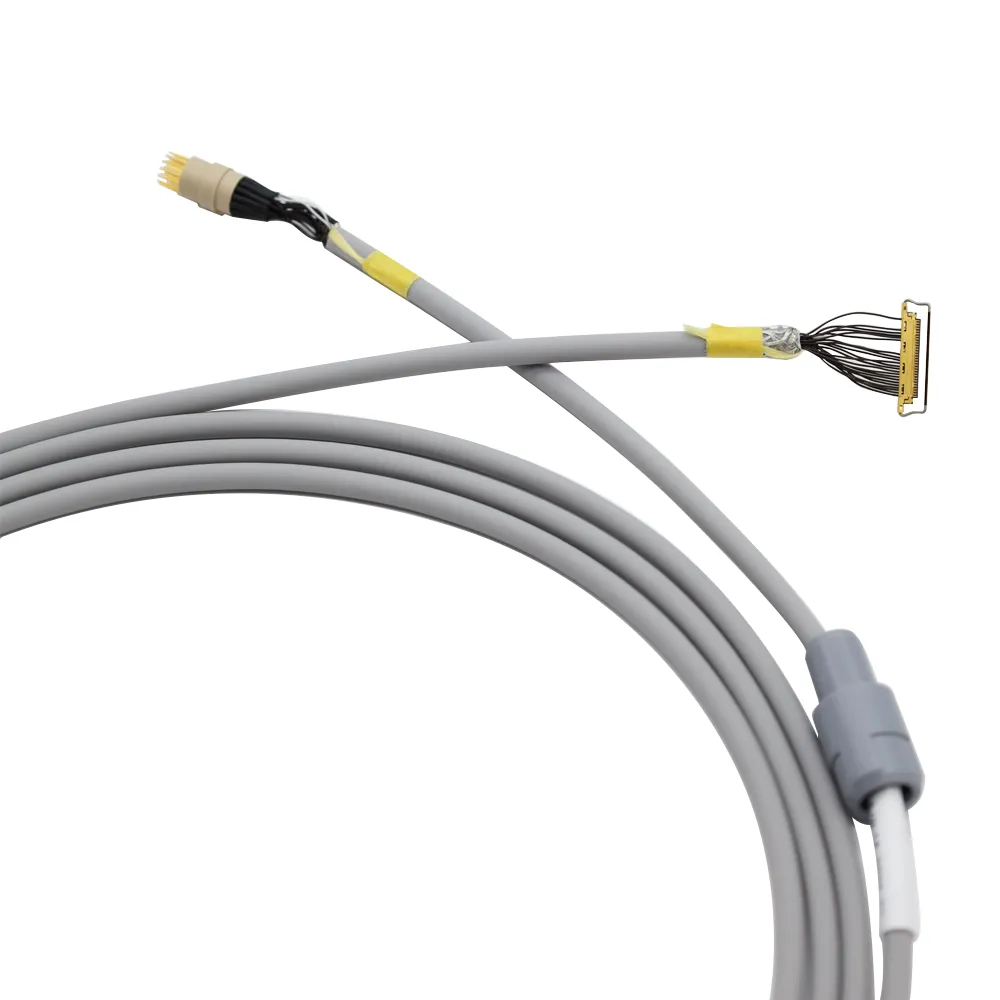
| OEM Requirement | Cable Assembly Consideration | Typical Engineering Focus |
|---|---|---|
| Miniaturization | Cable diameter and connector size | Space-constrained medical instruments |
| High-Frequency Signals | Impedance and shielding | Signal integrity and low interference |
| Repeated Flexing | Conductor and jacket construction | Flex life and bend radius |
| Sterilization | Material and jacket selection | Autoclave, EtO or other processes |
| Regulatory Requirements | Material documentation and traceability | Medical device qualification |
| Production Scaling | Assembly process and inspection | Prototype to volume production |
Regulatory Compliance: Built-In, Not Bolted-On
In the case of medical device OEMs, component sourcing is a risk to regulation. When a cable assembly fails a biocompatibility test, or fails in sterilization validation testing, the whole device submission may be delayed - months and millions of dollars.
Hotten solves this by using design-for-compliance engineering. We do not view regulatory requirements as an end verification point but we incorporate them in the process design and material selection.
Our medical cable assemblies are OEM and are designed with:
Material selection (cytotoxicity, sensitization, irritation) in accordance with ISO 10993.
Autoclave, EtO, gamma, compatibility with electron-beam sterilization.
Prop 65, REACH, and RoHS control of the restricted substances.
Complete material traceability used in harnesses, starting with resin lot and ending with finished harness.
Documentation of design verification to OEM design verification Design History File (DHF) documentation Design History File (DHF) documentation supporting OEM design verification.
To clients seeking FDA or CE marking, we supply technical dossiers, process validation Documentation and supplier statements which can be incorporated directly into the regulatory submissions of clients.
Scalability: From Engineering Samples to High-Volume Production
OEMs have to contend with transitioning between prototype and production as one of the most frequent challenges. A cable assembly carefully hand-terminated in an engineering laboratory might be impossible to scale to large-scale production may have unacceptable yield loss on transfer to large scale production.
The manufacturing engineering team at Hotten plays this role. We do not have generic assembly lines in our 40 production units, they are set up and equipped to do micro-coax-specific operations, and these include:
Laser stripping machines that do not nick the conductor or dielectric layers.
Ultra-miniature connector calibrated semi-automatic termination presses.
Vision-inspection stations to check concentricity, solder fillet quality and contact positioning.
Not only first article impedance profiling but impedance profiling of all production lots.
We can scale our engineering samples of 50 pieces all the way up to 50,000-unit production orders with this infrastructure and not requalify or performance drift.
Supply Chain Integration: JIT, Kanban, and Global Logistics
The schedules of medical devices production are highly variable. The enrollment of the clinical trials varies. Approaches to regulatory approvals are either proactive or reactive. The peaks of demand in consumable devices are caused by seasonal volumes of procedures.
Being an OEM partner, Hotten will synchronize our production plans and inventory needs with the demand indicators of our clients. We support:
Just-in-time (JIT) delivery based on OEM assembly lines.
Kanban replenishment systems of high usage components.
Consignment inventory projects at customer designated logistic hubs.
Shipping to North American, European and Southeast Asian contract manufacturers by drop-ship.
We have an annual production capacity of more than 144 million meters of cable that allows us to supply even when our clients grow in their product introduction to their market dominant position.
When preparing an RFQ, OEM teams should define the complete assembly:
fine wire / micro coaxial cable → termination → connector → shielding → strain relief → FPC / PCB / housing integration
This is particularly important when the connector, PCB, or housing is already defined by the medical device architecture.
If the customer already has an approved connector or PCB interface, then provide the exact part number, drawing, BOM and pinout, because the cable assembly should be built around the established device interface.
If the interface is not yet finalized, then provide the available mechanical envelope and electrical requirements, because these constraints determine which cable and termination structures are practical.
Micro coaxial cable selection should begin with the signal path rather than cable appearance.
OEM engineers should identify:
| Electrical parameter | Why it matters |
|---|---|
| Frequency | Determines the relevant high-frequency design requirements |
| Bandwidth | Defines the transmission range |
| Impedance | Helps control reflections and matching |
| Capacitance | Affects electrical loading |
| Cable length | Influences total distributed electrical characteristics |
| Channel count | Determines cable density |
| Shielding | Helps control unwanted coupling |
If the application involves ultrasound, imaging, RF, or other sensitive signals, then the cable specification should be tied to the system electrical architecture, because the same cable construction can behave differently depending on length, interface and operating conditions.
For ultrasound applications, see Ultrasound Probe Cable.
A smaller cable is useful only when it also meets the required electrical and mechanical performance.
Important mechanical inputs include:
maximum OD + bend radius + cable length + routing path + connector dimensions + strain relief
If the cable must pass through a narrow medical instrument, then the maximum cable OD should be established before cable construction is finalized, because the available routing space may determine the conductor, dielectric, shielding and jacket configuration.
For compact applications requiring high-density routing, see Micro Coaxial Cable.
Medical micro coax assemblies can have several simultaneous requirements:
These requirements can interact with each other.
If the cable requires both low capacitance and repeated bending, then conductor, dielectric, shielding and jacket construction should be optimized together, because changing one part of the cable structure can affect both electrical and mechanical behavior.
HOTTEN's role is not to manufacture every connector in the assembly.
For OEM projects, customers can specify the required:
HOTTEN can then integrate the specified connector with its fine electronic wire / micro coaxial cable and other customer-defined components.
If the connector is already fixed in the customer's BOM, then the connector PN and drawing should be included in the RFQ, because the connector geometry directly affects stripping, termination, routing and strain relief.
Some medical devices require more than a cable and connector.
The finished assembly may include:
Micro Coax + Connector + FPC + PCB + Housing / Shell
The RFQ should therefore provide all applicable interfaces.
| Component | Recommended information |
|---|---|
| Connector | Manufacturer, series, PN and drawing |
| FPC | PN, drawing, contact side and pinout |
| PCB | Interface dimensions and electrical definition |
| Housing | Dimensions, material and assembly requirements |
| Cable | AWG, OD, length and construction |
| Pinout | Signal assignment |
| Routing | Bend and exit requirements |
If the customer requires a fully assembled component, then the assembly drawing and BOM should cover all integrated components, because cable termination and mechanical integration need to be validated as one finished product.
The outer construction of a medical cable should match the actual operating environment.
Relevant conditions may include:
For sterilization-related applications, the OEM should specify the actual process, such as:
autoclave / EtO / gamma / other defined process
together with the applicable exposure conditions.
If sterilization is part of the device lifecycle, then material and cable construction should be validated against the specified sterilization process, because compatibility depends on the actual materials, construction and exposure conditions.
Micro coaxial cable can be designed with different shielding architectures depending on the system.
Possible structures include:
| Shielding approach | Typical engineering purpose |
|---|---|
| Individual shielding | Channel-level isolation |
| Group shielding | Protection around selected signal groups |
| Overall shielding | Protection around a cable assembly |
| Combined shielding | Higher isolation where required |
If multiple sensitive channels are routed through a compact medical device, then shielding should be evaluated together with channel density and routing, because EMI performance depends on the complete cable architecture.
For additional EMI-related engineering content, see the Medical Cable Assembly solution.
“High reliability” is not enough for an OEM specification.
The validation plan should define measurable conditions such as:
| Validation area | What to define |
|---|---|
| Flex | Bend radius, cycles and motion |
| Pull | Force and test method |
| Connector | Retention and mating requirements |
| Electrical | Continuity, resistance, insulation, etc. |
| High-frequency | Impedance, insertion loss or other relevant parameters |
| Environment | Temperature, humidity, chemical exposure |
| Sterilization | Process and cycle requirements |
| Dimensions | Critical dimensions and tolerances |
If the cable moves during normal operation, then mechanical testing should reproduce representative movement, because a static continuity test cannot demonstrate dynamic reliability.
For high-density ultrasound assemblies, see Ultrasound Probe Cable Assembly.
OEM development normally moves through several stages:
Engineering Sample → Prototype Validation → Pilot Production → Mass Production
The same cable construction should be controlled through each stage.
If a prototype requires changes to cable OD, AWG, connector orientation, shielding or strain relief, then those changes should be documented before pilot production, because uncontrolled changes can create differences between the validated prototype and the production assembly.
For OEM customization, HOTTEN can work from:
drawing + BOM + connector PN + pinout + sample + engineering requirements
and develop the finished assembly around those inputs.
A successful prototype does not automatically demonstrate stable production.
OEM buyers should evaluate how the manufacturer controls:
material → cable construction → cutting / stripping → termination → connector assembly → inspection → testing
Important production questions include:
If the medical device will enter long-term production, then process control and change management should be part of supplier qualification, because recurring production variation can affect the consistency of the validated product.
Before requesting a quotation, the OEM engineering or procurement team can prepare:
| RFQ Item | Information |
|---|---|
| Application | Ultrasound, endoscope, imaging, monitoring, surgical equipment, etc. |
| Signal | Type, frequency and bandwidth |
| Channel count | Required signal paths |
| Conductor | AWG and material |
| Cable structure | Micro coaxial / fine wire / hybrid |
| Capacitance | Target or maximum where applicable |
| Impedance | Required value where applicable |
| Cable length | Finished length and tolerance |
| Cable OD | Maximum allowable diameter |
| Shielding | Individual / grouped / overall |
| Flexibility | Bend radius and flex cycles |
| Connector | Manufacturer and PN |
| Pinout | Contact assignment |
| Connector orientation | Required direction |
| FPC / PCB | Drawings and interface data |
| Housing | Drawing and mechanical requirements |
| Environment | Temperature, cleaning, chemicals, vibration |
| Sterilization | Process and cycle conditions where applicable |
| Testing | Required electrical / mechanical validation |
| Quantity | Prototype / pilot / mass production |
If the OEM can provide a complete drawing and BOM, then supplier quotation and engineering review can usually be more precise, because connector, cable, routing and assembly requirements are clearly defined.
A supplier should be evaluated according to whether it can control both the fine-wire manufacturing and the finished assembly process.
| Capability | Qualification question |
|---|---|
| Fine-wire manufacturing | Can ultra-fine conductors be produced consistently? |
| Micro coaxial construction | Can the required miniature cable structure be manufactured? |
| Precision processing | Can fine cable be stripped and prepared accurately? |
| Connector termination | Can customer-specified connectors be integrated? |
| FPC / PCB integration | Can the finished assembly include customer-defined interfaces? |
| Shielding | Can the specified shielding structure be produced? |
| Testing | Can required electrical and mechanical tests be performed? |
| Prototyping | Can engineering samples be developed? |
| Production | Can the approved design move into stable production? |
| Documentation | Can drawings, inspection and test records be controlled? |
The key procurement question is therefore:
Can the supplier turn the OEM's fine-wire, connector, PCB/FPC, mechanical and testing requirements into a repeatable finished medical cable assembly?
For HOTTEN's medical application range, see Medical Cable Assembly, Micro Coaxial Cable Assembly, and Medical Devices
Confidentiality and IP Protection
The architecture of products and relationships with supply chains are the proprietary assets in the competitive medical devices landscape. Hotten signs extensive Non-Disclosure Agreement (NDAs) with all of its OEM partners and has strict access controls in our engineering and production area.
We do not take customer-specific designs and use them with other customers, or do we post recognizable OEM project information in our marketing texts without express permission. We are an established supplier of OEMs with a reputation of technical ability, but also discretion and integrity.
Conclusion: More Than a Vendor
The term OEM supplier implies a transactional relationship: specification made, components received, and money is paid. At Hotten we do not accept that restriction.
We consider ourselves as a part of the engineering, quality and manufacturing organizations of our customers. By partnering with Hotten, a medical device OEM can access dedicated skills in micro-coax domain, regulatory acumen, and affordable scale of production; all in a single relationship.
That integration is no longer optional in an industry where competitors are measured by miniaturization, which is the competitive advantage, and regulators by compliance, which is the competitive entrance to a market. It is a strategic necessity.
When designing a medical device that requires a high frequency signal integrity in a miniature-scale package, contact Hotten Electronic Wire. Together, we can create your advantage.
1. What is an OEM micro coax cable assembly?
An OEM micro coax cable assembly is a customized cable solution designed to meet the electrical, mechanical, dimensional and application-specific requirements of a medical device manufacturer.
2. Why do medical device manufacturers need custom micro coaxial cable assemblies?
Medical devices often require extremely small cable diameters, controlled impedance, high flexibility, reliable shielding and compatibility with specific sterilization processes. Standard cable assemblies may not meet all of these requirements simultaneously.
3. Can micro coax cable assemblies be customized for different medical devices?
Yes. Customization can include conductor size, dielectric material, impedance, shielding structure, cable diameter, jacket material, connector configuration, cable length and termination method.
4. Can medical micro coax cable assemblies withstand sterilization?
They can be engineered for specific sterilization requirements, including autoclave, EtO, gamma and other processes, depending on the selected materials and construction.
5. What information should an OEM provide when requesting a custom medical cable assembly?
Important information includes signal frequency and bandwidth, impedance, required cable diameter, bending requirements, flex life, sterilization method, connector requirements, operating environment and expected production volume.
6. Can HOTTEN support both prototypes and mass production?
Yes. HOTTEN supports the development process from engineering samples and pilot production through higher-volume manufacturing, allowing cable designs to transition from development to production.
 Hot News
2026-09-17
2026-09-04
2025-12-17
2025-12-11
2025-12-05