 EN
EN
Quick Links

Home > News > Company news
In the field of Robotic-Assisted Surgery (RAS), the robotic arm serves as a physical extension of the surgeon’s intent. Whether in multi-port laparoscopy systems, high-precision neurosurgery robots, or space-constrained single-port endoluminal platforms, the performance of these systems is fundamentally dependent on the stability and reliability of the Medical Cable Harness integrated within the mechanical structure.
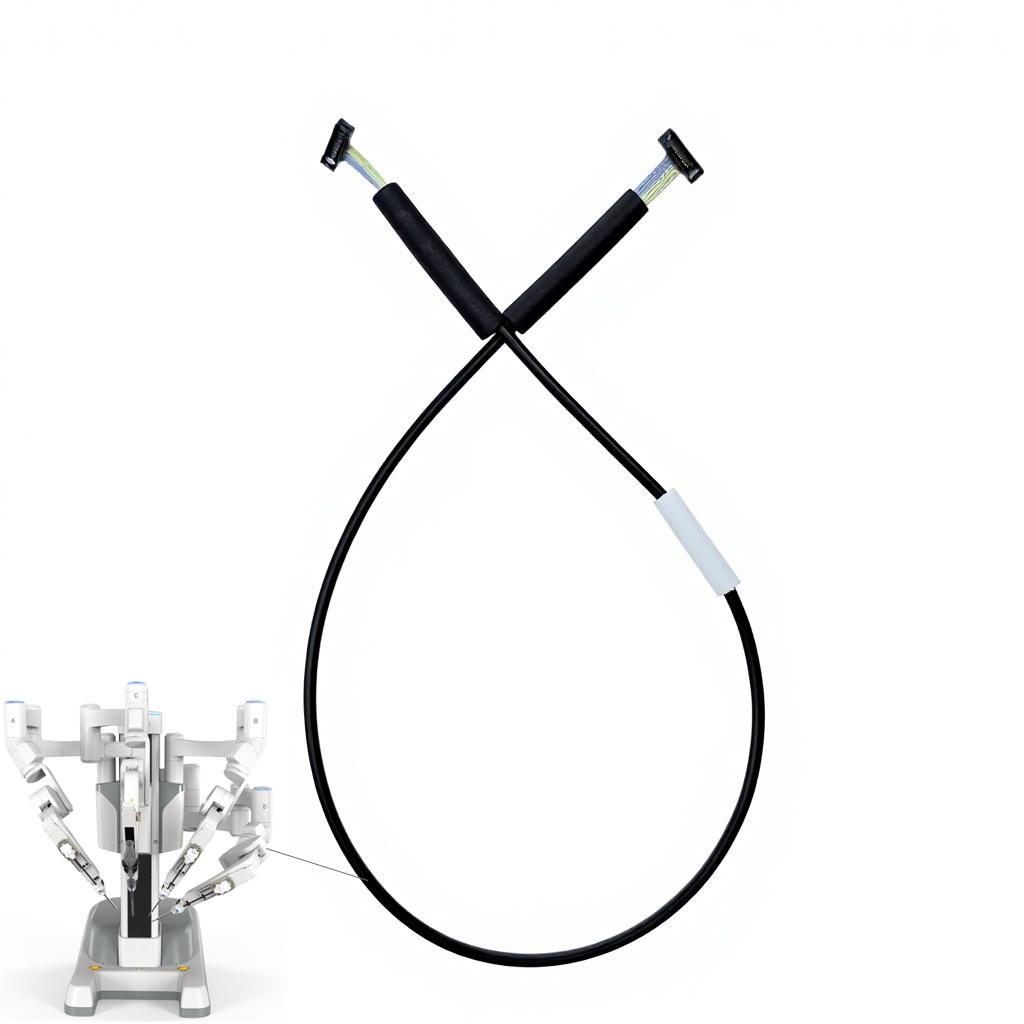
As surgical platforms evolve toward higher degrees of freedom (DoF) and miniaturization, the Surgical Robot Cable Assembly has transitioned from a standard power-and-signal carrier into a highly engineered, critical sub-system. It must withstand hundreds of thousands of bending cycles while maintaining absolute signal integrity across high-speed data links.
Surgical robot arm cable assemblies must balance continuous bending and torsion, limited routing space, signal integrity, EMI control, material durability, sterilization compatibility, and connector reliability within the mechanical structure of the robotic system.
If the cable moves continuously with a robotic joint → evaluate conductor construction, cable geometry, bend radius, torsion, shielding, and strain relief together → then validate the complete assembly under the expected motion profile.
If the cable carries high-speed camera, sensor, or control signals → evaluate impedance, attenuation, shielding, cable geometry, and connector transitions together → because the cable assembly is part of the complete signal path. For related high-frequency design considerations, see Why Ultra-Fine High-Frequency Coaxial Cable Design Is So Difficult.
If the cable must be compact enough to pass through confined robotic joints → evaluate conductor size, insulation structure, shielding, connector pitch, and cable OD together → then verify mechanical reliability and manufacturability. For related ultra-fine conductor considerations, see How Does AWG Affect Micro Coaxial Cable Performance?.
Material selection is another part of the system design. If repeated sterilization or chemical exposure is required → evaluate insulation and jacket materials against the actual operating and cleaning process → then verify flexibility and electrical performance after environmental testing. See Engineering Analysis: Insulation Material Selection for High-Reliability Medical Interconnect Systems.
For customized robotic and medical cable assemblies, see HOTTEN's Medical Cable Assembly and Robotics Wire Harness solutions.
Unlike stationary medical imaging equipment, a Robotic Arm Cable is in constant motion. The articulation of robotic joints involves complex 3D movements—combining high-frequency bending with continuous torsional stress.
In surgical robotics, particularly within Medical Mechanical Arms, internal space is at a premium. Cables are often routed through narrow pivots and "wrist" joints with extremely tight bend radii. To prevent core breakage due to dynamic fatigue, engineers specify high-flex cable designs featuring:
Ultra-Fine Stranded Conductors: Utilizing 0.05mm or finer multi-strand soft-alloy copper wires to enhance flexibility and tensile strength.
Optimized Cable Construction: Leveraging high-strength fillers, reduced pitch lengths, flex-resistant insulation, and high-elasticity elastomer jackets to achieve superior overall mechanical performance.
Modern surgical robots rely on 4K 3D endoscopy and real-time haptic feedback, requiring ultra-high-speed data transmission with zero latency. Micro Coaxial Cable (ranging from 40AWG to 46AWG) has become the industry standard for these high-speed links.
In applications such as laparoscopy or puncture robots, ultra-fine micro-coax allows for:
Superior Signal Integrity: Supporting data rates exceeding 12.5Gbps per channel with robust anti-interference capabilities for high-definition imaging.
Extreme Miniaturization: Bundling dozens of signals into a single harness with an outer diameter small enough to pass through 5mm or 8mm robotic trocars.
Micro-Connector Integration: Ensuring precision termination with high-density, low-profile SMT connectors from brands like I-PEX, Hirose, or KEL.
The operating room is a complex electromagnetic environment. High-frequency Electrosurgical Units (ESU), anesthesia monitors, and the robot’s own servo motors generate significant electromagnetic interference. Therefore, an EMI Shielded Cable for surgical robotics requires a comprehensive 360° structure:
Component-Level Shielding: Individual shielding of micro-coaxial pairs to eliminate internal crosstalk.
Overall Shielding: Utilizing high-coverage tinned copper braiding combined with aluminized Mylar to block external Radio Frequency (RF) interference.
Grounding Integrity: Ensuring the shield is reliably grounded to the connector shell to create a low-impedance path—critical for the stability of the Medical Robotics Wiring Harness.
The choice of jacket and insulation materials—such as TPU, FEP, or Silicone—depends on the sterilization method and the mechanical environment. Typical applications include:
FEP / PTFE: Features a low dielectric constant, making it ideal for high-speed signal transmission, coupled with excellent chemical resistance.
Medical-Grade TPU: Offers both abrasion resistance and high flexibility, making it perfect for dynamic drag-chain applications while maintaining a non-tacky surface.
In the surgical robotics industry, cable assemblies are not "off-the-shelf" commodities; they are critical components that dictate system longevity and signal stability. The ability to route cables in confined spaces while maintaining high-speed signal stability is the gold standard for high-end medical harnesses. Choosing a manufacturer that truly understands micro-coaxial termination and high-flex mechanical stress control is essential for ensuring patient safety and equipment reliability.
A surgical robot cable assembly should be specified according to the actual motion profile, signal requirements, available routing space, environmental conditions, and interface design. The objective is not to maximize one parameter such as flexibility or shielding, but to develop a complete assembly that can maintain the required performance throughout its operating life.
If the cable is routed through a robotic joint with repeated bending and torsion → define the actual bend radius, movement range, flex frequency, torsion, and expected service cycles first → then select the conductor, insulation, shielding, and jacket structure.
A cable designed for a fixed section of the robot may require a different mechanical construction from a cable running through a continuously moving wrist or arm.
For a related example of structural flexibility optimization in ultra-fine cable, see How We Optimized 46AWG Micro Coaxial Cable for Superior Flexibility.
If the cable carries high-speed video, sensor, or control signals → define frequency or data-rate requirements, impedance, attenuation, cable length, and shielding requirements → then determine the appropriate cable architecture.
Micro-coaxial cable can be considered for compact high-speed signal paths, but the complete cable and connector interface should be evaluated rather than selecting the cable solely by AWG.
For related impedance considerations, see The Importance of Impedance Consistency in Ultra-Fine AWG Micro Coaxial Cables.
For high-density interconnects, see HOTTEN's Micro Coaxial Cable Assembly.
If EMI protection is required in a compact moving system → evaluate shielding structure, shielding coverage, cable OD, stiffness, and bending performance together → then validate the complete assembly under dynamic motion.
A more heavily shielded structure is not automatically the most suitable option if it introduces excessive stiffness into a moving robotic joint. Shielding should therefore be matched to the actual electromagnetic environment and mechanical routing conditions.
For broader medical cable requirements, see HOTTEN's Medical Cable Assembly solutions.
If the cable is exposed to repeated sterilization or chemical cleaning → identify the actual sterilization and cleaning process first → then evaluate the insulation and jacket material for thermal, chemical, and mechanical stability.
The material decision should also consider flexibility, abrasion, surface characteristics, and long-term durability.
For a detailed material-selection framework, see Engineering Analysis: Insulation Material Selection for High-Reliability Medical Interconnect Systems.
If the cable passes through a highly articulated arm or wrist → define connector type, connector pitch, pin assignment, termination method, and strain-relief structure before finalizing the cable geometry → then validate the interface under the expected movement conditions.
In a compact robotic system, the termination region can become a major stress concentration point. A cable that performs well in the free span can still experience premature failure if the connector transition or strain relief is poorly matched to the motion profile.
For customized cable assemblies, see HOTTEN's Micro Coaxial Cable Assembly.
Different sections of a surgical robot may require different cable priorities.
If the cable is inside a highly mobile wrist or joint → prioritize flex life, torsion resistance, compact OD, strain relief, and signal stability → then validate dynamic performance.
If the cable is in a relatively fixed internal routing section → prioritize compact routing, connector integration, shielding, dimensional consistency, and the required electrical performance.
If the cable connects a high-speed camera or imaging subsystem → prioritize signal integrity, impedance, attenuation, shielding, and connector performance → then validate the complete transmission path.
If the cable is exposed to repeated cleaning or sterilization → prioritize material compatibility, mechanical durability, and environmental resistance → then verify performance after environmental testing.
A practical engineering or procurement request should define:
| Requirement | Parameters to Confirm |
|---|---|
| Application | Robotic arm, wrist, surgical instrument, camera, sensor |
| Motion | Bend radius, movement range, flex frequency, torsion |
| Electrical | Impedance, attenuation, frequency, data rate |
| Conductor | AWG, material, stranded / solid construction |
| Dimensions | Cable OD, routing envelope, connector space |
| Shielding | Individual shield, overall shield, grounding |
| Materials | Insulation, jacket, sterilization compatibility |
| Interface | Connector manufacturer, PN, pitch, pinout |
| Mechanical | Flex cycles, tensile load, strain relief |
| Environment | Temperature, cleaning, sterilization, abrasion |
| Validation | Electrical, mechanical, environmental testing |
| Production | Prototype quantity, annual volume, traceability |
Where available, the OEM should provide mechanical drawings, connector part numbers, cable path information, flex-cycle requirements, signal specifications, and existing samples. This allows the supplier to evaluate the complete assembly instead of quoting a generic cable structure.
If cable fatigue is the main risk → prioritize flex and torsion testing → then inspect conductor continuity, shielding integrity, and connector transitions after testing.
If signal integrity is the main risk → prioritize impedance, attenuation, crosstalk, and shielding validation → then verify the complete signal path.
If sterilization is the main risk → prioritize environmental aging and repeated sterilization testing → then verify mechanical and electrical performance after exposure.
If connector failure is the main risk → prioritize termination inspection, strain-relief testing, insertion / removal or mating-cycle requirements, and mechanical retention.
A practical surgical robot cable development process can be summarized as:
Robot motion profile → routing zone → signal requirements → cable architecture → conductor / dielectric → shielding → material → connector / strain relief → prototype → mechanical validation → electrical validation → environmental validation → production
The engineering objective is not simply to create the most flexible cable. It is to achieve the required flexibility, signal integrity, shielding, material durability, dimensional stability, connector reliability, and production consistency as one complete cable assembly.
For surgical robotics applications within the broader medical-device sector, see HOTTEN's Medical Equipment solutions.
For robotic cable products, see Robotics Wire Harness.
Surgical robot cable assemblies transmit power, signals and control data between robotic components. Their performance directly affects motion accuracy, system reliability and operational safety.
The main challenges include:
Manufacturers improve flexibility by using:
Surgical robot cables require higher precision and reliability compared with standard industrial robot cables. They must support repeated motion while maintaining stable electrical performance in medical environments.
Yes. OEM medical robotics companies can customize cable length, diameter, connector interfaces, shielding, bending radius and mechanical structure according to robotic system requirements.
Service life depends on bending cycles, operating environment, material selection and mechanical design. Properly engineered cable assemblies can withstand extensive repeated motion cycles while maintaining signal stability.
Are you developing the next generation of surgical robot arm systems? Our engineering team specializes in Custom Medical Cable Assembly development, covering the full workflow from rapid prototyping to mass production.
Contact us today to discuss your:
 Hot News
2026-09-17
2026-09-04
2025-12-17
2025-12-11
2025-12-05