 EN
EN
Quick Links

Home > News > Company news
In the design of modern high-density electronic systems, flexibility is no longer just a secondary feature of cable assemblies. For applications such as medical imaging equipment, endoscopic systems, wearable electronics, drone image transmission modules, robotic motion systems, and ultra-compact industrial devices, cable flexibility directly affects routing reliability, dynamic bending life, installation space, and overall product durability.
Among these applications, 46AWG ultra-fine micro coaxial cable assemblies are widely used because of their extremely compact size and excellent signal transmission capability. However, as cable diameters become smaller, achieving both signal integrity and mechanical flexibility becomes increasingly challenging. Excessive stiffness can lead to assembly difficulties, increased stress during repeated bending, and reduced long-term reliability in dynamic environments.
To address these challenges, our engineering team recently implemented an optimization solution focused on improving the softness and flexibility of 46AWG micro coaxial cables without compromising shielding performance or structural stability.
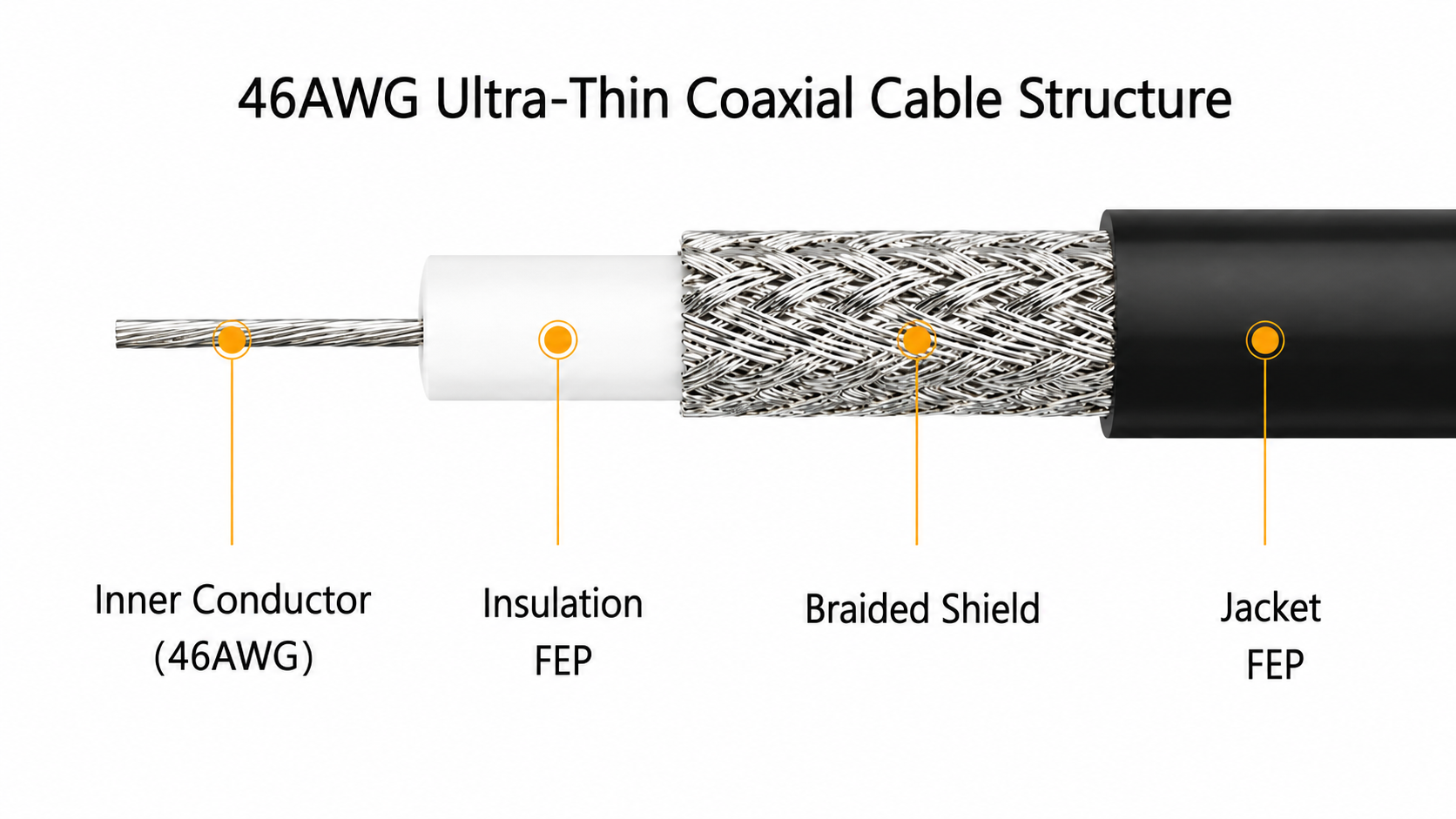
Improving flexibility in a 46AWG micro coaxial cable requires optimization of the complete cable structure rather than simply using softer materials. Conductor construction, shielding wire size, braid structure, jacket thickness, cable geometry, and manufacturing consistency can all influence bending behavior and long-term reliability.
If a 46AWG micro coaxial cable must operate in a repeatedly moving or space-constrained system → evaluate shielding structure and jacket construction together with cable OD and mechanical requirements → then verify that the optimized structure still maintains the required shielding and signal performance.
In this project, HOTTEN optimized the shielding wire diameter and outer jacket thickness to reduce mechanical resistance while maintaining the required cable structure. The shielding wire was changed from 0.02 mm to 0.018 mm, while the jacket thickness was reduced from 0.02 mm to 0.017 mm. The changes were followed by evaluation of bending, flex-cycle durability, tensile behavior, rebound characteristics, assembly handling, and signal consistency.
The broader engineering principle is that smaller dimensions do not automatically mean better flexibility. The interaction between conductor, dielectric, shielding, jacket, and termination must be considered as a complete cable architecture.
For related conductor-size considerations, see How Does AWG Affect Micro Coaxial Cable Performance?.
For the broader challenges of ultra-fine high-frequency cable construction, see Why Ultra-Fine High-Frequency Coaxial Cable Design Is So Difficult.
For customized cable structures, see HOTTEN's Micro Coaxial Cable and Micro Coaxial Cable Assembly solutions.
Compared with standard coaxial structures, 46AWG cables operate within an extremely limited dimensional tolerance range. Even minor material or structural changes can significantly influence cable behavior.
In practical applications, overly rigid cable assemblies may create several problems:
Increased stress concentration during repeated bending
Poor routing performance in compact internal spaces
Higher risk of conductor fatigue failure
Reduced assembly efficiency during manufacturing
Limited movement performance in robotic or dynamic systems
For high-end medical and imaging equipment, cable softness is especially critical. A more flexible cable can better adapt to multi-axis motion systems, compact hinge structures, and miniature rotating modules while reducing mechanical interference.
Therefore, improving softness while maintaining shielding stability became the key objective of this optimization project.
The first improvement focused on the shielding layer.
Originally, the shielding wire specification used a diameter of 0.02 mm. After extensive engineering evaluation and repeated testing, our team optimized the shielding wire diameter to 0.018 mm.
Although this adjustment appears very small numerically, the impact on cable flexibility is significant.
By reducing the shielding wire diameter:
The overall braid structure becomes more compliant
The cable achieves lower bending resistance
Internal mechanical stress during flexing is reduced
Dynamic movement performance improves noticeably
At the same time, our engineering team carefully balanced shielding density and structural integrity to ensure that signal protection performance remained stable after optimization.
For high-speed signal transmission systems, shielding effectiveness is essential to minimize EMI (Electromagnetic Interference) and maintain signal consistency. Therefore, the optimization process required precise control of braid coverage and manufacturing parameters rather than simply reducing material thickness.
The result is a softer cable structure with improved handling characteristics while preserving reliable electrical performance.
In addition to the shielding layer improvement, the outer jacket structure was also optimized.
The original jacket thickness of 0.02 mm was reduced to 0.017 mm.
This modification further enhanced the flexibility of the overall cable assembly.
The outer jacket plays several important roles in micro coaxial cable structures:
Mechanical protection
Insulation stability
Surface durability
Flex fatigue support
Environmental resistance
However, thicker jacket materials can also increase stiffness, especially in ultra-fine cable structures where every micron affects bending behavior.
Through careful material and process control, our engineering team successfully reduced the jacket thickness while maintaining stable extrusion quality and structural reliability.
After optimization, the cable demonstrated:
Improved softness
Better bending performance
Enhanced routing capability in confined spaces
Reduced rebound force after bending
More natural cable movement characteristics
These improvements are particularly beneficial for compact electronic devices requiring continuous motion or tight internal cable management.
The 46AWG optimization project demonstrates that cable flexibility is controlled by multiple structural parameters. Engineers should therefore evaluate flexibility as part of the complete cable design rather than treating softness as a material property alone.
If repeated bending is a primary requirement → evaluate shielding wire diameter, braid structure, coverage, and cable OD together → then verify whether the optimized shield still provides the required electrical protection.
Reducing shielding material can reduce bending resistance, but shielding cannot be optimized independently from EMI and structural requirements. The appropriate design should be validated under the actual mechanical and electrical conditions of the application.
For broader high-frequency shielding and impedance considerations, see The Importance of Impedance Consistency in Ultra-Fine AWG Micro Coaxial Cables.
If the cable requires lower bending resistance → evaluate jacket thickness and material → then verify mechanical protection, extrusion stability, environmental resistance, and flex life.
A thinner jacket may improve flexibility, but the jacket still needs to provide the required insulation, surface protection, and mechanical support. The correct thickness is therefore an engineering trade-off rather than simply the minimum possible value.
For related insulation and cable-construction considerations, see Comparison of Three High-Frequency Cable Foaming Technologies.
If flexibility is improved by changing the shielding or jacket structure → re-evaluate impedance, shielding stability, signal consistency, and cable geometry → then verify electrical performance on the finished cable.
Ultra-fine cable structures have limited dimensional tolerance, so a mechanical optimization can influence other properties of the complete cable.
This is why the development process in the 46AWG project included both mechanical and signal-related evaluation rather than using flexibility as the only acceptance criterion.
For the broader relationship between cable dimensions and high-frequency performance, see Why Ultra-Fine High-Frequency Coaxial Cable Design Is So Difficult.
The required cable flexibility depends on how the finished assembly moves inside the device.
If the cable is used in a medical imaging or endoscopic system → prioritize repeated bending, cable routing space, shielding stability, strain relief, and long-term mechanical reliability → then validate the finished assembly under the intended movement profile.
See HOTTEN's Medical Equipment, Ultrasound Probe Cable, and Endoscope Cable solutions.
If the cable is used in a UAV, gimbal, or robotic mechanism → prioritize low weight, compact OD, flex life, shielding, and dynamic routing → then validate bending and termination performance under actual movement conditions.
See HOTTEN's UAV & Robotics, Gimbal Camera Wire Harness, and Robotics Wire Harness solutions.
Before modifying an ultra-fine micro coaxial cable structure, the engineering team should define:
| Requirement | Parameters to Confirm |
|---|---|
| Cable Size | AWG, cable OD, available routing space |
| Shielding | Wire diameter, braid structure, coverage |
| Jacket | Material, thickness, extrusion consistency |
| Mechanical | Bend radius, flex cycles, torsion |
| Electrical | Impedance, attenuation, signal consistency |
| Interface | Connector type, termination, strain relief |
| Environment | Temperature, moisture, vibration and other conditions |
| Validation | Bending, flex-cycle, tensile and electrical testing |
| Production | Dimensional consistency and process stability |
If flexibility is the main problem → identify the structural source of stiffness → optimize shielding and jacket parameters → then validate mechanical and electrical performance together.
If the cable is already electrically compliant but too stiff for routing → evaluate shielding and jacket geometry before changing the conductor → because changing the conductor can create new electrical or mechanical constraints.
If the cable is flexible enough but the shielding structure becomes unstable → adjust braid parameters and material distribution → then revalidate EMI and signal performance.
If the prototype performs well but production variation is high → review extrusion, shielding, dimensional control, and process repeatability → then validate multiple production samples rather than relying on one prototype.
The practical development sequence is:
Identify stiffness source → adjust structural parameters → prototype → mechanical validation → electrical validation → production verification
The objective is not simply to make the cable softer. It is to achieve the required flexibility, shielding, electrical performance, dimensional stability, and production consistency simultaneously.
For customized ultra-fine cable development, see HOTTEN's Micro Coaxial Cable and Micro Coaxial Cable Assembly solutions.
Optimizing ultra-fine coaxial cables is far more complex than simply reducing dimensions.
When conductor structures become extremely small, manufacturing tolerances become increasingly sensitive. Small inconsistencies can directly affect:
Signal stability
Cable concentricity
Shielding uniformity
Mechanical lifespan
Production yield
For this reason, every adjustment in shielding wire diameter and jacket thickness required repeated validation through internal testing and production verification.
Our engineering team evaluated multiple performance factors, including:
Dynamic bending performance
Flex cycle durability
Tensile behavior
Cable rebound characteristics
Assembly handling performance
Signal transmission consistency
The final optimized structure was selected only after balancing both electrical and mechanical requirements.
The optimized flexible 46AWG micro coaxial cable structure is especially suitable for applications requiring miniature size and repeated movement.
Typical applications include:
Medical ultrasound systems
Endoscopic imaging devices
Surgical robotic systems
Drone HD image transmission modules
AR/VR wearable devices
Precision industrial cameras
Compact display interconnect systems
Portable diagnostic equipment
In these environments, softer cable structures help reduce internal stress accumulation and improve long-term operational reliability.
For moving systems such as robotic arms or rotating modules, flexibility directly contributes to cable lifespan and motion consistency.
As electronic devices continue evolving toward miniaturization, higher integration density, and dynamic motion capability, cable assembly engineering must also advance beyond traditional design approaches.
At Hotten, we continuously focus on optimizing ultra-fine interconnect solutions through material engineering, structural refinement, and precision manufacturing processes.
This 46AWG flexibility optimization project demonstrates how even micron-level structural improvements can create meaningful performance advantages in real-world applications.
By refining shielding wire dimensions and jacket thickness, we successfully developed a softer, more flexible micro coaxial cable structure capable of meeting the growing demands of next-generation electronic and medical systems.
In high-performance interconnect engineering, sometimes the smallest changes deliver the biggest improvements.
 Hot News
2026-09-17
2026-09-04
2025-12-17
2025-12-11
2025-12-05