 EN
EN
Quick Links

Accuracy is paramount to medical imaging. External electromagnetic and internal cable artifacts can cause a variety of problems from obscuring important anatomical structures to creating false pathology that stems from electrical noise rather than actual disease. This reduces diagnostic confidence in ultrasound procedures. The probe cable, acting as the connection between the transducer and the imaging system, is particularly vulnerable to interference. Hotten's shielded ultrasound probe cables employ an innovative combination of noise-reduction techniques that ensure that the signal being sent to the processor is clean, precise and artifact-free.
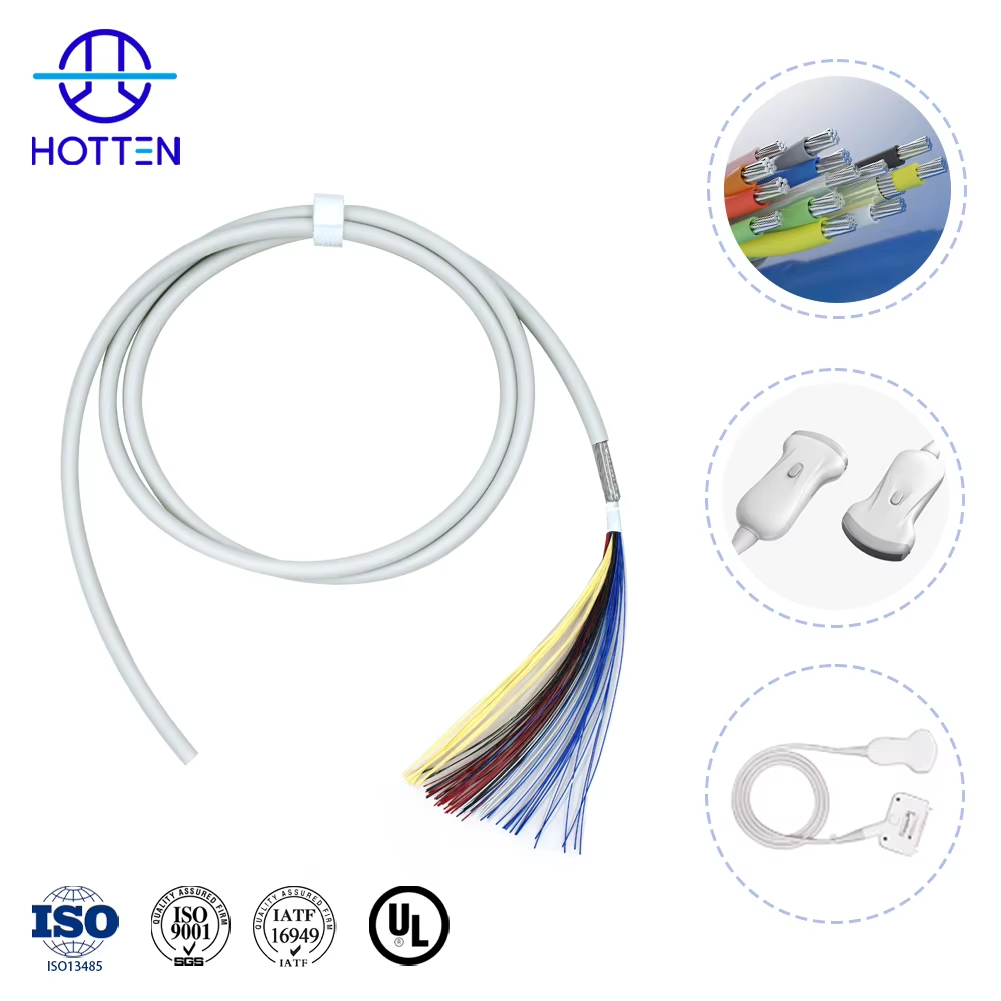
To effectively shield an ultrasound probe cable, it is first essential to understand the common sources of interference within the medical imaging environment. Image quality is threatened by two main sources of noise within ultrasound:
Electromagnetic Interference (EMI): abundant within a typical hospital or imaging center. Monitors, computers, electrosurgical units, fluorescent lights, and wireless devices all contribute to a high EMI background radiation level. In the absence of shielding, a standard ultrasound cable will act as an antenna and pick up external electrical noise, resulting in image interference.
Triboelectric Noise: Internal noise is generated within the cable itself. When a cable is flexed or bent, charge separation occurs between conductors and insulators through friction, resulting in voltage spikes or baseline shifts that interfere with the ultrasound waveform. Hotten's shielding methods combat both external and internal noise to provide a well-rounded solution.
Design of effective shielding is the first step in suppressing unwanted noise. Hotten's shields utilize a multi-layer system with complementary shielding techniques to maximize their effectiveness:
Aluminum-Polyester Foil Shield: The first layer is a 100% coverage foil shield, effective against high-frequency electromagnetic interference. A continuous conductive layer surrounds each wire pair and completely encloses each core wire in a Faraday cage which excludes external electrical fields.
High-Density Copper Braid Shield: Wrapped around the foil layer. This adds more protection against low frequency interference and provides a robust mechanical covering. The interlacing structure of a braided cable provides continued shielding performance despite repeated flexing, something foil alone cannot achieve, as it may fatigue and crack over time.
A dual shielding layer such as this can provide over 100 dB of shielding effectiveness throughout a broad frequency range, from 1MHz to over 1GHz; the external fields are prevented from entering and creating noise on the signal.
Not all conductors are equally sensitive in the cables of ultrasound probes. Hotten uses individually shielded twisted pairs in the most sensitive signal pathways. The two conductors are then each conductor is covered with a foil shield and then the foil shields are integrated into the complete cable assembly. This configuration provides:
Crosstalk Elimination: Avoids signal leakage between neighboring pairs, keeping channels separate and eliminating ghosting artifacts.
Isolation of Sensitive Signals: Isolates low-amplitude return signals of echoes produced by power conductors or by higher-voltage pulsing lines in the same cable.
Redundancy in Protection: Individual pair shielding is used in combination with the total cable shield, forming several layers of noise intrusion protection.
Anti-Microphonic Construction for Motion-Induced Noise
Triboelectric noise or interference from the movement of a cable can interfere significantly with the image display especially in procedures requiring a great deal of movement, such as cardiac and obstetric studies. Hotten's cables feature a anti-microphonic cable construction:
Semi-Conductive Layer: This is a thin carbon-infused coating placed between the conductor insulation and the shield helps balance out any electrical charges, preventing them from being transferred to the shield as an electrical pulse.
Precision-Stranded Conductors: Extremely fine conductors are used in Hotten's cable constructions which greatly minimize the movement between the individual wires and the insulation that they are enclosed within, further minimizing the generation of charges.
Lubricated Interfaces: The insulation layer is coated with either a PTFE or talc to allow ease of movement between that and the shield so that triboelectric effects are reduced when the cable is flexed.
As a result, the cable maintains signal integrity despite the physical stress of being moved about; essential in ultrasound where probe movement is constant and requires high fidelity diagnostic images regardless.
The connection point of the cable shield to the probe and system connectors is critical. A poorly terminated shield is provides little to no shielding effectiveness and can even actually increase the effective interference within a cable:
360-Degree Shield Termination: The system and probe connectors feature 360 degree termination of the shield without the use of pigtail leads to connect the shield. This allows for a continuous Faraday cage to encompass each sensitive wire pair thereby preventing them from acting as antennas and radiating interference throughout the cable system.
Low-Inductance Ground Paths: The electrical ground points are specifically designed with minimum inductance to readily pass high frequency interference into ground and away from the signal carrying wires.
Overmolded Shield Integration: The outside of the probe and system connectors is overmolded so that they physically shield the connection between the cable shield and the connector itself. Mechanical stress is prevented from damaging the ground integrity of the cable system.
Hotten confirms the effectiveness of their shielding technology with a wide variety of testing protocols:
Transfer Impedance Testing: Measures shield performance against high-frequency electromagnetic interference (up to 1 GHz). This verifies the signal attenuation capability.
EMI Chamber Testing: The entire cable assembly is tested in an EMI chamber where a controlled electromagnetic field can be applied to measure noise rejection performance.
Triboelectric Noise Measurement: This protocol places the cable through numerous cycles of repeated flex testing while continuously measuring the amount of noise generated to assure adequate triboelectric noise rejection performance.
These tests offer an objective measurement of the excellent noise rejection provided by Hotten's shielding technology.

| Design Factor | Performance Benefit |
|---|---|
| Foil Shielding | Provides broad EMI coverage |
| Braided Shielding | Improves mechanical strength and shielding continuity |
| Multi-Layer Shielding | Enhances protection in demanding environments |
| Shielding Coverage | Helps reduce electromagnetic interference |
| Flexible Shield Structure | Maintains shielding performance during repeated bending |
| Grounding Design | Helps control unwanted electrical noise |
Q1: Why does an ultrasound probe cable need shielding?
Shielding helps reduce electromagnetic interference and unwanted electrical noise that can affect sensitive ultrasound signals during transmission.
Q2: How does shielding reduce noise in ultrasound imaging systems?
A properly designed shielding structure helps prevent external electromagnetic interference from coupling into the signal conductors, supporting cleaner and more stable signal transmission.
Q3: Can poor cable shielding affect ultrasound image quality?
Yes. Excessive electromagnetic interference or signal noise can affect the quality and stability of transmitted ultrasound signals, potentially impacting imaging performance.
Q4: What shielding structures are used in ultrasound probe cables?
Depending on the application, ultrasound probe cables may use foil shielding, braided shielding, served shielding or combinations of different shielding structures.
Q5: Does shielding affect ultrasound probe cable flexibility?
It can. Shielding design must balance electromagnetic protection with bending flexibility, especially for probes that are repeatedly moved during medical examinations.
Q6: Can HOTTEN customize shielded ultrasound probe cables?
Yes. HOTTEN can customize cable construction, shielding structure, conductor configuration, cable length, jacket material and connector assembly according to medical equipment requirements.
Noise in medical imaging is not merely an inconvenience—it is a potential threat to diagnostic accuracy. Hotten’s shielded ultrasound probe cables combine multi-layer shielding architectures, individual pair protection, anti-microphonic construction, and precision termination to create a comprehensive noise suppression system. By blocking external EMI, eliminating crosstalk, and neutralizing motion-induced artifacts, these cables ensure that the image displayed reflects true anatomy—not electrical interference. In the pursuit of diagnostic clarity, Hotten’s shielding technology provides the silent, stable foundation upon which accurate diagnoses are built.
 Hot News
2026-09-17
2026-09-04
2025-12-17
2025-12-11
2025-12-05