
+86-13912615597 [email protected]
All Categories
embracing sustainability our rd in eco friendly pfas free cable materials-0

Technical Articles

Home >  News >  Technical Articles

Embracing Sustainability Our R&D in Eco-Friendly, PFAS-Free Cable Materials

Nov 07, 2025

High performance at Hotten Electronic Wire does not only constitute half the story. As we take high-temperature materials like PEEK to the greatest extent possible in the most extreme environments, we also have the goal of creating solutions and services that are good here on our planet and for our people. We are very pleased to introduce today our ongoing R&D on a ground-breaking PFAS-Free super material.

Fluorocarbon materials have long been the source of the insulation capabilities and thermal properties of the electronics wire industries. However, a highly significant environmental issue in modern times is Per- and polyfluoroalkyl substances (PFAS) or so-called forever chemicals due to their persistence and possible toxicity.

Such materials are the future, and overcoming them is one of the keys to survival. Our news is related to a next-level polymer that offers uncompromising performance and is the next giant leap in our green materials strategy.

Main benefits of our new PFAS-free material:

Eco-friendly and Biocompatible: The best feature of the material is its fluorine-free character. It is a much safer one, reducing the ecological footprint of the whole product life cycle and reducing the potential health hazards when being used and being produced. It complies with the increasing global control trend to restrict PFAS.

Superior Electricity Performance: The material has a superior electricity performance (the loss is less than or equal to 0.003). The dielectric constant in a wide frequency range and stable (2.17±0.02), making it an excellent choice for high frequency applications such as PCBs, semiconductor test sockets, PC modules, and mobile communication devices good insulation properties make you use. It meets with high electrical performance for data-sensitive transmission.

High Temperature Resistance and Lightweight: It can work well in high-temperature environments. On top of that, it is low in density, thus it would be a preferred material for weight-sensitive applications, like in drones and portable AR/VR devices.

Concept Exploration into Practice: Sample Availability and Manufacturing Readiness

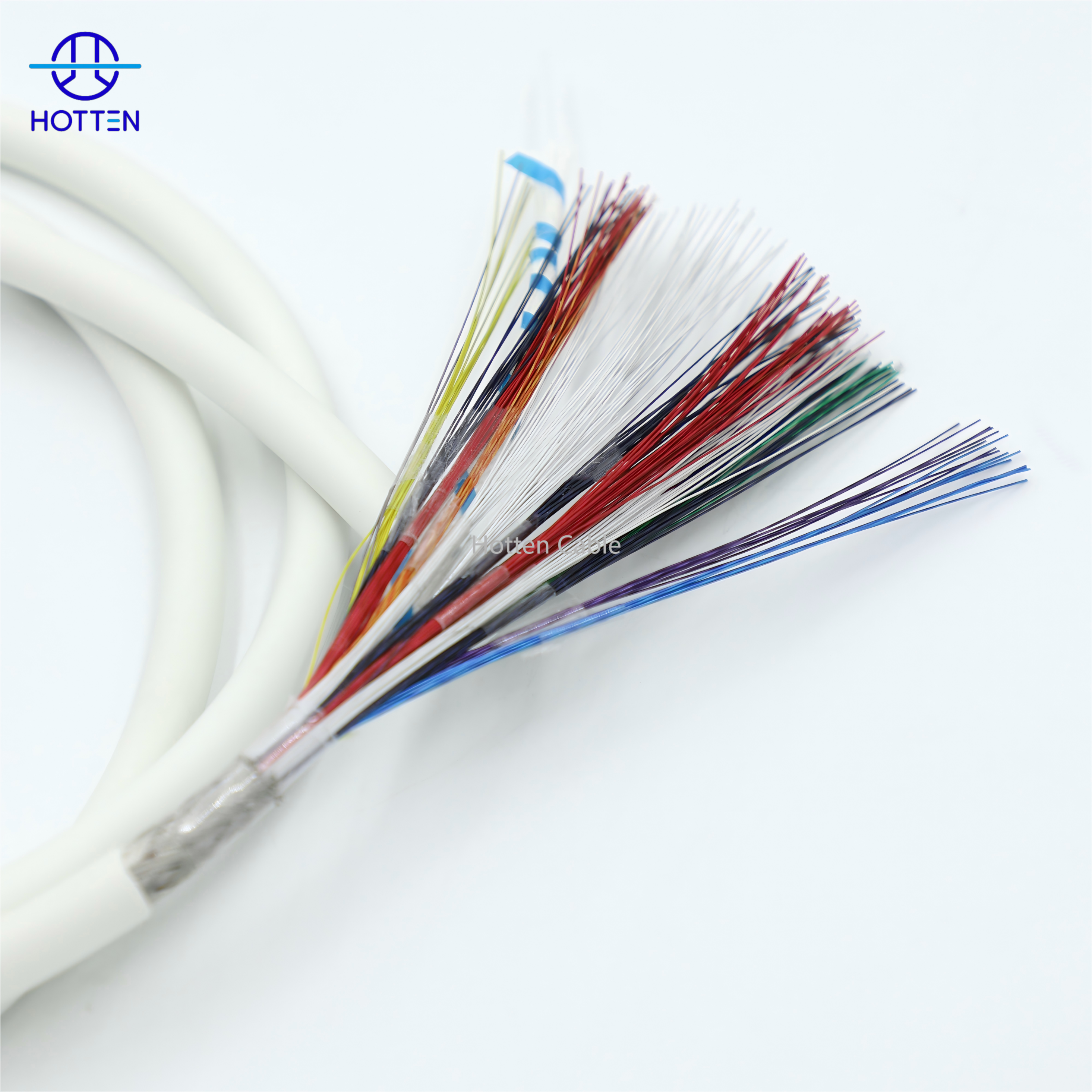
We are already seeing the benefits of our investment in this technology. We have conducted successful sample development with cables of this PFAS-Free material. And our capacity now spans from 30 to 46 AWG, we can fulfill the ends for power and micro signal transmission as well.

What Should OEMs Consider When Selecting PFAS-Free Cable Materials?

Direct Answer

PFAS-free cable materials can help OEMs address material-reduction and sustainability goals, but the correct material should be selected according to the electrical, mechanical, thermal, chemical, and manufacturing requirements of the finished cable.

For electronic wire and micro coaxial cable, changing the insulation material can affect:

dielectric performance + cable OD + flexibility + temperature resistance + chemical resistance + processing + long-term reliability

Therefore, PFAS-free should be treated as an engineering requirement, not simply as a label indicating that one material is automatically better than another.

OEM requirement What should be evaluated
PFAS-related material requirement Which substances are restricted and what documentation is required
Electrical performance Dielectric properties, capacitance, impedance and insulation
Cable OD Insulation thickness and overall dimensional limits
Flexibility Material hardness, thickness and cable construction
Temperature Continuous and peak operating conditions
Chemical exposure Cleaning agents, solvents and other chemicals
Mechanical durability Abrasion, bending and fatigue
High-frequency performance Dielectric behavior and signal-loss requirements
Manufacturing Extrusion, processing and termination compatibility
Compliance documentation Material declarations, specifications and test evidence

If an OEM requires PFAS-free construction, then the material selection should start from the complete product specification rather than replacing one insulation material with another by name, because the replacement must still satisfy the cable's electrical and mechanical requirements.

Traditional Cable Materials vs PFAS-Free Cable Materials

Material Type Advantages Limitations Typical Applications
PFAS-Based Fluoropolymer Materials Excellent chemical resistance, high temperature stability, low friction and reliable electrical performance Environmental concerns and increasing regulatory pressure Aerospace, medical devices, high-performance electronics
PFAS-Free Alternative Materials Reduced environmental impact, improved sustainability compliance and future regulatory adaptability Requires continuous R&D to achieve equivalent thermal and electrical performance Sustainable electronics, medical equipment, consumer electronics
Silicone Materials Excellent flexibility, temperature resistance and biocompatibility Lower mechanical strength compared with some fluoropolymers Medical cables, wearable devices, flexible cable assemblies
TPE / TPU Materials Lightweight, flexible and recyclable potential Performance varies depending on formulation Consumer electronics, industrial cable assemblies

What Should OEMs Consider When Selecting PFAS-Free Cable Materials?

The Future is PFAS-Free

PFAS-free is not a fad; it's the future of sustainable manufacturing. This brand-new material platform creates a strong base for our cable solutions of the future. It is an ideal solution for applications in which both environmental compliance and user safety are needed, such as:

Consumer-Tech AR/VR Headsets: Safer extended skin-contact.

Industrial Drones Reimagined: Less weight and less waste.

Advanced Medical Wearables: A designed biocompatible and safe cable solution.

At Hotten Electronic Wire, we feel that innovation and conservation must walk together on the way to prosperity. Our PFAS-Free material development, in concert with our PEEK advancements, illustrates both our dual commitment–breaking barriers to performance and progress towards a more sustainable future.

We are prepared to work together on your upcoming project using our new PFAS-Free cables. Reach out to us to inquire about samples and explore how you can incorporate this sustainable solution in your designs.

Engineering Selection and OEM Considerations

1. PFAS-Free Should Be Defined as a Specific Material Requirement

“PFAS-free cable” can be too broad for an engineering drawing.

Before selecting materials, OEMs should define:

  • Which substances or material families are restricted
  • Whether the requirement applies to insulation only or the complete assembly
  • Whether connectors, adhesives, jackets and overmolds are included
  • What supplier documentation is required
  • Whether third-party testing is required

If the PFAS-related requirement applies to the complete cable assembly, then all relevant materials and components should be reviewed, because the insulation is only one part of the finished product.

2. Insulation Material Must Still Meet Electrical Requirements

Cable insulation is part of the electrical structure, especially in fine wire and micro coaxial cable.

Important parameters include:

Electrical factor Why it matters
Dielectric constant Influences capacitance and transmission characteristics
Dissipation / dielectric loss Can affect high-frequency attenuation
Insulation resistance Supports electrical isolation
Breakdown strength Relevant to dielectric withstand
Thickness uniformity Helps maintain consistent cable geometry
Surface quality Affects processing and downstream termination

If the cable carries high-speed or RF signals, then the replacement insulation should be evaluated for its dielectric characteristics as part of the complete cable design, because changing insulation can change capacitance, impedance and signal behavior.

For related high-frequency applications, see Micro Coaxial Cable and RF Coaxial Cable Assembly.

3. PFAS-Free and Miniaturization Can Create a Design Trade-Off

Ultra-fine electronic wire and micro coaxial cable often require extremely thin insulation layers.

The material therefore needs to provide the required electrical and mechanical performance within a small dimensional envelope.

If the OEM requires both PFAS-free insulation and very small cable OD, then insulation thickness, dielectric properties, extrusion stability and mechanical performance should be evaluated together, because changing the insulation material can affect the complete cable geometry.

This is especially important for:

  • 40AWG / 42AWG / 44AWG fine wire
  • Micro coaxial cable
  • High-density medical cables
  • Camera assemblies
  • UAV and robotics cable assemblies

4. Flexibility Must Be Evaluated After Material Changes

Different insulation materials can behave differently during repeated bending.

Relevant characteristics include:

  • Hardness
  • Elongation
  • Flexural behavior
  • Fatigue resistance
  • Friction
  • Adhesion
  • Temperature dependence

If a cable is used in a dynamic application, then a PFAS-free insulation change should be validated under representative flex conditions, because a material that works electrically may still change the cable's bending behavior or flex life.

For flexible applications, see Ultrasound Probe Cable and UAV & Robotics.

5. Temperature Resistance Cannot Be Evaluated in Isolation

Some traditional high-performance fluoropolymer systems are selected specifically because of their thermal and electrical properties.

When evaluating a PFAS-free alternative, OEM engineers should compare:

continuous temperature + peak temperature + thermal cycling + mechanical performance at temperature

If the cable operates near its material limits, then the PFAS-free alternative should be evaluated under the actual thermal profile, because room-temperature test results do not demonstrate long-term performance at elevated temperatures.

6. Chemical Resistance Is an Application-Specific Requirement

One reason certain high-performance cable materials are used in demanding environments is their resistance to chemicals.

A PFAS-free alternative should therefore be evaluated against the actual exposure conditions:

Exposure What to evaluate
Cleaning agents Surface and material compatibility
Disinfectants Long-term chemical stability
Solvents Swelling / cracking / degradation
Oils Surface and insulation resistance
Moisture Water resistance and aging
Sterilization Process-specific compatibility

If the cable will be exposed to cleaning chemicals or sterilization, then the actual chemical/process conditions should be included in material qualification, because general chemical-resistance claims do not establish compatibility with every application.

7. Sustainable Material Selection Should Not Ignore Cable Performance

A lower-impact material is useful only if the finished cable still performs as required.

OEM material selection should balance:

sustainability requirement ↔ electrical performance ↔ mechanical performance ↔ manufacturing capability ↔ service life

If a PFAS-free material meets the sustainability requirement but requires substantially greater thickness or reduces flex life, then the complete cable design should be reviewed before approval, because a material change can shift the performance of the entire assembly.

8. Manufacturing Process Compatibility Is a Key Qualification Point

A material may have suitable laboratory properties but still be difficult to process consistently into ultra-fine cable.

Important manufacturing considerations include:

  • Extrusion temperature
  • Melt behavior
  • Die design
  • Line speed
  • Insulation thickness
  • Concentricity
  • Surface quality
  • Cooling conditions
  • Stripping performance
  • Termination compatibility

If the cable uses ultra-fine conductors, then the insulation material should be qualified together with the production process, because small dimensional variations become more significant as the cable size decreases.

This is particularly relevant to HOTTEN's fine-wire and micro coaxial manufacturing.

9. PFAS-Free Insulation Can Affect Cable OD

For high-density cable assemblies, a small change in insulation thickness can have a significant effect on the final dimensions.

The resulting chain is:

material → insulation thickness → cable OD → routing space → connector integration

If the device has a tightly constrained mechanical envelope, then the PFAS-free insulation should be evaluated against the maximum allowable cable OD, because the material change should not create an assembly that no longer fits the device.

10. High-Frequency Applications Need a Dielectric Comparison

For micro coaxial and RF cable applications, a material change should be assessed using actual electrical parameters rather than environmental claims alone.

OEM engineers can compare:

Parameter Material-selection question
Dielectric constant Does it meet the required cable design?
Dielectric loss Is attenuation within the system budget?
Capacitance Does the cable maintain the required electrical loading?
Impedance Can the target impedance be maintained?
Temperature stability Do properties remain stable over the operating range?
Processing Can the required cable geometry be manufactured consistently?

If the cable operates at high frequency, then dielectric properties should be validated on the finished cable construction, because the material's nominal datasheet values do not by themselves define the performance of the final miniature coaxial structure.

11. Medical Applications Require Additional Material Review

For medical cable assemblies, material selection may be affected by:

  • Patient contact
  • Cleaning and disinfection
  • Sterilization
  • Long-term flexibility
  • Chemical exposure
  • Device-specific biological evaluation

If the finished cable can contact the patient or body, then the OEM should assess the material configuration within the applicable medical-device biological evaluation process, because a material being PFAS-free does not automatically establish its biological suitability.

For medical applications, see Medical Cable Assembly.

12. The Complete Cable Assembly Should Be Evaluated

A PFAS-related material change may affect more than the wire insulation.

The complete assembly can contain:

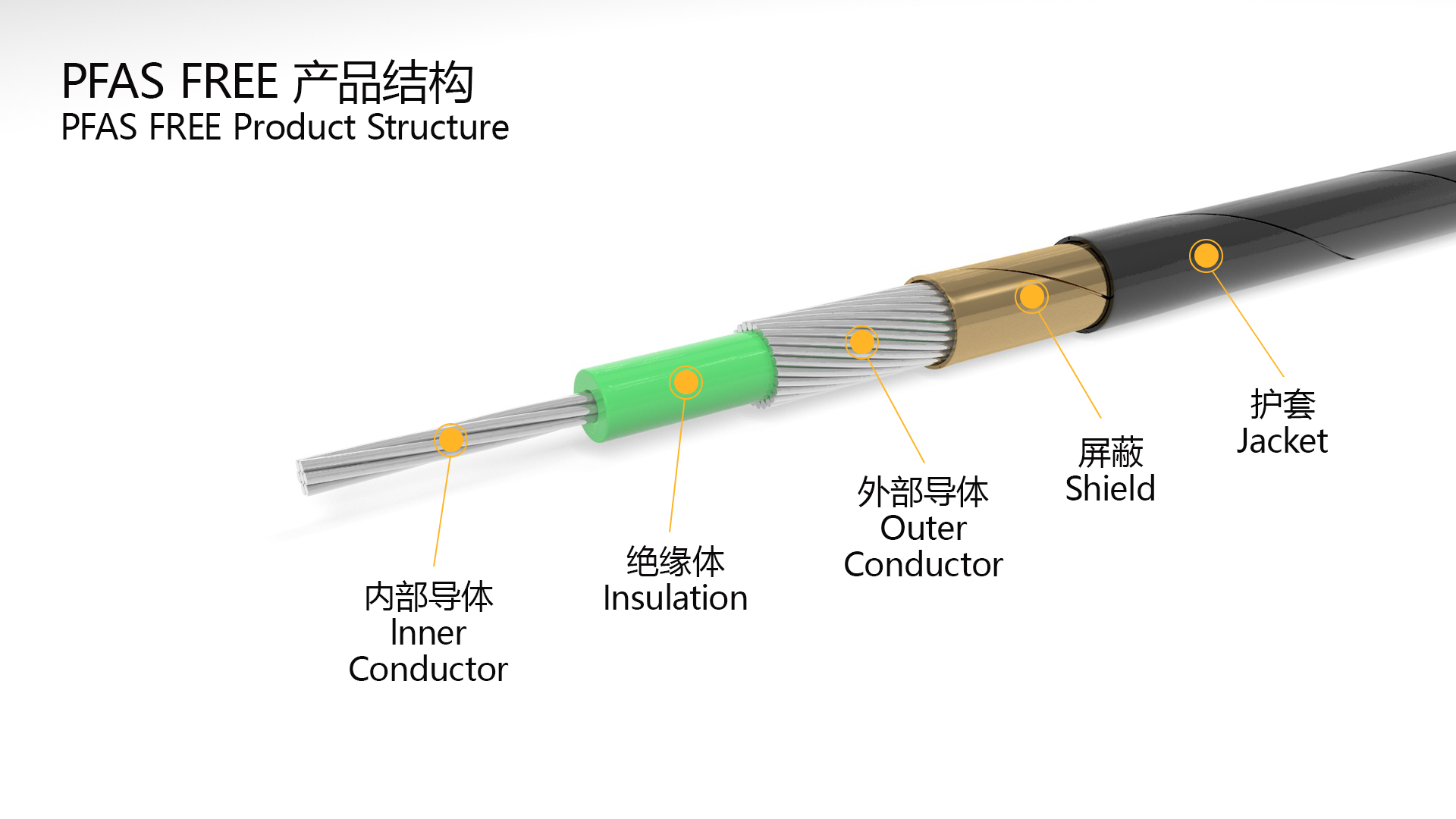
conductor + insulation + dielectric + shield + jacket + adhesive + connector + strain relief + overmold

If an OEM wants a PFAS-free finished assembly, then the material review should cover all applicable components, because the final product may contain several different polymeric or processed materials.

13. Documentation Is Part of OEM Material Qualification

For OEM purchasing, the supplier should be able to identify the material construction clearly.

Useful documentation may include:

Documentation Purpose
Material specification Defines the approved material
Supplier declaration Documents material information
Technical datasheet Provides electrical / thermal / mechanical data
Test report Supports specific qualification requirements
BOM Identifies materials and components
Engineering drawing Defines approved cable construction
Change-control records Controls later material changes
Traceability Supports production investigation

If PFAS-free status is a formal customer requirement, then the exact scope and evidence should be agreed during the RFQ stage, because “PFAS-free” can otherwise be interpreted differently by different suppliers.

14. OEM RFQ Requirements for PFAS-Free Cable

A practical RFQ should specify:

RFQ item Recommended information
PFAS requirement Restricted substances / defined scope
Application Medical, RF, camera, UAV, robotics, etc.
Conductor AWG and material
Insulation Required material / approved alternatives
Cable OD Maximum allowable diameter
Frequency Operating range where relevant
Capacitance Target / maximum where applicable
Impedance Required value where applicable
Flexibility Bend radius and cycle requirements
Temperature Operating and processing range
Chemical exposure Cleaning / disinfectant / solvent conditions
Sterilization Method and cycle requirements where applicable
Shielding Required construction
Connector Manufacturer / part number
Testing Electrical / mechanical / environmental tests
Documentation Material declarations and test evidence
Quantity Prototype / pilot / mass production

If the OEM has not finalized the insulation material, then the RFQ can specify the required performance envelope and PFAS-related restrictions, because the cable manufacturer can evaluate suitable material options before the construction is locked.

15. Material Selection Should Follow the Actual Device Requirement

A useful selection process is:

Define restriction → Define electrical requirements → Define mechanical requirements → Define environmental conditions → Compare materials → Prototype → Validate → Approve → Control production

This avoids treating PFAS-free as an isolated purchasing specification.

If a PFAS-free material satisfies the environmental requirement while maintaining the necessary electrical, mechanical and manufacturing performance, then it can become part of the approved cable construction, because the material has been selected against the complete engineering requirement rather than a single attribute.

For HOTTEN's fine-wire and custom cable projects, see Thin Electronic Wire, Micro Coaxial Cable, and Micro Coaxial Cable Assembly.

FAQ

Q1: What are PFAS-free cable materials?

A: PFAS-free cable materials are insulation or jacket materials developed without intentionally added per- and polyfluoroalkyl substances (PFAS). They aim to provide reliable cable performance while reducing environmental impact.


Q2: Why are PFAS-free materials becoming important in cable manufacturing?

A: PFAS-free materials are becoming important because industries are focusing more on sustainable manufacturing, environmental regulations and safer material selection throughout the product lifecycle.


Q3: Can PFAS-free cable materials provide the same performance as traditional fluoropolymer materials?

A: PFAS-free alternatives are continuously improving. Their performance depends on material formulation and application requirements, including temperature resistance, flexibility, electrical properties and durability.


Q4: What industries require sustainable cable materials?

A: Sustainable cable materials are increasingly considered in industries such as medical equipment, consumer electronics, automotive electronics, industrial automation and advanced electronic devices.


Q5: What factors should engineers consider when selecting PFAS-free cable materials?

A: Engineers should evaluate electrical performance, operating temperature, flexibility, mechanical durability, regulatory requirements and compatibility with the final application.


Q6: Can Hotten provide customized cable solutions using eco-friendly materials?

A: Yes. Hotten focuses on customized cable solutions and can work with customers to evaluate suitable insulation materials, cable structures and performance requirements for specific applications.

If you have any suggestions, please contact us

CONTACT US

Get a Free Quote

Our representative will contact you soon.
Email
Phone number
Company Name
Message
0/1000
embracing sustainability our rd in eco friendly pfas free cable materials-1 embracing sustainability our rd in eco friendly pfas free cable materials-2 embracing sustainability our rd in eco friendly pfas free cable materials-3 embracing sustainability our rd in eco friendly pfas free cable materials-4 embracing sustainability our rd in eco friendly pfas free cable materials-5