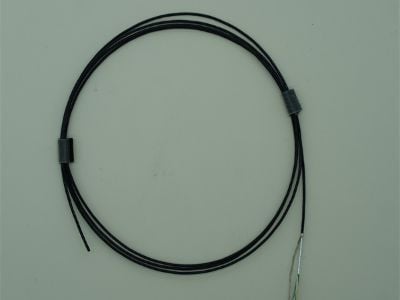
Micro coaxial cables are compact signal cables used in applications where space, signal integrity, and reliable electrical performance are critical. They are widely used in medical devices, telecommunications, consumer electronics, aerospace, imaging equipment, and other high-density electronic systems.
For B2B buyers, choosing a micro coaxial cable supplier involves more than comparing unit prices. The supplier must be able to meet the required electrical specifications, mechanical constraints, quality requirements, production volumes, and customization needs.
A micro coaxial cable is a miniature coaxial cable consisting of a center conductor, dielectric insulation, shielding layer, and outer jacket or protective structure.
Its coaxial construction helps control signal transmission and reduce the influence of electromagnetic interference. Compared with conventional coaxial cables, micro coaxial cables are designed for applications where limited space and high-density signal routing are important.
Depending on the application, specifications such as impedance, conductor size, cable diameter, attenuation, shielding, bend radius, and operating frequency need to be carefully evaluated.
5 Factors to Consider When Choosing a Micro Coaxial Cable Supplier
1. Electrical and Signal Performance
The supplier should be able to provide cable designs that meet the required electrical specifications.
Important parameters may include:
- Characteristic impedance
- Attenuation
- Return loss
- Shielding effectiveness
- Crosstalk
- Operating frequency
- Capacitance
For high-speed or high-frequency applications, consistent electrical performance is particularly important because small variations in cable construction can affect signal integrity.
2. Customization and Engineering Capability
Many OEM applications cannot use standard off-the-shelf micro coaxial cables.
The supplier should be capable of customizing:
- Cable diameter and length
- Conductor configuration
- Shielding structure
- Connector type
- Termination
- Bend and flex requirements
- Cable assembly geometry
For medical devices and compact electronic equipment, engineering support during the design stage can also help ensure that the cable fits the available mechanical space.
3. Manufacturing and Quality Control
A supplier's manufacturing capability directly affects consistency between production batches.
B2B buyers should evaluate whether the manufacturer has appropriate process controls, inspection procedures, testing equipment, and traceability systems.
For high-volume OEM projects, stable production processes are particularly important because even small variations in cable dimensions or electrical characteristics can affect final product performance.
4. Production Capacity and Delivery Reliability
Production capacity should be considered together with actual manufacturing experience.
A supplier may be able to produce prototypes but struggle when an OEM project moves into mass production. Buyers should therefore evaluate:
- Prototype capability
- Pilot production
- Mass-production capacity
- Lead times
- Production scalability
- Raw-material supply
- Delivery consistency
A supplier capable of supporting the complete transition from prototype to volume production can reduce supply-chain risk.
5. Technical Support and Long-Term Reliability
Micro coaxial cable projects often require engineering communication between the cable supplier and the customer's electrical and mechanical teams.
A capable supplier should be able to review drawings, discuss technical specifications, recommend suitable cable structures, support prototype development, and address quality issues during production.
For long-term OEM programs, technical support and product traceability can be just as important as the initial cable price.
How B2B Buyers Can Streamline Micro Coaxial Cable Sourcing
Before requesting a quotation, buyers should prepare as much technical information as possible.
Useful information includes:
- Required cable length
- Cable diameter
- Impedance
- Operating frequency
- Required attenuation
- Connector specifications
- Flex or bend requirements
- Operating temperature
- Shielding requirements
- Annual demand
- Prototype quantity
- Target production schedule
Providing these specifications allows manufacturers to evaluate the application more accurately and reduces unnecessary quotation and sampling cycles.
Custom Micro Coaxial Cable Solutions from Hotten
Hotten supports OEM customers requiring customized micro coaxial cables and cable assemblies for demanding electronic applications.
Our engineering team can work with customers on cable construction, electrical specifications, mechanical dimensions, connector integration, and production requirements.
For projects that require more than a standard cable, a customized design can provide better integration with the final device while supporting consistent performance during volume production.
Conclusion
Choosing the right micro coaxial cable supplier requires evaluating more than price. Electrical performance, customization capability, manufacturing quality, production capacity, delivery reliability, and engineering support should all be considered during supplier selection.
For B2B buyers, selecting a supplier capable of supporting both development and mass production can reduce technical risk and simplify long-term sourcing.
FAQ
What should I look for in a micro coaxial cable supplier?
Key factors include electrical performance, manufacturing quality, customization capability, production capacity, testing capabilities, delivery reliability, and technical support.
Can micro coaxial cables be customized for OEM applications?
Yes. Micro coaxial cables can be customized for cable diameter, length, impedance, shielding, connectors, termination, bend requirements, and other application-specific specifications.
What information should I provide when requesting a micro coaxial cable quotation?
Useful information includes cable dimensions, impedance, operating frequency, attenuation requirements, connector type, cable length, flex requirements, annual volume, and application environment.
What is the difference between a micro coaxial cable supplier and a cable assembly manufacturer?
A cable supplier may primarily provide cable itself, while a cable assembly manufacturer can additionally provide termination, connectors, overmolding, testing, and complete customized assemblies.
Why is manufacturing capacity important when selecting a micro coaxial cable supplier?
A supplier needs sufficient production capability to maintain consistent quality and delivery when a project moves from prototypes to larger OEM production volumes.

 EN
EN