 EN
EN
Quick Links

When sourcing a custom medical cable, many OEM engineers and purchasing teams are not sure what information they need to provide to a cable manufacturer.
Sometimes the customer has a complete cable drawing and BOM. In other cases, the only information available may be a connector part number, an existing cable sample, or a basic description of the medical device.
So, what does a medical cable manufacturer actually need to prepare a useful quotation?
A connector part number alone is usually not enough to quote a complete medical cable assembly accurately.
For a faster and more reliable quotation, a supplier should ideally receive information about the cable structure, connector, pin assignment, cable length, conductor configuration, shielding, electrical requirements, mechanical requirements, quantity, and application.
However, you do not always need a complete engineering drawing before contacting a custom cable manufacturer.
If your project is still in development, a connector model, application description, existing sample, photos, or preliminary specifications can still be useful for an initial engineering evaluation.
A connector determines how a cable interfaces with a medical device, but it does not define the entire cable assembly.
For example, a customer may provide a connector model such as a board-to-wire connector or a miniature medical connector.
The manufacturer may still need to know:
How many conductors are required?
What conductor size or AWG is needed?
Is the cable single-ended, differential, coaxial, or multi-core?
Is shielding required?
What is the required cable length?
What is the maximum cable diameter?
What type of termination is required?
What is the pin assignment?
What are the electrical requirements?
How will the cable move or bend inside the device?
Two cable assemblies can use the same connector while having completely different internal structures.
This is particularly important for medical applications where compact dimensions, signal integrity, flexibility, and routing constraints often need to be considered together.
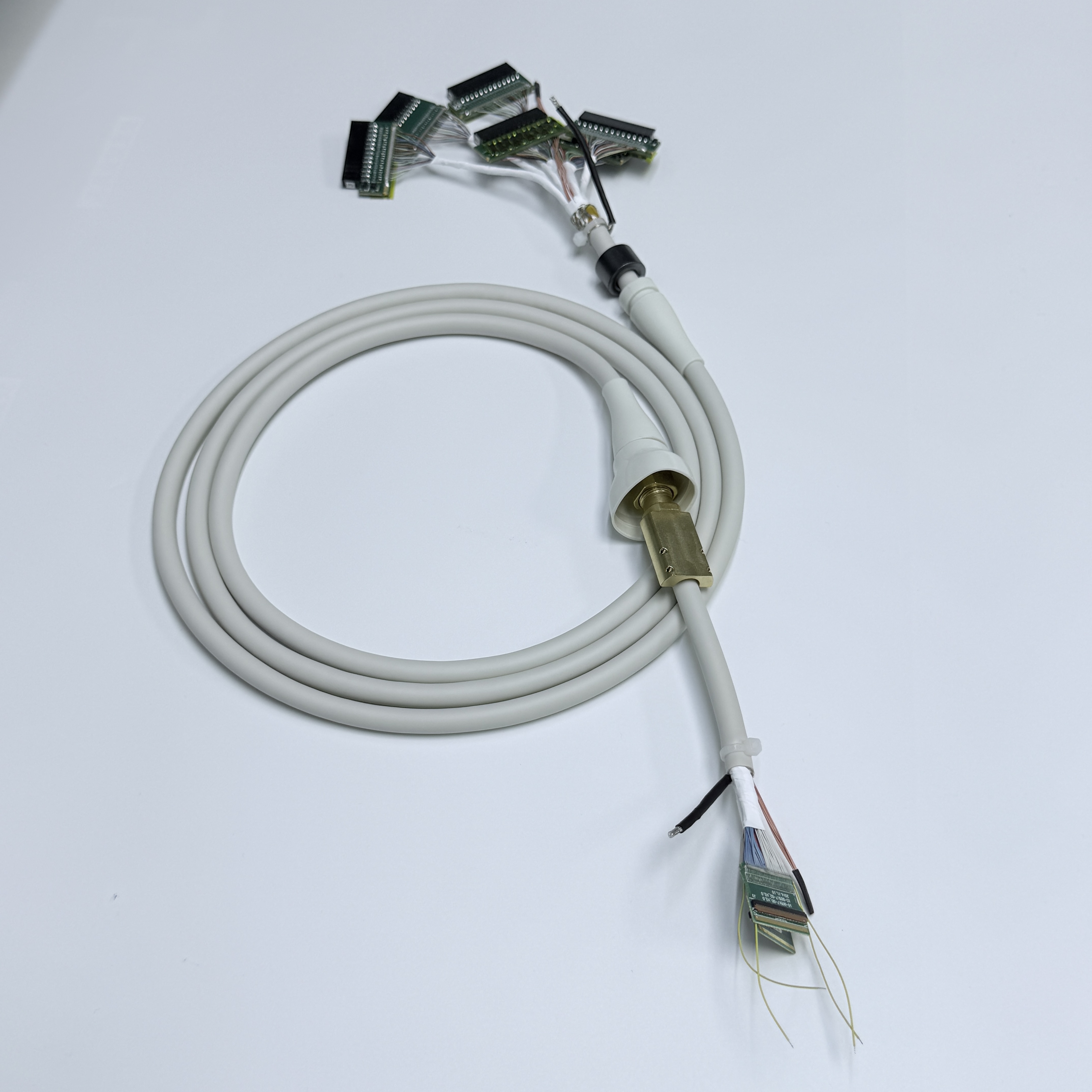
For example, an ultrasound probe cable may contain a large number of fine conductors or micro coaxial structures. The connector is only one part of the overall engineering solution.
 2. What Information Should You Send for a Medical Cable RFQ?
A useful RFQ does not necessarily need to contain dozens of technical parameters.
The most important information can be divided into several groups.
Start with the basic cable configuration.
Useful information includes:
| Requirement | Example |
|---|---|
| Cable type | Medical cable / micro coaxial cable / multi-core cable |
| Number of conductors | 12 / 32 / 64 / 128 / customized |
| Conductor size | 36 AWG / 40 AWG / 44 AWG |
| Cable diameter | Maximum or target OD |
| Cable length | 500 mm / 1 m / customized |
| Shielding | Individual / overall / both |
| Insulation | PVC / TPU / silicone / FEP / PFA |
| Jacket | PVC / TPU / silicone / other |
| Flexibility | Fixed installation / repeated bending |
These specifications help the supplier determine whether a standard structure is suitable or whether a custom cable construction is required.
If you already know the connector model, include it.
A connector part number is particularly valuable because it allows the manufacturer to identify the basic interface and assembly requirements.
Where possible, provide:
Connector manufacturer
Connector part number
Number of contacts
Pitch
Plug or receptacle
Mating connector information
Termination method
Connector drawing
Connector-side photos
For example, a customer may provide an I-PEX, Hirose, Molex, JAE, or other connector part number.
This is a useful starting point, but the manufacturer still needs to understand how the connector will be integrated into the cable assembly.
If you only have the connector model, simply tell the supplier:
“This is the connector currently specified for our device. We need a customized medical cable assembly around this interface.”
That gives the engineering team a starting point for discussion.
For a custom cable assembly, knowing the connector is not the same as knowing the electrical connection.
The supplier may also need the pin assignment.
For example:
| Pin | Function |
|---|---|
| 1 | Signal 1 |
| 2 | Signal 2 |
| 3 | Ground |
| 4 | Signal 3 |
| 5 | Power |
| ... | ... |
For a high-density medical cable, the pinout can affect conductor arrangement, shielding, termination and assembly.
If the customer does not yet have a finalized pin assignment, the supplier should know that the design is still under development rather than assuming a fixed configuration.
Electrical requirements become particularly important when the cable carries sensitive signals.
Depending on the application, the manufacturer may need to evaluate:
Impedance
Capacitance
Resistance
Voltage
Current
Signal frequency
Attenuation
Shielding
Crosstalk
Signal integrity requirements
For an ultrasound probe cable, for example, capacitance and cable structure can become important design considerations because the cable may carry a large number of sensitive channels.
For high-frequency or high-speed applications, micro coaxial cable may be considered instead of a conventional multi-core cable.
The important point is that the cable should be selected according to the actual electrical requirements of the medical device rather than simply choosing the smallest available wire.
A medical cable can have acceptable electrical performance and still fail to work properly in the actual device.
Why?
Because the cable also has to fit and move within the equipment.
Important mechanical information can include:
Maximum cable diameter
Minimum bend radius
Cable length
Flexibility
Repeated bending
Torsion
Routing direction
Installation space
Strain relief
Jacket material
Connector orientation
This becomes especially important for equipment such as ultrasound probes, endoscopes, surgical instruments and other handheld or moving medical devices.
For these applications, fine wire and compact cable structures may be required to achieve the necessary combination of size and flexibility.
One of the most useful pieces of information is often the simplest:
What does the cable do?
Instead of only saying:
“We need a 1-meter cable with this connector.”
You can provide:
“This cable connects an ultrasound probe to the imaging system.”
Or:
“This cable is installed inside a dental imaging device.”
Or:
“This is a flexible cable for an endoscopic imaging module.”
Application information gives the custom cable manufacturer engineering context.
For example, an ultrasound probe cable may require high channel density and controlled electrical characteristics.
An endoscope cable may place greater emphasis on compact routing and repeated bending.
A patient-monitoring cable may have different conductor, shielding and termination requirements.
The application does not replace technical specifications, but it helps the manufacturer understand why those specifications matter.
An existing cable sample can be extremely useful.
This is common when an OEM wants to:
Replace an existing supplier
Develop a second source
Reduce cost
Improve cable performance
Solve a supply problem
Reproduce an existing cable
Develop a modified version
If you have an existing cable, you can send:
Cable sample
Connector information
Cable length
Photos
Device application
Existing drawing, if available
Required quantity
The manufacturer can then evaluate the cable structure and determine what additional information is required.
For a custom medical cable, a physical sample can sometimes communicate details that are difficult to describe in an email.
This is one of the most common situations during early-stage development.
If the only confirmed information is a connector part number, you can still contact a medical cable manufacturer.
Instead of waiting until the entire design is finished, provide whatever information is already available:
Connector manufacturer
Connector part number
Medical device application
Estimated cable length
Approximate quantity
Number of signals or conductors, if known
Any known electrical requirements
Any dimensional restrictions
Target development stage
Then explain what is still unknown.
For example:
“We are developing a new medical imaging device. The connector has already been selected, but the cable structure has not yet been finalized. We need a manufacturer to evaluate the cable assembly based on the connector and application requirements.”
This is a much better RFQ starting point than simply sending a connector number with the message:
“Please quote.”
A capable supplier should be able to identify the missing information and help determine what needs to be clarified before production.
Once the basic technical requirements are understood, purchasing teams usually want to know:
What determines the price of a custom medical cable?
Several factors can have a significant impact:
A simple multi-core cable is generally different from a high-density micro coaxial cable in terms of materials and processing requirements.
Ultra-fine conductors can require more specialized processing and assembly.
Connector type, quantity, termination method and assembly complexity all affect the final cost.
Individual shielding, overall shielding or multi-layer structures can increase processing complexity.
Material consumption and processing requirements change with cable length.
A cable supplied as a cut length is different from a complete medical cable assembly with connectors, terminals, PCB termination or other components.
Specialized terminals, molds, fixtures or assembly tooling may be required for customized projects.
Prototype quantities, small batches and volume production can have very different unit economics.
For this reason, a reliable quotation should be based on the complete project requirements rather than only the connector price.
Price is important, but it should not be the only purchasing criterion.
For a medical device project, ask the supplier:
Can you manufacture the required cable structure?
Can you work from drawings or samples?
Can you support customized connectors or specified connector models?
Can you manufacture fine-wire or micro coaxial structures?
Can you provide prototype samples?
What information is required before sample development?
What testing can be performed?
What are the MOQ and lead time?
Can the same design move from prototype to volume production?
What quality system and documentation can be provided?
The objective is not simply to find the lowest quotation.
The objective is to find a supplier capable of maintaining the required technical, mechanical and production consistency as the project moves from prototype to production.
At HOTTEN, customers do not always arrive with a complete cable drawing.
Depending on the project, customers may provide:
Connector part number
Cable drawing
Existing cable sample
Probe drawing
Device application
Pin assignment
Cable length
Channel count
Electrical requirements
Estimated production quantity
HOTTEN can evaluate these inputs and determine what additional information is needed for the cable structure and assembly.
Our medical cable capabilities include fine-wire cable, micro coaxial cable, multi-core cable and customized medical cable assemblies for applications such as ultrasound, medical imaging, endoscopy and other precision medical equipment.
For example, HOTTEN's medical imaging cable solutions can be customized according to connector information, channel count, pin assignment, cable length, cable diameter, shielding and other project requirements.
You can explore HOTTEN's medical cable solutions or browse the broader custom cable and cable assembly product range.
Before contacting a custom cable manufacturer, use this checklist:
| Information | Required for Initial RFQ? |
|---|---|
| Medical application | Yes |
| Connector manufacturer/model | If available |
| Cable type | If known |
| Number of conductors/channels | Preferable |
| Cable length | Preferable |
| Cable diameter | If restricted |
| Conductor/AWG | If known |
| Shielding | If required |
| Pin assignment | If available |
| Electrical requirements | If applicable |
| Mechanical requirements | If applicable |
| Existing sample | Very useful |
| Drawing/BOM | If available |
| Annual/estimated quantity | Important |
| Prototype quantity | Important |
You do not need to wait until every field is complete.
If some parameters are unknown, mark them as TBD and explain the application.
A good supplier should be able to identify the missing engineering information instead of simply rejecting the RFQ.
A connector part number is useful, but it is only the beginning of a custom medical cable project.
For an accurate quotation, the manufacturer needs to understand the complete cable assembly: cable structure, conductor configuration, connector, pin assignment, electrical performance, mechanical requirements, application and production quantity.
If you already have a drawing or existing cable sample, provide it.
If you only have a connector model and a basic description of the medical device, you can still start the conversation.
The key is to give the custom cable manufacturer enough engineering context to understand the project and identify what information is still missing.
For medical OEM projects involving medical cable assemblies, ultrasound probe cables, micro coaxial cables, fine wire or other customized medical device cables, HOTTEN can evaluate your available drawings, samples, connector information and application requirements for prototype and production development.
If you already have a connector model, cable sample, drawing, BOM or even a preliminary project requirement, send it to HOTTEN for an initial evaluation.
 Hot News
2026-09-17
2026-09-04
2025-12-17
2025-12-11
2025-12-05